
晚期卵巢癌新辅助化疗与初次手术的对比研究
Neoadjuvant chemotherapy versus primary surgery in advanced ovarian carcinoma.
作者信息
Hegazy Mohamed A F, Hegazi Refaat A F, Elshafei Mohamed A, Setit Ahmed E, Elshamy Maged R, Eltatoongy Mohamed, Halim Amal A F
机构信息
Surgical Oncology Department, Mansoura University, Mansoura, Egypt.
出版信息
World J Surg Oncol. 2005 Aug 31;3:57. doi: 10.1186/1477-7819-3-57.
BACKGROUND
Patients with advanced ovarian cancer should be treated by radical debulking surgery aiming at complete tumor resection. Unfortunately about 70% of the patients present with advanced disease, when optimal debulking can not be obtained, and therefore these patients gain little benefit from surgery. Neoadjuvant chemotherapy (NACT) has been proposed as a novel therapeutic approach in such cases. In this study, we report our results with primary surgery or neoadjuvant chemotherapy as treatment modalities in the specific indication of operable patients with advanced ovarian carcinoma (no medical contraindication to debulking surgery).
PATIENTS AND METHODS
A total of 59 patients with stage III or IV epithelial ovarian carcinomas were evaluated between 1998 and 2003. All patients were submitted to surgical exploration aiming to evaluate tumor resectability. Neoadjuvant chemotherapy was given (in 27 patients) where optimal cytoreduction was not feasible. Conversely primary debulking surgery was performed when we considered that optimal cytoreduction could be achieved by the standard surgery (32 patients).
RESULTS
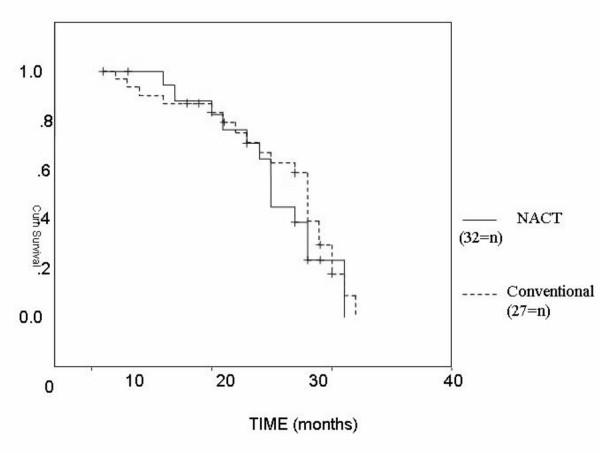
Optimal cytoreduction was higher in the NACT group (72.2%) than the conventional group (62.4%), though not statistically significant (P = 0.5). More important was the finding that parameters of surgical aggressiveness (blood loss rates, ICU stay and total hospital stay) were significantly lower in NACT group than the conventional group. The median overall survival time was 28 months in the conventional group and 25 months in NACT group with a P value of 0.5. The median disease free survival was 19 months in the conventional group and 21 months in NACT group (P = 0.4). In multivariate analysis, the pathologic type and degree of debulking were found to affect the disease free survival significantly. Overall survival was not affected by any of the study parameters.
CONCLUSION
Primary chemotherapy followed by interval debulking surgery in select group of patients doesn't appear to worsen the prognosis, but it permits a less aggressive surgery to be performed.
背景
晚期卵巢癌患者应接受旨在完全切除肿瘤的根治性减瘤手术。不幸的是,约70%的患者就诊时已处于晚期,无法实现最佳减瘤,因此这些患者从手术中获益甚微。新辅助化疗(NACT)已被提议作为此类情况下的一种新型治疗方法。在本研究中,我们报告了在可手术的晚期卵巢癌患者(无减瘤手术医学禁忌证)的特定适应证中,将初次手术或新辅助化疗作为治疗方式的结果。
患者与方法
1998年至2003年间共评估了59例III期或IV期上皮性卵巢癌患者。所有患者均接受手术探查以评估肿瘤的可切除性。在无法实现最佳细胞减灭的情况下给予新辅助化疗(27例患者)。相反,当我们认为通过标准手术可以实现最佳细胞减灭时,则进行初次减瘤手术(32例患者)。
结果
新辅助化疗组的最佳细胞减灭率(72.2%)高于传统组(62.4%),尽管无统计学意义(P = 0.5)。更重要的发现是,新辅助化疗组的手术侵袭性参数(失血量、重症监护病房停留时间和总住院时间)明显低于传统组。传统组的中位总生存时间为28个月,新辅助化疗组为25个月,P值为0.5。传统组的中位无病生存时间为19个月,新辅助化疗组为21个月(P = 0.4)。在多变量分析中,发现病理类型和减瘤程度对无病生存有显著影响。总生存不受任何研究参数的影响。
结论
在部分患者中先进行初次化疗然后进行间隔减瘤手术似乎不会使预后恶化,但可以进行侵袭性较小的手术。



 Zotero 插件