Curtain Robert, Sundholm James, Lea Rod, Ovcaric Mick, MacMillan John, Griffiths Lyn
Genomics Research Centre, School of Health Science, Griffith University, Gold Coast, Queensland, Australia.
BMC Med Genet. 2005 Sep 14;6:32. doi: 10.1186/1471-2350-6-32.
Migraine is a polygenic multifactorial disease, possessing environmental and genetic causative factors with multiple involved genes. Mutations in various ion channel genes are responsible for a number of neurological disorders. KCNN3 is a neuronal small conductance calcium-activated potassium channel gene that contains two polyglutamine tracts, encoded by polymorphic CAG repeats in the gene. This gene plays a critical role in determining the firing pattern of neurons and acts to regulate intracellular calcium channels.
The present association study tested whether length variations in the second (more 3') polymorphic CAG repeat in exon 1 of the KCNN3 gene, are involved in susceptibility to migraine with and without aura (MA and MO). In total 423 DNA samples from unrelated individuals, of which 202 consisted of migraine patients and 221 non-migraine controls, were genotyped and analysed using a fluorescence labelled primer set on an ABI310 Genetic Analyzer. Allele frequencies were calculated from observed genotype counts for the KCNN3 polymorphism. Analysis was performed using standard contingency table analysis, incorporating the chi-squared test of independence and CLUMP analysis.
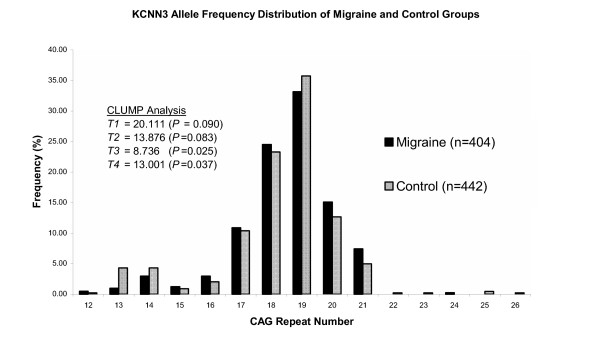
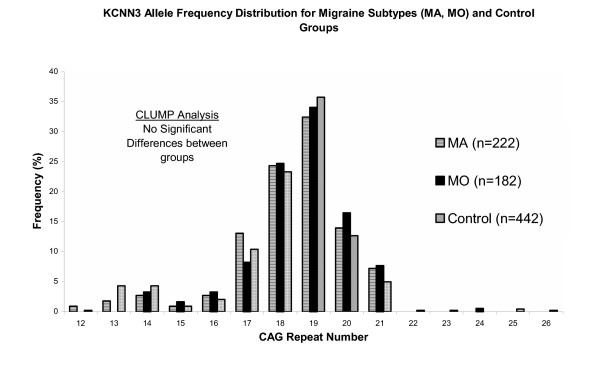
Overall, there was no convincing evidence that KCNN3 CAG lengths differ between Caucasian migraineurs and controls, with no significant difference in the allelic length distribution of CAG repeats between the population groups (P = 0.090). Also the MA and MO subtypes did not differ significantly between control allelic distributions (P > 0.05). The prevalence of the long CAG repeat (>19 repeats) did not reach statistical significance in migraineurs (P = 0.15), nor was there a significant difference between the MA and MO subgroups observed compared to controls (P = 0.46 and P = 0.09, respectively), or between MA vs MO (P = 0.40).
This association study provides no evidence that length variations of the second polyglutamine array in the N-terminus of the KCNN3 channel exert an effect in the pathogenesis of migraine.
偏头痛是一种多基因多因素疾病,具有环境和遗传致病因素,涉及多个基因。各种离子通道基因的突变与多种神经系统疾病有关。KCNN3是一种神经元小电导钙激活钾通道基因,包含两个多聚谷氨酰胺序列,由该基因中多态性的CAG重复序列编码。该基因在决定神经元的放电模式中起关键作用,并作用于调节细胞内钙通道。
本关联研究检测了KCNN3基因外显子1中第二个(更靠近3'端)多态性CAG重复序列的长度变化是否与伴或不伴先兆偏头痛(MA和MO)的易感性有关。总共对423份无关个体的DNA样本进行基因分型并分析,其中202份为偏头痛患者,221份为非偏头痛对照,使用荧光标记引物组在ABI310遗传分析仪上进行检测。根据观察到的KCNN3多态性基因型计数计算等位基因频率。使用标准列联表分析进行分析,包括独立性卡方检验和CLUMP分析。
总体而言,没有令人信服的证据表明白种人偏头痛患者和对照之间KCNN3的CAG长度存在差异,人群组之间CAG重复序列的等位基因长度分布没有显著差异(P = 0.090)。此外,MA和MO亚型在对照等位基因分布之间也没有显著差异(P > 0.05)。长CAG重复序列(>19次重复)在偏头痛患者中的患病率未达到统计学显著性(P = 0.15),与对照相比,MA和MO亚组之间也没有显著差异(分别为P = 0.46和P = 0.09),MA与MO之间也没有显著差异(P = 0.40)。
本关联研究没有提供证据表明KCNN3通道N端第二个多聚谷氨酰胺序列的长度变化在偏头痛发病机制中起作用。