Görtz Birgit, Hayer Silvia, Tuerck Birgit, Zwerina Jochen, Smolen Josef S, Schett Georg
Division of Rheumatology, Department of Internal Medicine III, University of Vienna, Vienna, Austria.
Arthritis Res Ther. 2005;7(5):R1140-7. doi: 10.1186/ar1797. Epub 2005 Jul 28.
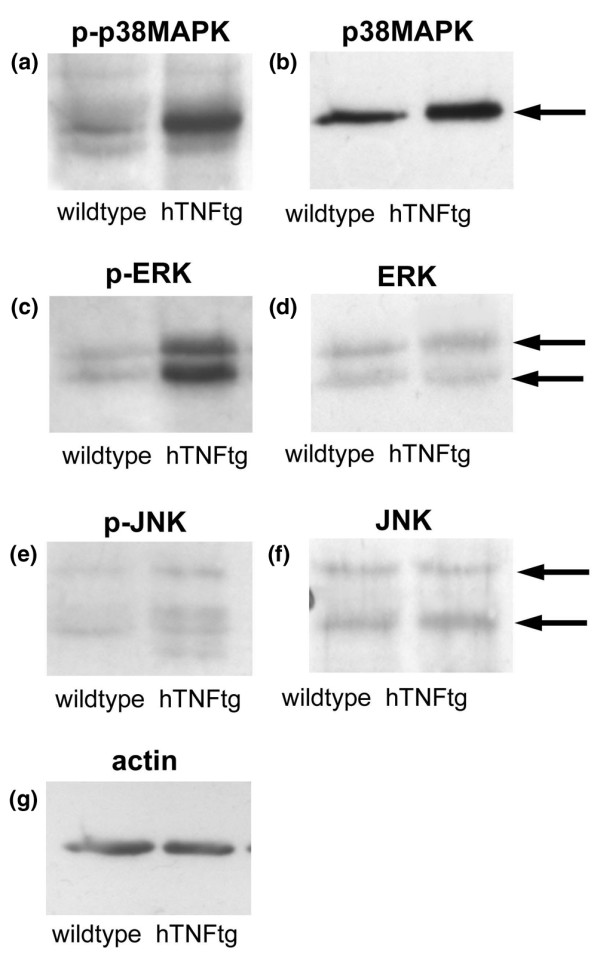
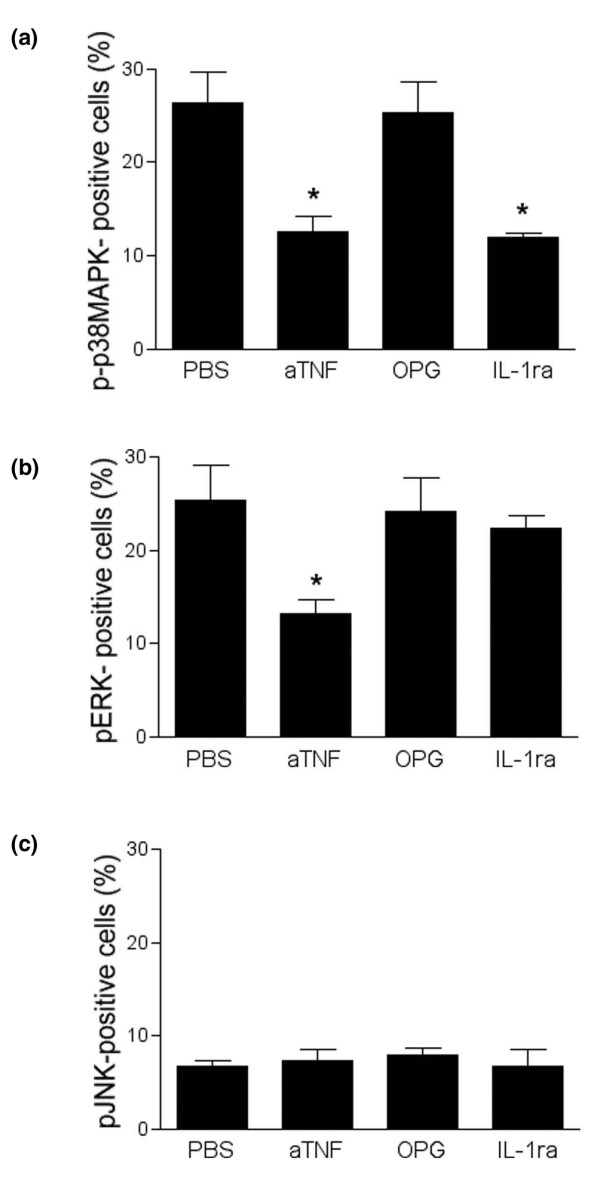
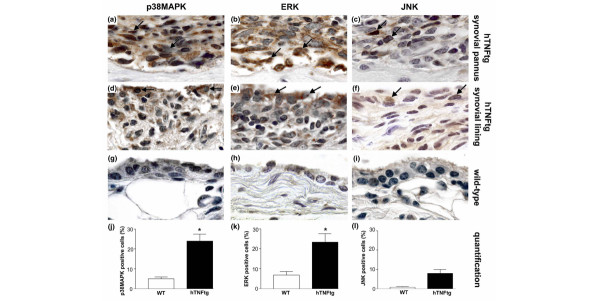
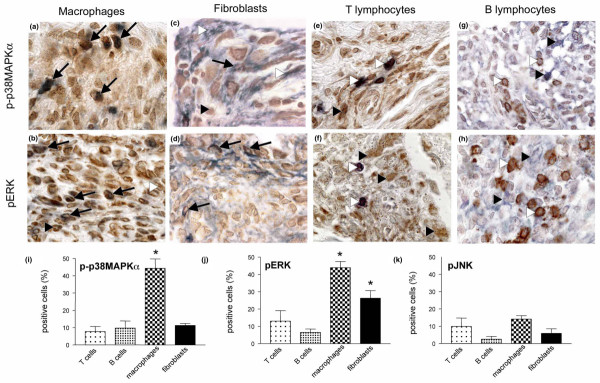
Tumour necrosis factor (TNF) is considered to be a major factor in chronic synovial inflammation and is an inducer of mitogen-activated protein kinase (MAPK) signalling. In the present study we investigated the ability of TNF to activate MAPKs in the synovial membrane in vivo. We studied human TNF transgenic mice--an in vivo model of TNF-induced arthritis--to examine phosphorylation of extracellular signal-regulated kinase (ERK), c-Jun amino terminal kinase (JNK) and p38MAPKalpha in the inflamed joints by means of immunoblot and immunohistochemistry. In addition, the effects of systemic blockade of TNF, IL-1 and receptor activator of nuclear factor-kappaB (RANK) ligand on the activation of MAPKs were assessed. In vivo, overexpression of TNF induced activation of p38MAPKalpha and ERK in the synovial membrane, whereas activation of JNK was less pronounced and rarely observed on immunohistochemical analysis. Activated p38MAPKalpha was predominantly found in synovial macrophages, whereas ERK activation was present in both synovial macrophages and fibroblasts. T and B lymphocytes did not exhibit major activation of any of the three MAPKs. Systemic blockade of TNF reduced activation of p38MAPKalpha and ERK, whereas inhibition of IL-1 only affected p38MAPKalpha and blockade of RANK ligand did not result in any decrease in MAPK activation in the synovial membrane. These data indicate that TNF preferentially activates p38MAPKalpha and ERK in synovial membrane exposed to TNF. This not only suggests that targeted inhibition of p38MAPKalpha and ERK is a feasible strategy for blocking TNF-mediated effects on joints, but it also shows that even currently available methods to block TNF effectively reduce activation of these two MAPKs.
肿瘤坏死因子(TNF)被认为是慢性滑膜炎的主要因素,并且是丝裂原活化蛋白激酶(MAPK)信号传导的诱导剂。在本研究中,我们调查了TNF在体内激活滑膜中MAPK的能力。我们研究了人TNF转基因小鼠——一种TNF诱导性关节炎的体内模型——通过免疫印迹和免疫组织化学方法检测炎性关节中细胞外信号调节激酶(ERK)、c-Jun氨基末端激酶(JNK)和p38MAPKα的磷酸化情况。此外,还评估了全身性阻断TNF、白细胞介素-1(IL-1)和核因子κB受体激活剂(RANK)配体对MAPK激活的影响。在体内,TNF的过表达诱导滑膜中p38MAPKα和ERK的激活,而JNK的激活不太明显,在免疫组织化学分析中很少观察到。活化的p38MAPKα主要存在于滑膜巨噬细胞中,而ERK激活则同时存在于滑膜巨噬细胞和成纤维细胞中。T和B淋巴细胞未表现出这三种MAPK中的任何一种的主要激活。全身性阻断TNF可降低p38MAPKα和ERK的激活,而抑制IL-1仅影响p38MAPKα,阻断RANK配体并未导致滑膜中MAPK激活的任何降低。这些数据表明,TNF优先激活暴露于TNF的滑膜中的p38MAPKα和ERK。这不仅表明靶向抑制p38MAPKα和ERK是阻断TNF对关节介导作用的可行策略,而且还表明即使是目前可用的阻断TNF的方法也能有效降低这两种MAPK的激活。