Lo Hsin-Lung, Nakajima Satoshi, Ma Lisa, Walter Barbara, Yasui Akira, Ethell Douglas W, Owen Laurie B
Division of Biomedical Sciences, University of California Riverside, Riverside, CA 92521, USA.
BMC Cancer. 2005 Oct 19;5:135. doi: 10.1186/1471-2407-5-135.
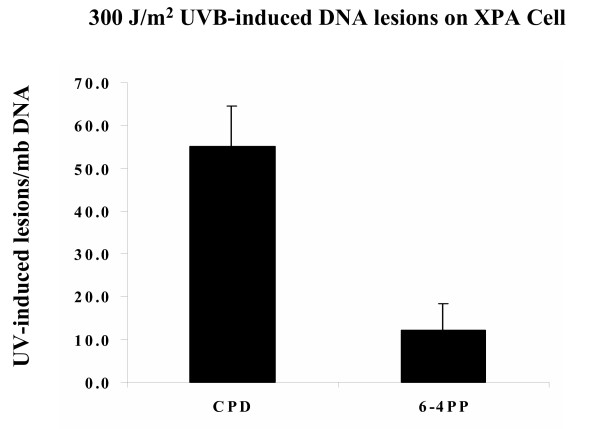
UV-induced damage can induce apoptosis or trigger DNA repair mechanisms. Minor DNA damage is thought to halt the cell cycle to allow effective repair, while more severe damage can induce an apoptotic program. Of the two major types of UV-induced DNA lesions, it has been reported that repair of CPD, but not 6-4PP, abrogates mutation. To address whether the two major forms of UV-induced DNA damage, can induce differential biological effects, NER-deficient cells containing either CPD photolyase or 6-4 PP photolyase were exposed to UV and examined for alterations in cell cycle and apoptosis. In addition, pTpT, a molecular mimic of CPD was tested in vitro and in vivo for the ability to induce cell death and cell cycle alterations.
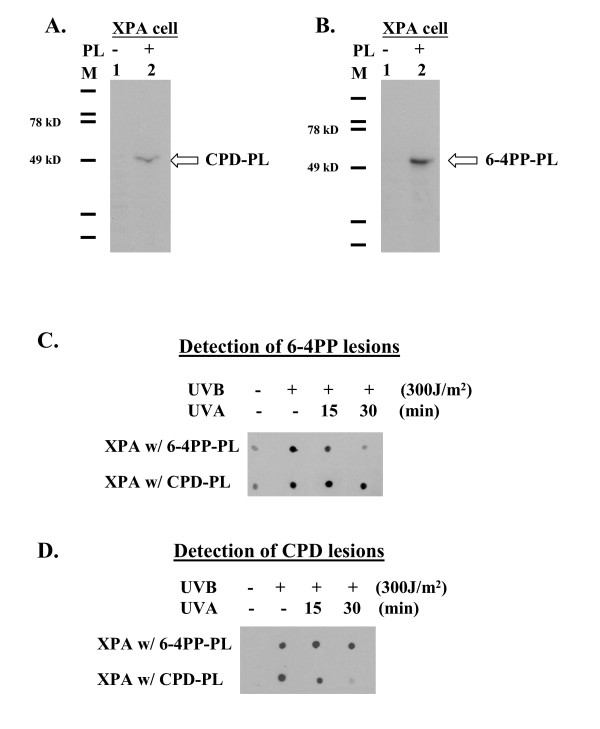
NER-deficient XPA cells were stably transfected with CPD-photolyase or 6-4PP photolyase to specifically repair only CPD or only 6-4PP. After 300 J/m2 UVB exposure photoreactivation light (PR, UVA 60 kJ/m2) was provided for photolyase activation and DNA repair. Apoptosis was monitored 24 hours later by flow cytometric analysis of DNA content, using sub-G1 staining to indicate apoptotic cells. To confirm the effects observed with CPD lesions, the molecular mimic of CPD, pTpT, was also tested in vitro and in vivo for its effect on cell cycle and apoptosis.
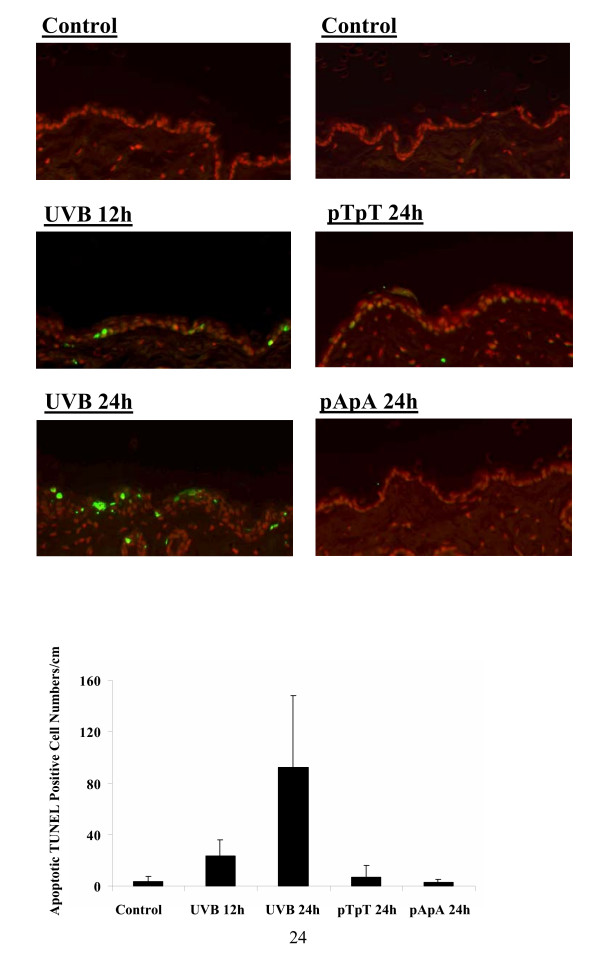
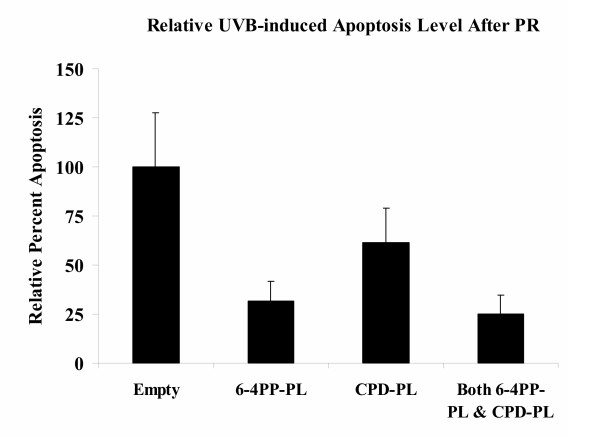
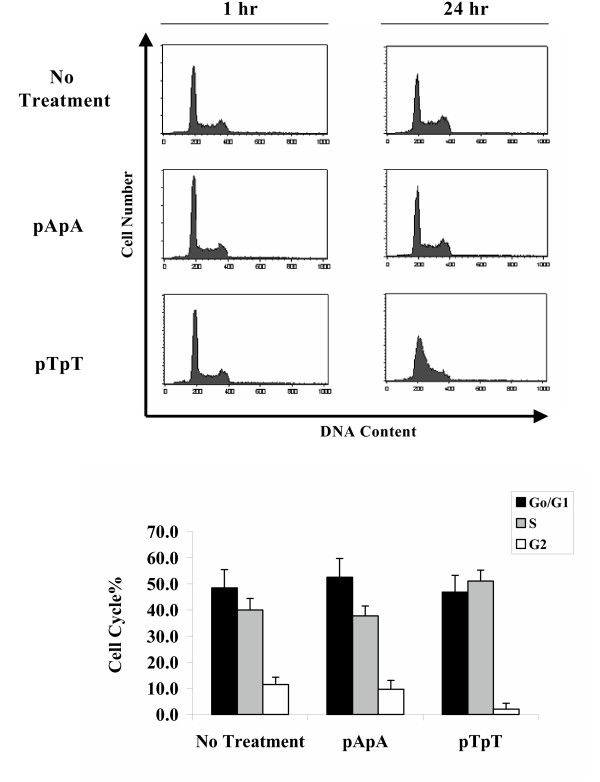
The specific repair of 6-4PP lesions after UVB exposure resulted in a dramatic reduction in apoptosis. These findings suggested that 6-4PP lesions may be the primary inducer of UVB-induced apoptosis. Repair of CPD lesions (despite their relative abundance in the UV-damaged cell) had little effect on the induction of apoptosis. Supporting these findings, the molecular mimic of CPD, (dinucleotide pTpT) could mimic the effects of UVB on cell cycle arrest, but were ineffective to induce apoptosis.
The primary response of the cell to UV-induced 6-4PP lesions is to trigger an apoptotic program whereas the response of the cell to CPD lesions appears to principally involve cell cycle arrest. These findings suggest that CPD and 6-4 PP may induce differential biological effects in the UV-damaged cell.
紫外线诱导的损伤可诱导细胞凋亡或触发DNA修复机制。轻微的DNA损伤被认为会使细胞周期停滞以进行有效的修复,而更严重的损伤则可诱导凋亡程序。在紫外线诱导的两种主要类型的DNA损伤中,据报道,CPD(环丁烷嘧啶二聚体)的修复而非6-4PP(6-4光产物)的修复可消除突变。为了探讨紫外线诱导的两种主要形式的DNA损伤是否能诱导不同的生物学效应,将含有CPD光解酶或6-4PP光解酶的核苷酸切除修复(NER)缺陷细胞暴露于紫外线,并检测细胞周期和细胞凋亡的变化。此外,还在体外和体内测试了CPD的分子模拟物pTpT诱导细胞死亡和细胞周期改变的能力。
将NER缺陷的XPA细胞用CPD光解酶或6-4PP光解酶进行稳定转染,以特异性地仅修复CPD或仅修复6-4PP。在300 J/m² 的UVB照射后,提供光复活光(PR,UVA 60 kJ/m²)以激活光解酶并进行DNA修复。24小时后,通过对DNA含量进行流式细胞术分析监测细胞凋亡,使用亚G1期染色来指示凋亡细胞。为了证实CPD损伤所观察到的效应,还在体外和体内测试了CPD的分子模拟物pTpT对细胞周期和细胞凋亡的影响。
UVB照射后对6-4PP损伤的特异性修复导致细胞凋亡显著减少。这些发现表明,6-4PP损伤可能是UVB诱导细胞凋亡的主要诱导因素。CPD损伤的修复(尽管它们在紫外线损伤的细胞中相对丰富)对细胞凋亡的诱导作用很小。支持这些发现的是,CPD的分子模拟物(二核苷酸pTpT)可以模拟UVB对细胞周期停滞的影响,但不能诱导细胞凋亡。
细胞对紫外线诱导的6-4PP损伤的主要反应是触发凋亡程序,而细胞对CPD损伤的反应似乎主要涉及细胞周期停滞。这些发现表明,CPD和6-4PP可能在紫外线损伤的细胞中诱导不同的生物学效应。