Djouad Farida, Bony Claire, Häupl Thomas, Uzé Gilles, Lahlou Najiba, Louis-Plence Pascale, Apparailly Florence, Canovas François, Rème Thierry, Sany Jacques, Jorgensen Christian, Noël Danièle
INSERM Unit 475, Montpellier, France.
Arthritis Res Ther. 2005;7(6):R1304-15. doi: 10.1186/ar1827. Epub 2005 Sep 20.
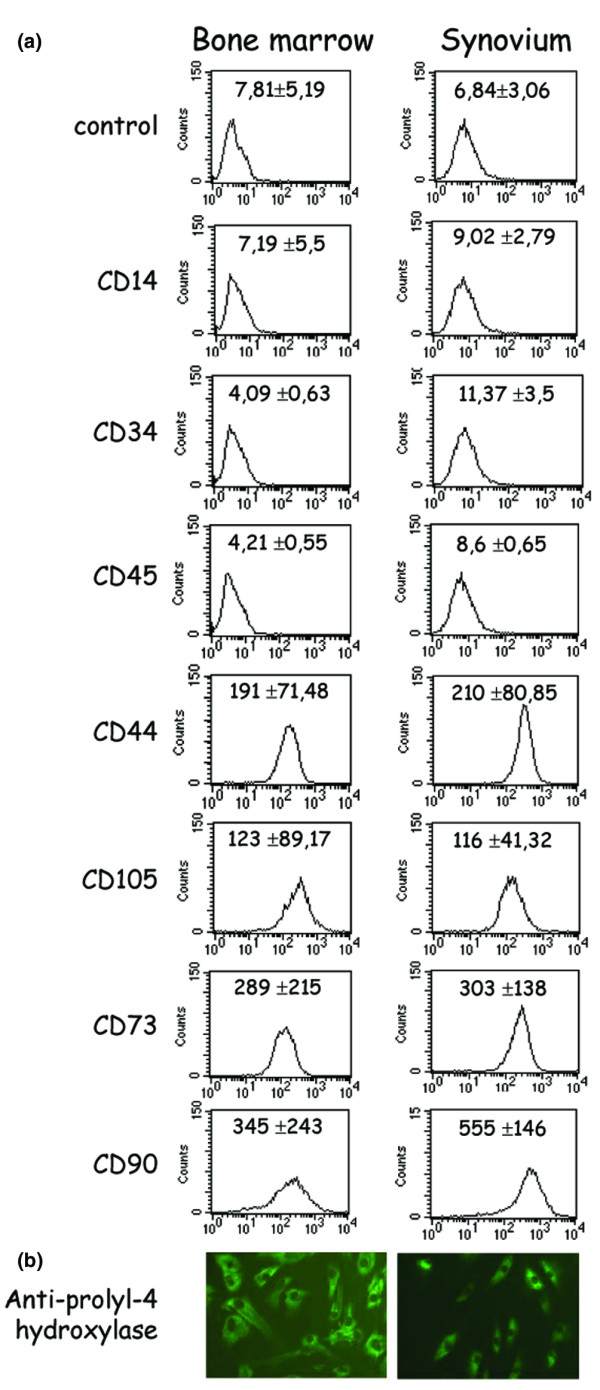
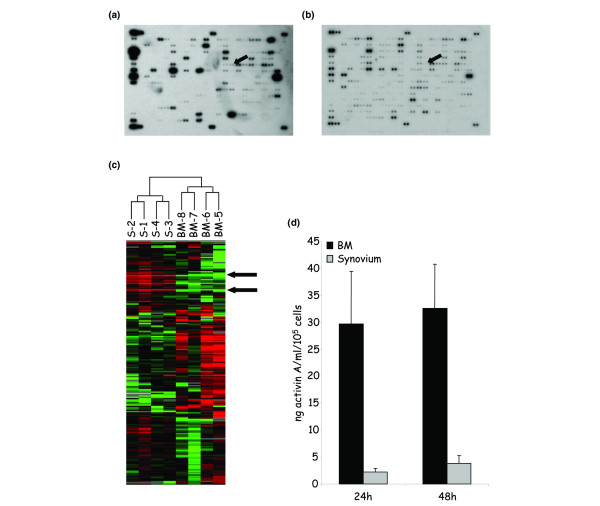
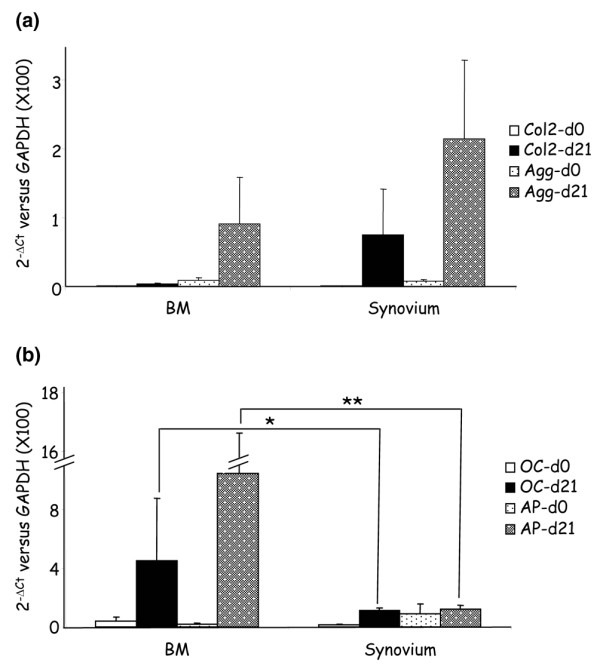
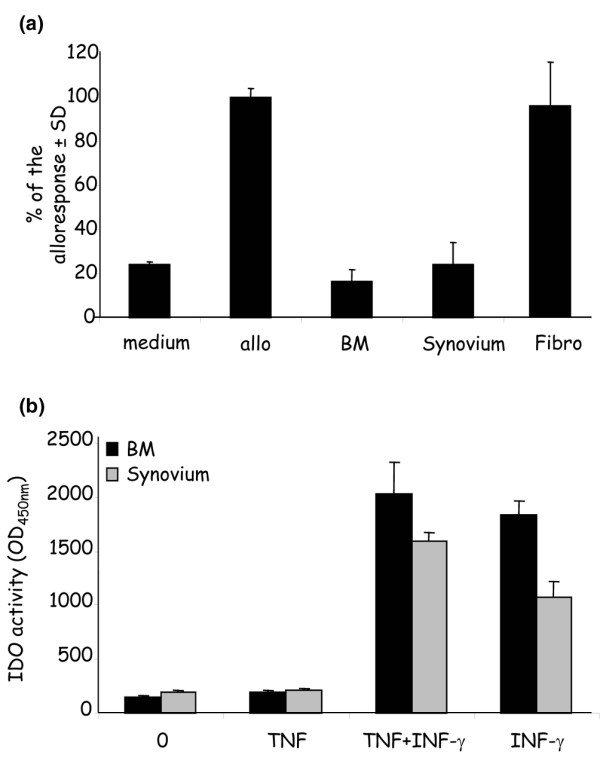
Previous studies have reported that mesenchymal stem cells (MSC) may be isolated from the synovial membrane by the same protocol as that used for synovial fibroblast cultivation, suggesting that MSC correspond to a subset of the adherent cell population, as MSC from the stromal compartment of the bone marrow (BM). The aims of the present study were, first, to better characterize the MSC derived from the synovial membrane and, second, to compare systematically, in parallel, the MSC-containing cell populations isolated from BM and those derived from the synovium, using quantitative assays. Fluorescent-activated cell sorting analysis revealed that both populations were negative for CD14, CD34 and CD45 expression and that both displayed equal levels of CD44, CD73, CD90 and CD105, a phenotype currently known to be characteristic of BM-MSC. Comparable with BM-MSC, such MSC-like cells isolated from the synovial membrane were shown for the first time to suppress the T-cell response in a mixed lymphocyte reaction, and to express the enzyme indoleamine 2,3-dioxygenase activity to the same extent as BM-MSC, which is a possible mediator of this suppressive activity. Using quantitative RT-PCR these data show that MSC-like cells from the synovium and BM may be induced to chondrogenic differentiation and, to a lesser extent, to osteogenic differentiation, but the osteogenic capacities of the synovium-derived MSC were significantly reduced based on the expression of the markers tested (collagen type II and aggrecan or alkaline phosphatase and osteocalcin, respectively). Transcription profiles, determined with the Atlas Human Cytokine/Receptor Array, revealed discrimination between the MSC-like cells from the synovial membrane and the BM-MSC by 46 of 268 genes. In particular, activin A was shown to be one major upregulated factor, highly secreted by BM-MSC. Whether this reflects a different cellular phenotype, a different amount of MSC in the synovium-derived population compared with BM-MSC adherent cell populations or the impact of a different microenvironment remains to be determined. In conclusion, although the BM-derived and synovium-derived MSC shared similar phenotypic and functional properties, both their differentiation capacities and transcriptional profiles permit one to discriminate the cell populations according to their tissue origin.
以往研究报道,间充质干细胞(MSC)可通过与滑膜成纤维细胞培养相同的方法从滑膜中分离得到,这表明MSC相当于贴壁细胞群的一个亚群,如同来自骨髓(BM)基质区室的MSC。本研究的目的,一是更好地表征源自滑膜的MSC,二是使用定量分析方法,系统地、并行地比较从BM分离得到的含MSC细胞群和源自滑膜的细胞群。荧光激活细胞分选分析显示,这两个细胞群的CD14、CD34和CD45表达均为阴性,且两者的CD44、CD73、CD90和CD105水平相同,目前已知该表型是BM-MSC的特征。与BM-MSC类似,首次证明从滑膜分离得到的此类MSC样细胞在混合淋巴细胞反应中可抑制T细胞反应,并与BM-MSC一样表达相同程度的吲哚胺2,3-双加氧酶活性,这是这种抑制活性的一种可能介质。使用定量逆转录聚合酶链反应,这些数据表明,来自滑膜和BM的MSC样细胞可被诱导向软骨分化,在较小程度上也可向成骨分化,但基于所测试标志物(分别为II型胶原蛋白和聚集蛋白聚糖或碱性磷酸酶和骨钙素)的表达,源自滑膜的MSC的成骨能力显著降低。用Atlas Human Cytokine/Receptor Array测定的转录谱显示,268个基因中的46个基因可区分来自滑膜的MSC样细胞和BM-MSC。特别是,激活素A被证明是一个主要上调因子,由BM-MSC大量分泌。这是否反映了不同的细胞表型、与BM-MSC贴壁细胞群相比源自滑膜的群体中MSC数量的差异或不同微环境的影响,仍有待确定。总之,尽管源自BM和滑膜的MSC具有相似的表型和功能特性,但它们的分化能力和转录谱都允许根据组织来源区分细胞群。