Bonaventure J, Lasselin C, Mellier J, Cohen-Solal L, Maroteaux P
CNRS URA 584, Clinique M Lamy, Hôpital des Enfants Malades, Paris, France.
J Med Genet. 1992 Jul;29(7):465-70.
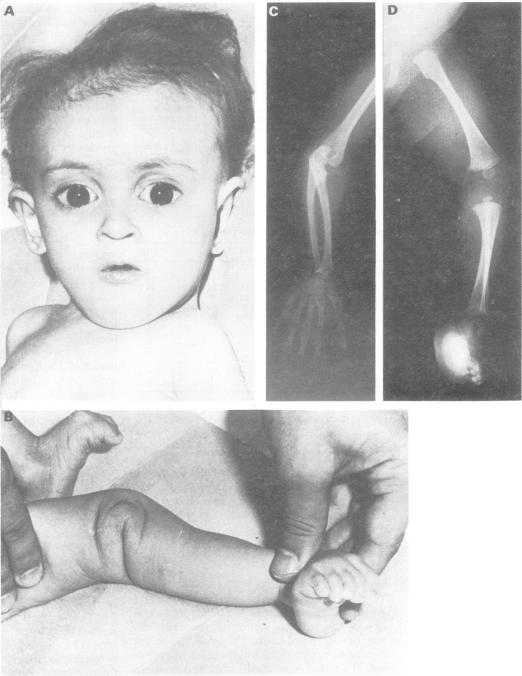
We report seven children from three families who had a set of common clinical features suggestive of Larsen-like syndrome, including unusual facies, bilateral dislocations of the knees and elbows, club foot, and short stature. All of the patients originated from the island of La Réunion in the Indian Ocean. The occurrence of several affected sibs in these families and the large number of consanguineous marriages on this island are consistent with autosomal recessive inheritance of the disease. Based on this hypothesis, the pedigrees were used for linkage analysis in a candidate gene assay. Lod score calculations in a pairwise study with four different fibrillar collagen genes, COL1A1, COL1A2, COL3A1, and COL5A2, allowed us to exclude these genes as the mutant loci. Supporting this, electrophoretic analysis of collagens derived from fibroblast cultures failed to show defective molecules. We conclude that this syndrome is not a collagen disorder.
我们报告了来自三个家庭的七名儿童,他们具有一系列提示类拉森综合征的共同临床特征,包括特殊面容、双膝和双肘脱位、马蹄内翻足以及身材矮小。所有患者均来自印度洋的留尼汪岛。这些家庭中有多名患病同胞,且该岛近亲结婚比例高,这与该疾病的常染色体隐性遗传相符。基于这一假设,我们在候选基因检测中利用这些家系进行连锁分析。在与四个不同的纤维状胶原基因COL1A1、COL1A2、COL3A1和COL5A2进行的成对研究中计算连锁值,结果使我们排除了这些基因作为突变位点的可能性。成纤维细胞培养所得胶原蛋白的电泳分析结果也支持这一点,未显示有缺陷分子。我们得出结论,该综合征并非胶原紊乱疾病。