Went P, Vasei M, Bubendorf L, Terracciano L, Tornillo L, Riede U, Kononen J, Simon R, Sauter G, Baeuerle P A
Institute of Pathology, University Hospital Basel, Schönbeinstrasse 40, 4003 Basel, Switzerland.
Br J Cancer. 2006 Jan 16;94(1):128-35. doi: 10.1038/sj.bjc.6602924.
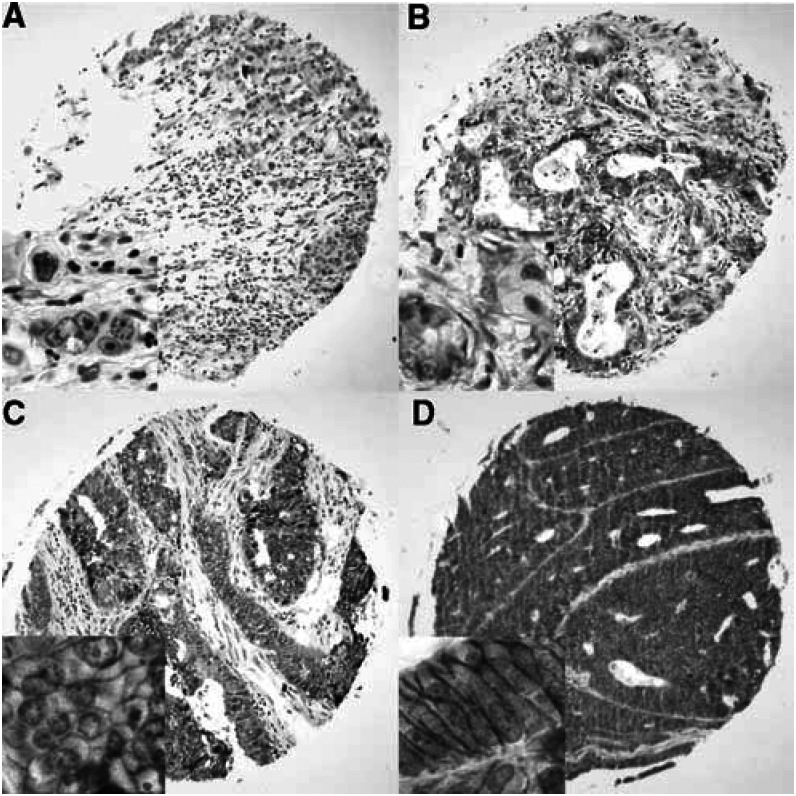
Epithelial cell adhesion molecule (Ep-CAM; CD326) is used as a target by many immunotherapeutic approaches, but little data are available about Ep-CAM expression in major human malignancies with respect to level, frequency, tumour stage, grade, histologic tumour type and impact on survival. We analysed by immunohistochemical staining tissue microarrays with 4046 primary human carcinoma samples from colon, stomach, prostate and lung cancers for both frequency and intensity of Ep-CAM expression under highly standardised conditions. A total of 3360 samples were analysable. High-level Ep-CAM expression was observed in 97.7% (n=1186) of colon, 90.7% of gastric (n=473), and 87.2% of prostate cancers (n=414), and in 63.9% of lung cancers (n=1287). No detectable Ep-CAM staining was found with only 0.4% of colon, 2.5% of gastric, 1.9% of prostate cancers, and 13.5% of lung cancers. The only significant correlation of Ep-CAM expression with tumour grading was observed in colon cancer where high-level Ep-CAM expression on grade 3 tumours was down to 92.1% (P<0.0001). Adenosquamous and squamous carcinomas of the lung had a lower percentage of high-level Ep-CAM expression compared to adenocarcinomas with 35.4 and 53.6%, respectively, and with 45.5 and 17.3% of tumours being Ep-CAM negative. With the exception of moderately differentiated colon carcinoma, where patients not expressing Ep-CAM on their tumours showed an inferior survival (P=0.0014), correlation of Ep-CAM expression with survival did not reach statistical significance for any of the other cancer indications and subgroups. In conclusion, the data strongly support the notion that Ep-CAM is a prime target for immunotherapies in major human malignancies. This is because the most common human cancers show (i) a low frequency of Ep-CAM-negative tumours, (ii) a high frequency of Ep-CAM expression on cells of a given tumour, and (iii) for most cancers, an insignificant influence of tumour staging, grading and histology on Ep-CAM expression.
上皮细胞粘附分子(Ep-CAM;CD326)是多种免疫治疗方法的作用靶点,但关于Ep-CAM在人类主要恶性肿瘤中的表达水平、频率、肿瘤分期、分级、组织学肿瘤类型及对生存的影响,目前可用数据较少。我们在高度标准化条件下,通过免疫组化染色分析了包含4046例来自结肠、胃、前列腺和肺癌的原发性人类癌样本的组织微阵列,以检测Ep-CAM表达的频率和强度。总共3360个样本可进行分析。在97.7%(n = 1186)的结肠癌、90.7%的胃癌(n = 473)和87.2%的前列腺癌(n = 414)中观察到高水平的Ep-CAM表达,在63.9%的肺癌(n = 1287)中观察到高水平表达。仅在0.4%的结肠癌、2.5%的胃癌、1.9%的前列腺癌和13.5%的肺癌中未检测到Ep-CAM染色。仅在结肠癌中观察到Ep-CAM表达与肿瘤分级有显著相关性,其中3级肿瘤的高水平Ep-CAM表达降至92.1%(P < 0.0001)。与腺癌相比,肺腺鳞癌和肺鳞癌中高水平Ep-CAM表达的百分比更低,分别为35.4%和53.6%,且分别有45.5%和17.3%的肿瘤Ep-CAM呈阴性。除了中度分化的结肠癌外,肿瘤不表达Ep-CAM的患者生存较差(P = 0.0014),对于其他任何癌症指征和亚组,Ep-CAM表达与生存的相关性均未达到统计学显著性。总之,这些数据有力地支持了Ep-CAM是人类主要恶性肿瘤免疫治疗主要靶点的观点。这是因为最常见的人类癌症显示:(i)Ep-CAM阴性肿瘤的频率较低;(ii)给定肿瘤细胞上Ep-CAM表达的频率较高;(iii)对于大多数癌症,肿瘤分期、分级和组织学对Ep-CAM表达的影响不显著。