Comer Sandra D, Sullivan Maria A, Yu Elmer, Rothenberg Jami L, Kleber Herbert D, Kampman Kyle, Dackis Charles, O'Brien Charles P
Division on Substance Abuse, New York State Psychiatric Institute, and Department of Psychiatry, College of Physicians and Surgeons of Columbia University, New York 10032, USA.
Arch Gen Psychiatry. 2006 Feb;63(2):210-8. doi: 10.1001/archpsyc.63.2.210.
Oral naltrexone can completely antagonize the effects produced by opioid agonists. However, poor compliance with naltrexone has been a major obstacle to the effective treatment of opioid dependence.
To evaluate the safety and efficacy of a sustained-release depot formulation of naltrexone in treating opioid dependence.
Randomized, double-blind, placebo-controlled, 8-week trial conducted at 2 medical centers.
Sixty heroin-dependent adults.
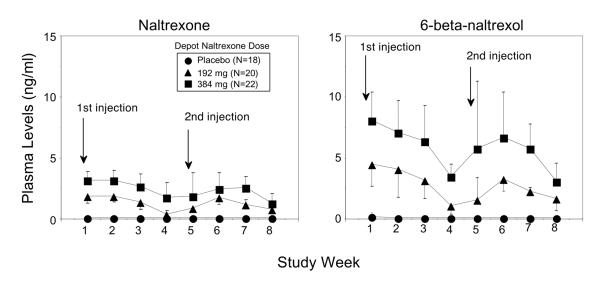
Participants were stratified by sex and years of heroin use (> or = 5 vs < 5) and then were randomized to receive placebo or 192 or 384 mg of depot naltrexone. Doses were administered at the beginning of weeks 1 and 5. All participants received twice-weekly relapse prevention therapy, provided observed urine samples, and completed other assessments at each visit.
Retention in treatment and percentage of opioid-negative urine samples.
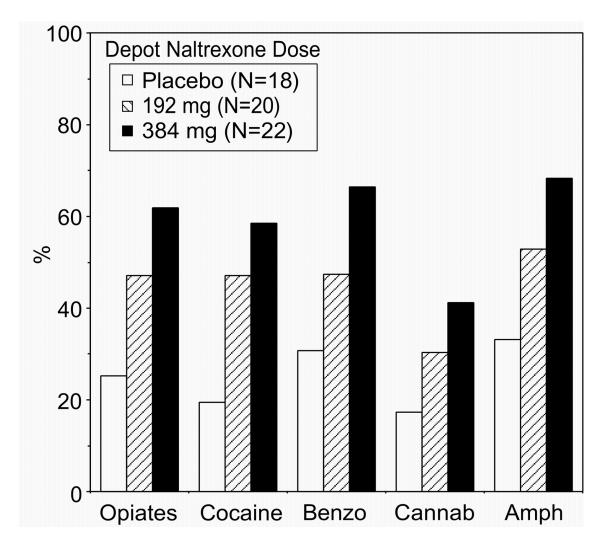
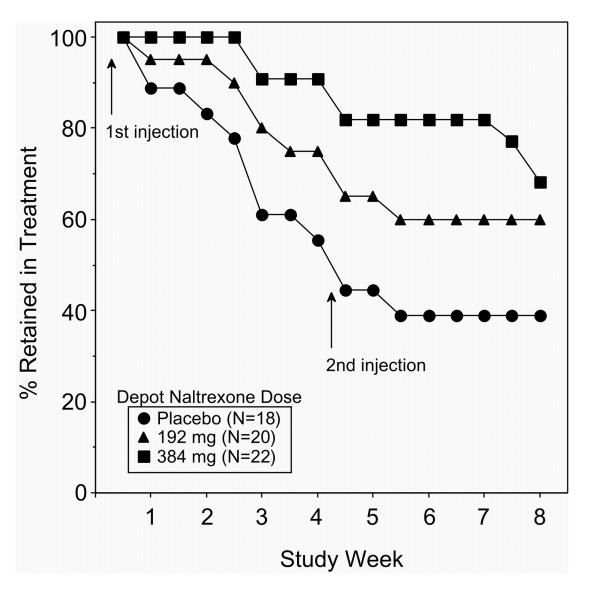
Retention in treatment was dose related, with 39%, 60%, and 68% of patients in the placebo, 192 mg of naltrexone, and 384 mg of naltrexone groups, respectively, remaining in treatment at the end of 2 months. Time to dropout had a significant main effect of dose, with mean time to dropout of 27, 36, and 48 days for the placebo, 192 mg of naltrexone, and 384 mg of naltrexone groups, respectively. The percentage of urine samples negative for opioids, methadone, cocaine, benzodiazepines, and amphetamine varied significantly as a function of dose. When the data were recalculated without the assumption that missing urine samples were positive, a main effect of group was not found for any drugs tested except cocaine, where the percentage of cocaine-negative urine samples was lower in the placebo group. Adverse events were minimal and generally mild. This formulation of naltrexone was well tolerated and produced a robust, dose-related increase in treatment retention.
These data provide new evidence of the feasibility, efficacy, and tolerability of long-lasting antagonist treatments for opioid dependence.
口服纳曲酮可完全拮抗阿片类激动剂产生的效应。然而,纳曲酮依从性差一直是有效治疗阿片类药物依赖的主要障碍。
评估纳曲酮缓释长效注射剂治疗阿片类药物依赖的安全性和有效性。
在2个医疗中心进行的随机、双盲、安慰剂对照、为期8周的试验。
60名海洛因依赖成年人。
参与者按性别和海洛因使用年限(≥5年与<5年)分层,然后随机接受安慰剂或192或384mg长效注射用纳曲酮。剂量在第1周和第5周开始时给予。所有参与者接受每周两次的预防复发治疗,提供观察尿样,并在每次就诊时完成其他评估。
治疗保留率和阿片类药物阴性尿样百分比。
治疗保留率与剂量相关,安慰剂组、192mg纳曲酮组和384mg纳曲酮组在2个月末仍留在治疗中的患者分别为39%、60%和68%。停药时间有显著的剂量主效应,安慰剂组、192mg纳曲酮组和384mg纳曲酮组的平均停药时间分别为27天、36天和48天。阿片类药物、美沙酮、可卡因、苯二氮卓类和苯丙胺类阴性尿样的百分比随剂量有显著变化。在不假设缺失尿样为阳性的情况下重新计算数据时,除可卡因外,所检测的任何药物均未发现组间主效应,安慰剂组可卡因阴性尿样百分比较低。不良事件极少且一般较轻。这种纳曲酮制剂耐受性良好,并使治疗保留率显著且与剂量相关地增加。
这些数据为长效拮抗剂治疗阿片类药物依赖的可行性、有效性和耐受性提供了新证据。