Łegiewicz Michał, Wichłacz Agnieszka, Brzezicha Bartosz, Ciesiołka Jerzy
Institute of Bioorganic Chemistry, Polish Academy of Sciences, Noskowskiego 12/14, 61-704, Poznan, Poland.
Nucleic Acids Res. 2006 Mar 2;34(4):1270-80. doi: 10.1093/nar/gkl018. Print 2006.
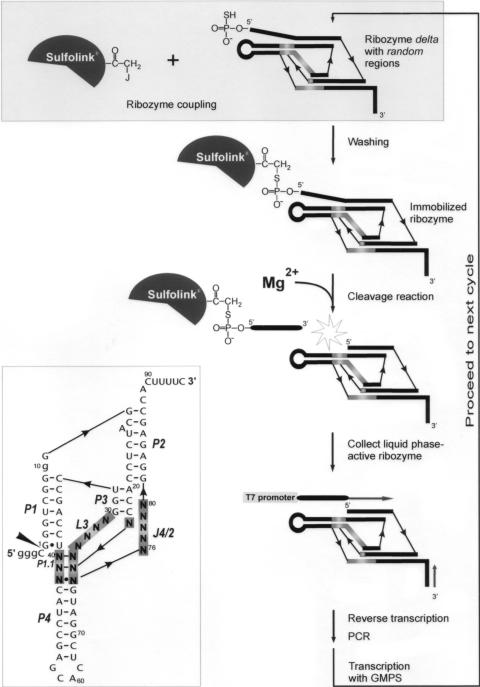
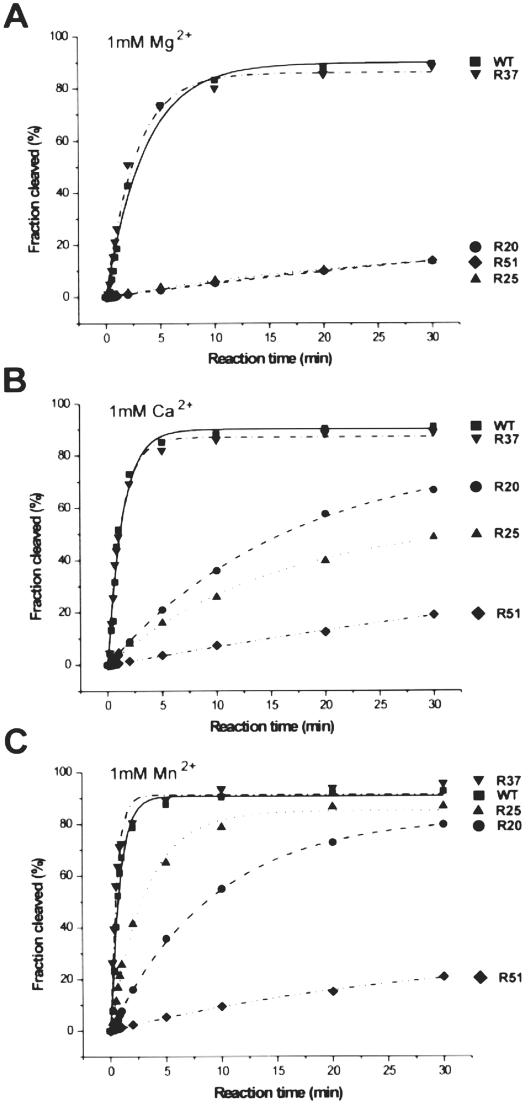
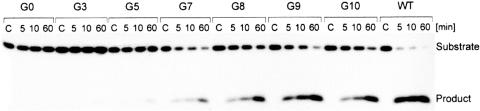
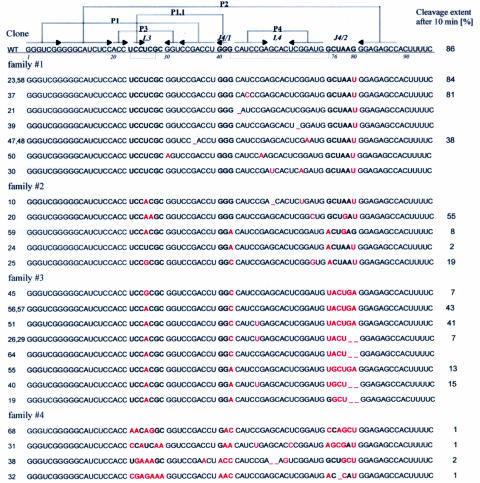
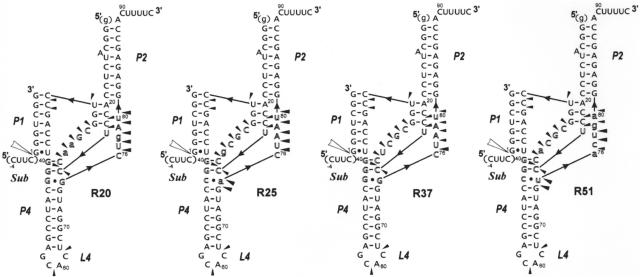
We have used the in vitro selection method to search for catalytically active variants of the antigenomic delta ribozyme with mutations in the regions that constitute the ribozyme active site: L3, J1/4 and J4/2. In the initial combinatorial library 16 nt positions were randomized and the library contained a full representation of all possible sequences. Following ten cycles of selection-amplification several catalytically active ribozyme variants were identified. It turned out that one-third of the variants contained only single mutation G80U and their activity was similar to that of the wild-type ribozyme. Unexpectedly, in the next one-third of the variants the C76 residue, which was proposed to play a crucial role in the ribozyme cleavage mechanism, was mutated. In these variants, however, a cytosine residue was present in a neighboring position to the polynucleotide chain. It shows that the ribozyme catalytic core possesses substantial 'structural plasticity' and the capacity of functional adaptation. Four selected ribozyme variants were subjected to more detailed analysis. It turned out that the variants differed in their relative preferences towards Mg2+, Ca2+ and Mn2+ ions. Thus, the functional properties of the variants were dependent on both the structure of their catalytic sites and divalent metal ions performing catalysis.
我们使用体外筛选方法,在构成核酶活性位点的区域(L3、J1/4和J4/2)发生突变的情况下,寻找反基因组δ核酶的催化活性变体。在初始组合文库中,16个核苷酸位置是随机的,该文库包含了所有可能序列的完整表示。经过十轮筛选-扩增,鉴定出了几种具有催化活性的核酶变体。结果发现,三分之一的变体仅含有单个突变G80U,其活性与野生型核酶相似。出乎意料的是,在接下来三分之一的变体中,在核酶切割机制中被认为起关键作用的C76残基发生了突变。然而,在这些变体中,多核苷酸链的相邻位置存在一个胞嘧啶残基。这表明核酶催化核心具有显著的“结构可塑性”和功能适应能力。对四个选定的核酶变体进行了更详细的分析。结果发现,这些变体对Mg2+、Ca2+和Mn2+离子的相对偏好不同。因此,变体的功能特性既取决于其催化位点的结构,也取决于进行催化的二价金属离子。