Dear J W, Yasuda H, Hu X, Hieny S, Yuen P S T, Hewitt S M, Sher A, Star R A
Renal Diagnostics and Therapeutics Unit, National Institute of Diabetes and Digestive and Kidney Diseases/NIH, 10 Center Drive, Bldg. 10, Bethesda, MD, USA.
Kidney Int. 2006 Mar;69(5):832-6. doi: 10.1038/sj.ki.5000165.
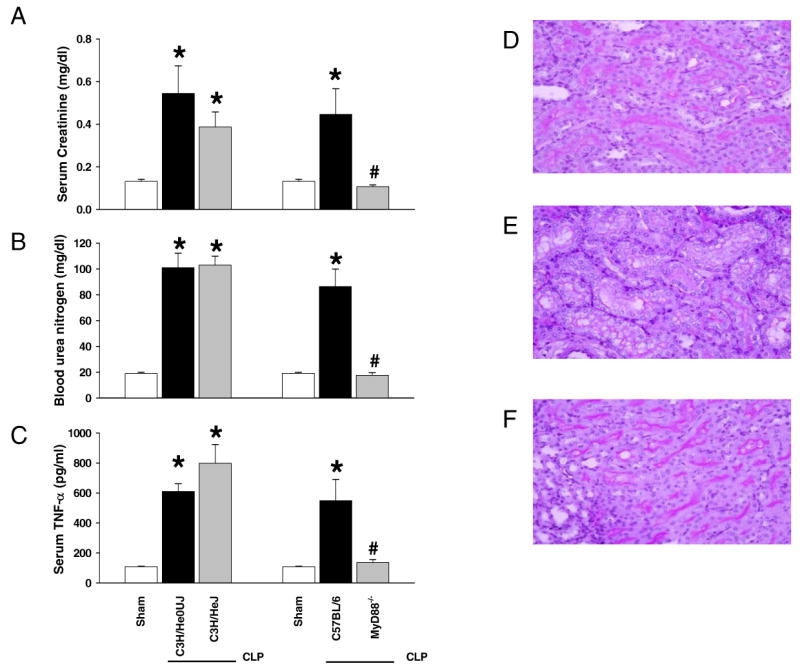
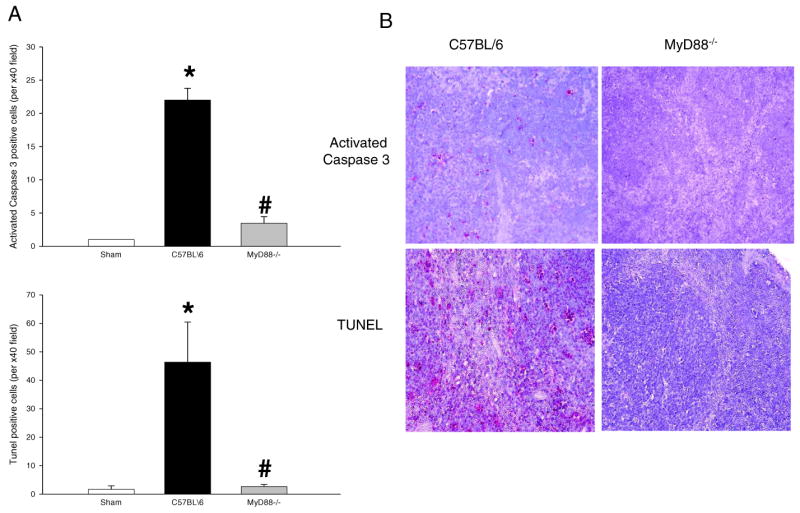
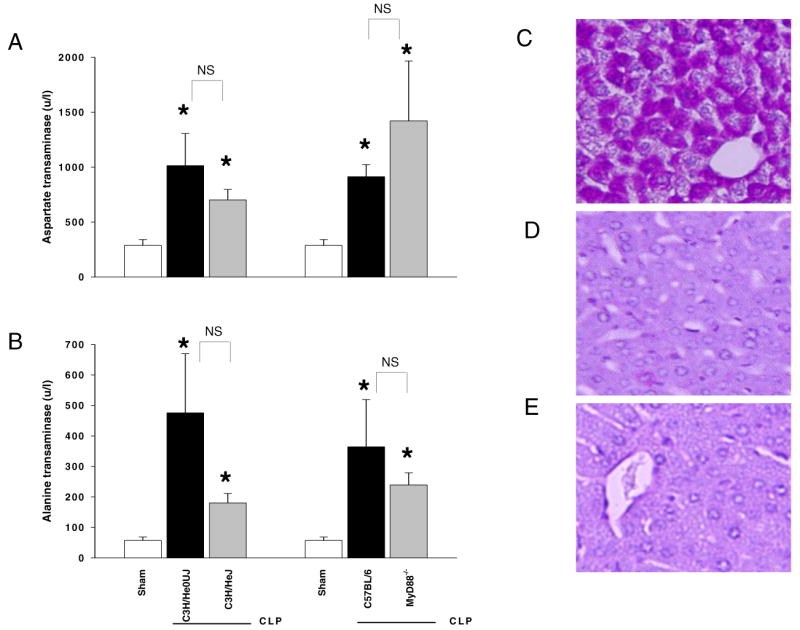
Toll-like receptors (TLRs) are important in sepsis. Myeloid differentiation factor 88 (MyD88) is a key molecule involved in signal transduction by multiple TLRs. The objective of this study was to investigate the contribution of TLR4 and MyD88 to acute renal failure (ARF) induced by polymicrobial sepsis. Liver dysfunction and apoptosis in the spleen contribute to sepsis severity after cecal ligation and puncture (CLP). Therefore, we also investigated liver injury and splenic apoptosis. We used a mouse model of sepsis-induced ARF using CLP to generate polymicrobial sepsis. Despite fluid and antibiotic resuscitation the mice developed multi-organ failure, including ARF, which resembles human sepsis. We investigated the role of the TLR4 receptor by comparing C3H/HeJ mice (which lack TLR4) with C3H/He0UJ normal controls. The role of MyD88 was investigated by comparing MyD88 knockout mice (MyD88(-/-)) with wild-type controls. Following CLP, mice lacking TLR4 and wild-type mice both developed comparable ARF. However, MyD88(-/-) mice did not develop ARF compared to wild-type controls. In contrast, MyD88(-/-) mice developed liver injury comparable to wild type. After CLP, MyD88(-/-) mice had significantly reduced apoptosis in the spleen compared with wild type. Apoptosis was not detected in the kidney of wild-type or MyD88(-/-) mice after CLP. In summary, ARF induced by polymicrobial sepsis is dependent on MyD88, but not TLR4. The absence of MyD88 dissociates ARF from liver injury; liver injury is MyD88-independent. There was MyD88-dependent apoptosis in the spleen, but no apoptosis in the kidney. MyD88 may be a good drug target for some, but not all, organ dysfunctions following sepsis.
Toll样受体(TLRs)在脓毒症中起重要作用。髓样分化因子88(MyD88)是多个TLRs信号转导所涉及的关键分子。本研究的目的是探讨TLR4和MyD88在多微生物脓毒症诱导的急性肾衰竭(ARF)中的作用。肝损伤和脾脏凋亡会加重盲肠结扎和穿刺(CLP)后脓毒症的严重程度。因此,我们还研究了肝损伤和脾脏凋亡情况。我们使用CLP诱导的脓毒症小鼠模型来引发多微生物脓毒症,从而建立脓毒症诱导的ARF小鼠模型。尽管进行了液体复苏和抗生素治疗,这些小鼠仍发生了多器官功能衰竭,包括ARF,这与人类脓毒症相似。我们通过将C3H/HeJ小鼠(缺乏TLR4)与C3H/He0UJ正常对照进行比较,研究了TLR4受体的作用。通过将MyD88基因敲除小鼠(MyD88(-/-))与野生型对照进行比较,研究了MyD88的作用。CLP后,缺乏TLR4的小鼠和野生型小鼠均发生了程度相当的ARF。然而,与野生型对照相比,MyD88(-/-)小鼠未发生ARF。相反,MyD88(-/-)小鼠发生的肝损伤与野生型相当。CLP后,与野生型相比,MyD88(-/-)小鼠脾脏中的凋亡明显减少。CLP后,野生型或MyD88(-/-)小鼠的肾脏中均未检测到凋亡。总之,多微生物脓毒症诱导的ARF依赖于MyD88,而非TLR4。MyD88的缺失使ARF与肝损伤分离;肝损伤不依赖于MyD88。脾脏中存在MyD88依赖性凋亡,但肾脏中无凋亡。MyD88可能是脓毒症后部分而非全部器官功能障碍的良好药物靶点。