Hinz John M, Tebbs Robert S, Wilson Paul F, Nham Peter B, Salazar Edmund P, Nagasawa Hatsumi, Urbin Salustra S, Bedford Joel S, Thompson Larry H
Biosciences Directorate, Lawrence Livermore National Laboratory, Livermore, CA 94551, USA.
Nucleic Acids Res. 2006 Mar 6;34(5):1358-68. doi: 10.1093/nar/gkl020. Print 2006.
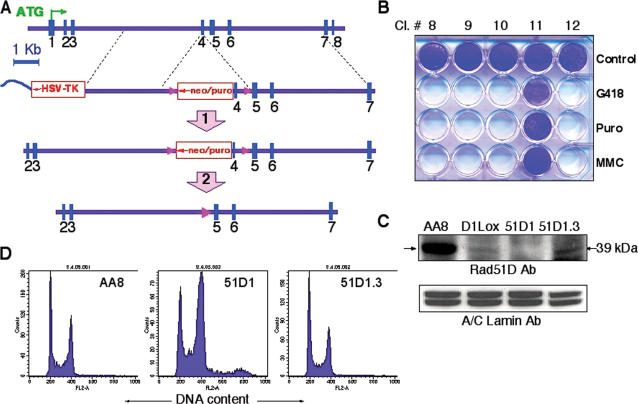
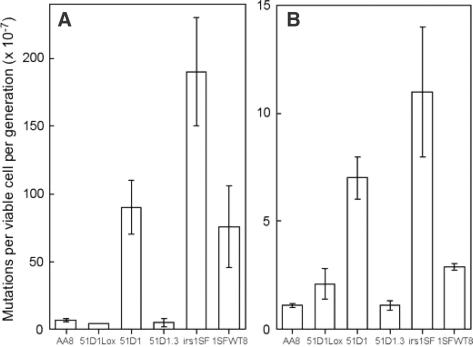
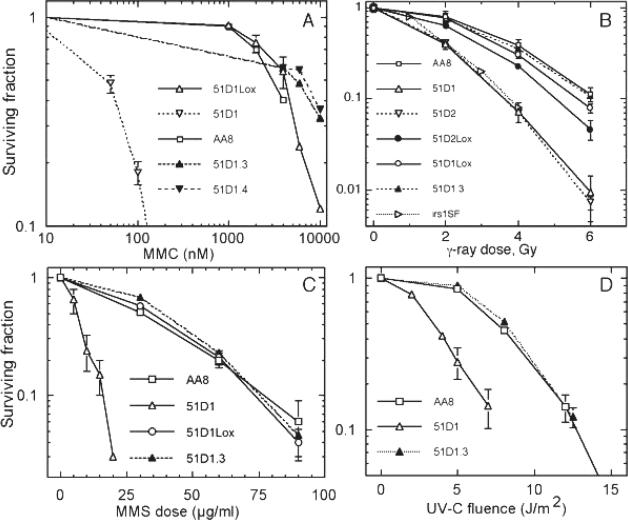
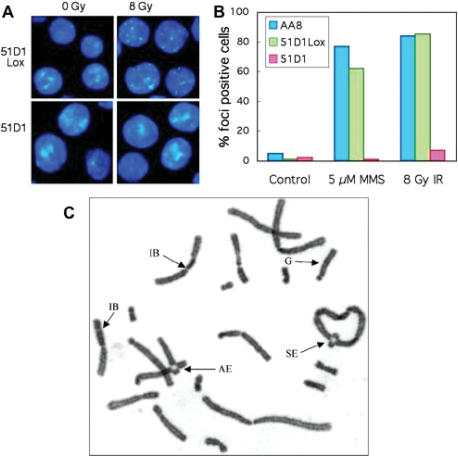
Homologous recombinational repair (HRR) restores chromatid breaks arising during DNA replication and prevents chromosomal rearrangements that can occur from the misrepair of such breaks. In vertebrates, five Rad51 paralogs are identified that contribute in a nonessential but critical manner to HRR proficiency. We constructed and characterized a knockout of the paralog Rad51D in widely studied CHO cells. The rad51d mutant (clone 51D1) displays sensitivity to a diverse spectrum of induced DNA damage including gamma-rays, ultraviolet (UV)-C radiation, and methyl methanesulfonate (MMS), indicating the broad relevance of HRR to genotoxicity. Spontaneous chromatid breaks/gaps and isochromatid breaks are elevated 3- to 12-fold, but the chromosome number distribution remains unchanged. Most importantly, 51D1 cells exhibit a 12-fold-increased rate of hprt mutation, as well as 4- to 10-fold increased rates of gene amplification at the dhfr and CAD loci, respectively. Xrcc3 irs1SF cells from the same parental CHO line show similarly elevated mutagenesis at these three loci. Collectively, these results confirm the a priori expectation that HRR acts in an error-free manner to repress three classes of genetic alterations (chromosomal aberrations, loss of gene function and increased gene expression), all of which are associated with carcinogenesis.
同源重组修复(HRR)可修复DNA复制过程中出现的染色单体断裂,并防止因此类断裂修复错误而可能发生的染色体重排。在脊椎动物中,已鉴定出五个Rad51旁系同源物,它们以非必需但关键的方式对HRR的效率起作用。我们构建并鉴定了广泛研究的CHO细胞中旁系同源物Rad51D的基因敲除。rad51d突变体(克隆51D1)对多种诱导性DNA损伤敏感,包括γ射线、紫外线(UV)-C辐射和甲基磺酸甲酯(MMS),这表明HRR与遗传毒性广泛相关。自发染色单体断裂/间隙和等染色单体断裂增加了3至12倍,但染色体数分布保持不变。最重要的是,51D1细胞的hprt突变率增加了12倍,在dhfr和CAD位点的基因扩增率分别增加了4至10倍。来自同一亲本CHO系的Xrcc3 irs1SF细胞在这三个位点也表现出类似的诱变率升高。总体而言,这些结果证实了先验预期,即HRR以无差错的方式发挥作用,以抑制三类遗传改变(染色体畸变、基因功能丧失和基因表达增加),所有这些都与致癌作用相关。