Mignini Luciano E, Khan Khalid S
Centro Rosarino de Estudios Perinatales, Rosario, Argentina.
BMC Med Res Methodol. 2006 Mar 13;6:10. doi: 10.1186/1471-2288-6-10.
Systematic reviews can serve as a tool in translation of basic life sciences research from laboratory to human research and healthcare. The extent to which reviews of animal research are systematic and unbiased is not known.
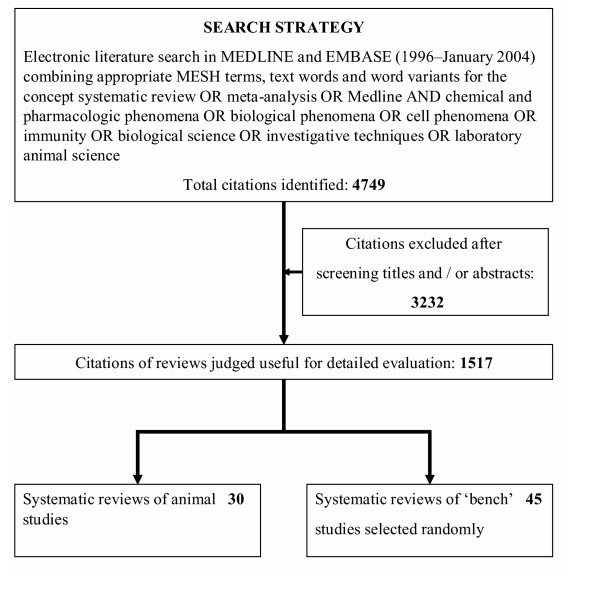
We searched, without language restrictions, Medline, Embase, bibliographies of known reviews (1996-2004) and contacted experts to identify citations of reviews of basic science literature which, as a minimum, performed search of a publicly available resource. From these we identified reviews of animal studies where laboratory variables were measured or where treatments were administered to live animals to examine their effects, and compared them with reviews of bench studies in which human or animal tissues, cell systems or organ preparations were examined in laboratories to better understand mechanisms of diseases.
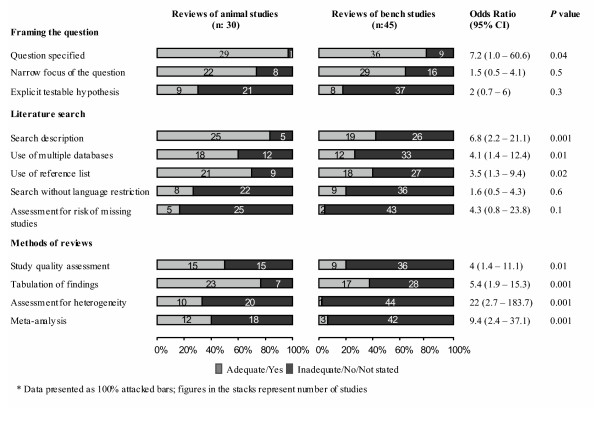
Systematic reviews of animal studies often lacked methodological features such as specification of a testable hypothesis (9/30, 30%); literature search without language restriction (8/30, 26.6%); assessment of publication bias (5/30, 16.6%), study validity (15/30, 50%) and heterogeneity (10/30, 33.3%); and meta-analysis for quantitative synthesis (12/30, 40%). Compared to reviews of bench studies, they were less prone to bias as they specified the question (96.6% vs. 80%, p = 0.04), searched multiple databases (60% vs. 26.6%, p = 0.01), assessed study quality (50% vs. 20%, p = 0.01), and explored heterogeneity (33.3% vs. 2.2%, p = 0.001) more often.
There seems to be a gradient of frequency of methodological weaknesses among reviews: Attempted systematic reviews of whole animal research tend to be better than those of bench studies, though compared to systematic reviews of human clinical trials they are apparently poorer. There is a need for rigour when reviewing animal research.
系统评价可作为将基础生命科学研究从实验室转化为人体研究及医疗保健的一种工具。动物研究评价的系统程度及无偏性尚不清楚。
我们在无语言限制的情况下检索了Medline、Embase、已知评价的参考文献(1996 - 2004年),并联系专家以识别基础科学文献评价的引文,这些评价至少对一个公开可用资源进行了检索。从中我们识别出对动物研究的评价,其中测量了实验室变量或对活体动物进行了处理以检查其效果,并将它们与对基础研究的评价进行比较,基础研究中在实验室检查了人类或动物组织、细胞系统或器官制剂以更好地理解疾病机制。
动物研究的系统评价往往缺乏方法学特征,如可检验假设的明确(9/30,30%);无语言限制的文献检索(8/30,26.6%);发表偏倚评估(5/30,16.6%)、研究有效性评估(15/30,50%)和异质性评估(10/30,33.3%);以及定量合成的荟萃分析(12/30,40%)。与基础研究评价相比,它们在明确问题(96.6%对80%,p = 0.04)、检索多个数据库(60%对26.6%,p = 0.01)、评估研究质量(50%对20%,p = 0.01)和探索异质性(33.3%对2.2%,p = 0.001)方面较少出现偏倚。
评价中方法学弱点的出现频率似乎存在梯度:对全动物研究的尝试性系统评价往往优于对基础研究的评价,不过与人类临床试验的系统评价相比明显较差。在评价动物研究时需要严谨性。