Srinivasan Ramesh, Bibi F Alouani, Nunez Paul L
Department of Cognitive Sciences, University of California, Irvine, 92617, USA.
Brain Topogr. 2006 Spring;18(3):167-87. doi: 10.1007/s10548-006-0267-4. Epub 2006 Mar 1.
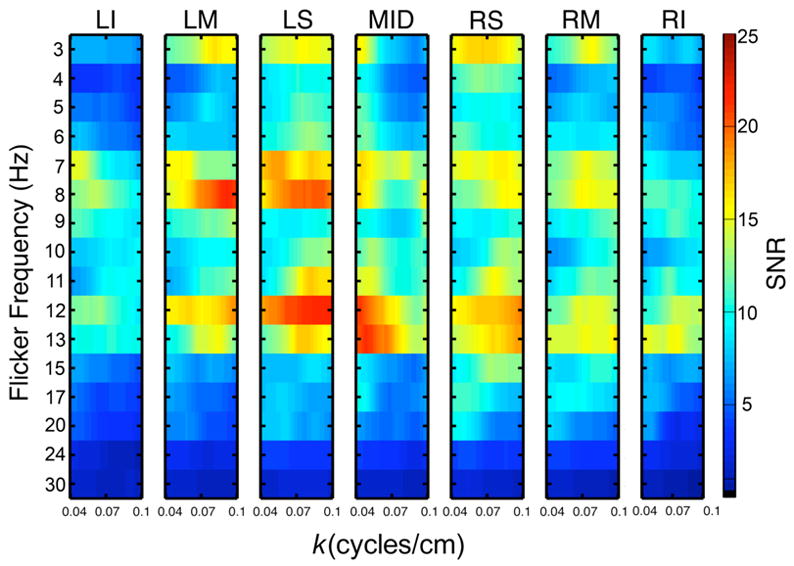
Steady-state visual evoked potentials (SSVEPs) are used in cognitive and clinical studies of brain function because of excellent signal-to-noise ratios and relative immunity to artifacts. SSVEPs also provide a means to characterize preferred frequencies of neocortical dynamic processes. In this study, SSVEPs were recorded with 110 electrodes while subjects viewed random dot patterns flickered between 3 and 30 Hz. Peaks in SSVEP power were observed at delta (3 Hz), lower alpha (7 and 8 Hz), and upper alpha band (12 and 13 Hz) frequencies; the spatial distribution of SSVEP power is also strongly dependent on the input frequency suggesting cortical resonances. We characterized the cortical sources that generate SSVEPs at different input frequencies by applying surface Laplacians and spatial spectral analysis. Laplacian SSVEPs recorded are sensitive to small changes (1-2 Hz) in the input frequency at occipital and parietal electrodes indicating distinct local sources. At 10 Hz, local source activity occurs in multiple cortical regions; Laplacian SSVEPs are also observed in lateral frontal electrodes. Laplacian SSVEPs are negligible at many frontal electrodes that elicit strong potential SSVEPs at delta, lower alpha, and upper alpha bands. One-dimensional (anterior-posterior) spatial spectra indicate that distinct large-scale source distributions contribute SSVEP power in these frequency bands. In the upper alpha band, spatial spectra indicate the presence of long-wavelength (> 15 cm) traveling waves propagating from occipital to prefrontal electrodes. In the delta and lower alpha band, spatial spectra indicate that long-wavelength source distributions over posterior and anterior regions form standing-wave patterns. These results suggest that the SSVEP is generated by both (relatively stationary) localized sources and distributed sources that exhibit characteristics of wave phenomena.
稳态视觉诱发电位(SSVEPs)因其出色的信噪比和相对不受伪迹干扰的特性,被应用于大脑功能的认知和临床研究。SSVEPs还提供了一种表征新皮层动态过程偏好频率的方法。在本研究中,当受试者观看在3至30赫兹之间闪烁的随机点图案时,用110个电极记录SSVEPs。在δ(3赫兹)、低α(7和8赫兹)以及高α频段(12和13赫兹)频率处观察到SSVEP功率峰值;SSVEP功率的空间分布也强烈依赖于输入频率,这表明存在皮层共振。我们通过应用表面拉普拉斯算子和空间频谱分析,对在不同输入频率下产生SSVEPs的皮层源进行了表征。记录的拉普拉斯SSVEPs对枕叶和顶叶电极处输入频率的微小变化(1 - 2赫兹)敏感,表明存在不同的局部源。在10赫兹时,局部源活动出现在多个皮层区域;在外侧额叶电极处也观察到拉普拉斯SSVEPs。在许多额叶电极处,拉普拉斯SSVEPs可忽略不计,而这些电极在δ、低α和高α频段会引发强烈的电位SSVEPs。一维(前后)空间频谱表明,不同的大规模源分布在这些频段中对SSVEP功率有贡献。在高α频段,空间频谱表明存在从枕叶电极向前额叶电极传播的长波长(> 15厘米)行波。在δ和低α频段,空间频谱表明后区和前区的长波长源分布形成驻波模式。这些结果表明,SSVEP是由(相对静止的)局部源和表现出波动现象特征的分布式源共同产生的。