Bryant Helen E, Helleday Thomas
The Institute for Cancer Studies, University of Sheffield, Medical School, Beech Hill Road, Sheffield S10 2RX, UK.
Nucleic Acids Res. 2006 Mar 23;34(6):1685-91. doi: 10.1093/nar/gkl108. Print 2006.
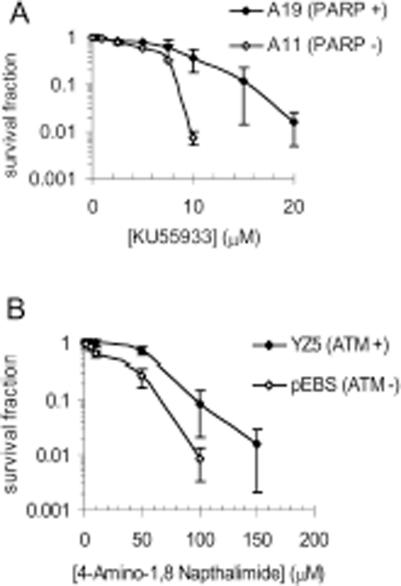
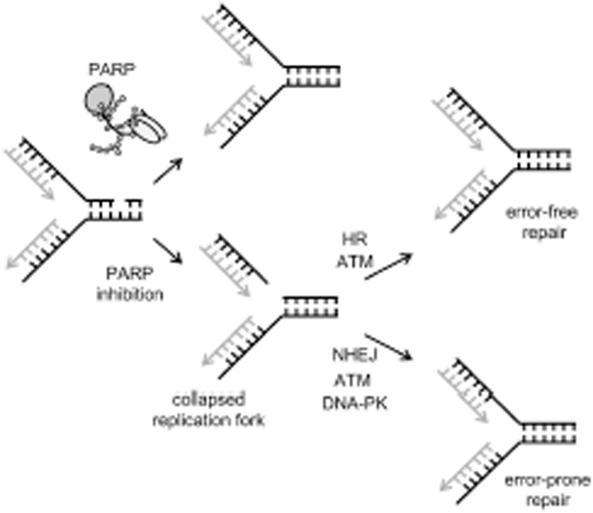
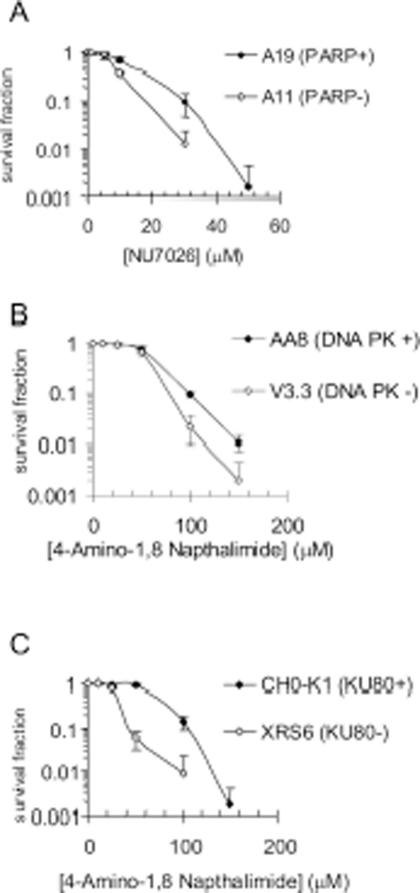
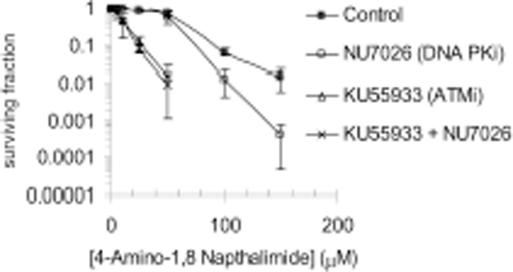
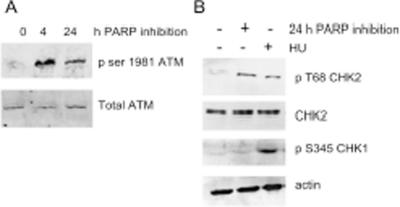
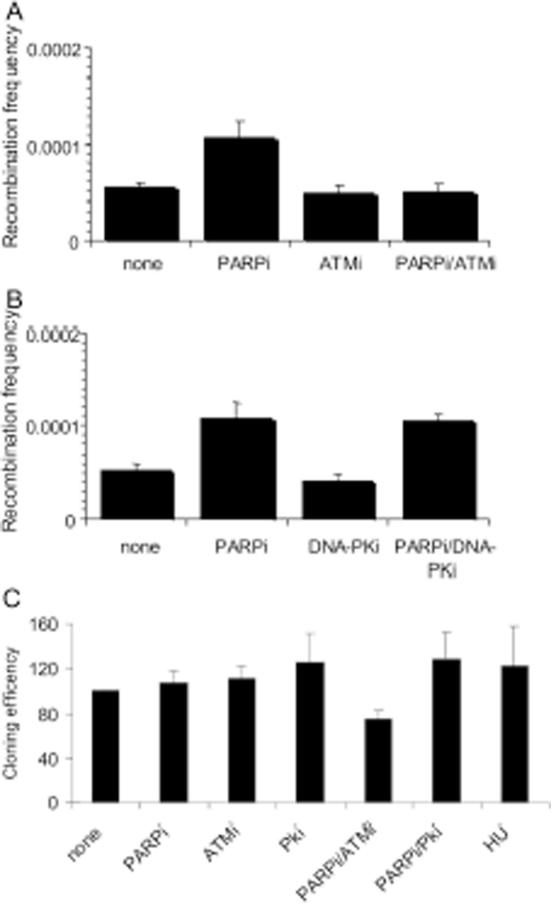
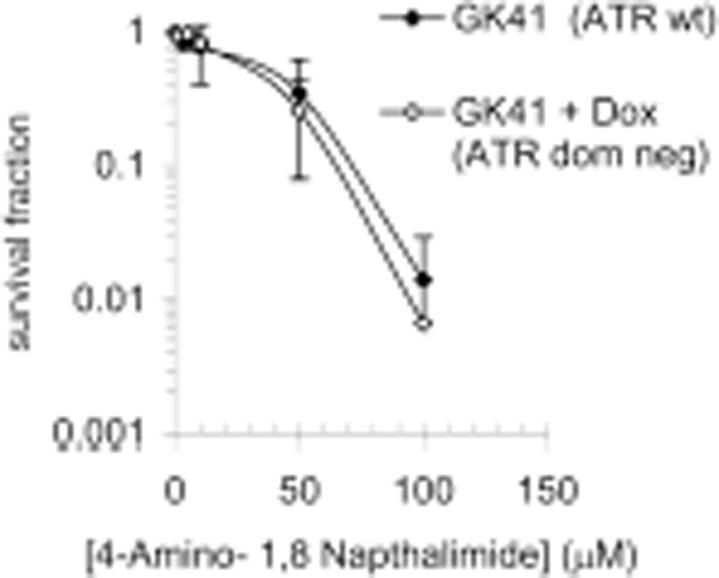
Poly (ADP-ribose) polymerase (PARP-1), ATM and DNA-dependent protein kinase (DNA-PK) are all involved in responding to DNA damage to activate pathways responsible for cellular survival. Here, we demonstrate that PARP-1-/- cells are sensitive to the ATM inhibitor KU55933 and conversely that AT cells are sensitive to the PARP inhibitor 4-amino-1,8-napthalamide. In addition, PARP-1-/- cells are shown to be sensitive to the DNA-PK inhibitor NU7026 and DNA-PKcs or Ku80 defective cells shown to be sensitive to PARP inhibitors. We believe PARP inhibition results in an increase in unresolved spontaneous DNA single-strand breaks (SSBs), which collapse replication forks and trigger homologous recombination repair (HRR). We show that ATM is activated following inhibition of PARP. Furthermore, PARP inhibitor-induced HRR is abolished in ATM, but not DNA-PK, inhibited cells. ATM and DNA-PK inhibition together give the same sensitivity to PARP inhibitors as ATM alone, indicating that ATM functions in the same pathways as DNA-PK for survival at collapsed forks, likely in non-homologous end joining (NHEJ). Altogether, we suggest that ATM is activated by PARP inhibitor-induced collapsed replication forks and may function upstream of HRR in the repair of certain types of double-strand breaks (DSBs).
聚(ADP - 核糖)聚合酶(PARP - 1)、共济失调毛细血管扩张症突变基因(ATM)和DNA依赖性蛋白激酶(DNA - PK)均参与对DNA损伤的应答,以激活负责细胞存活的信号通路。在此,我们证明PARP - 1基因敲除细胞对ATM抑制剂KU55933敏感,反之,共济失调毛细血管扩张症(AT)细胞对PARP抑制剂4 - 氨基 - 1,8 - 萘二甲酰胺敏感。此外,PARP - 1基因敲除细胞对DNA - PK抑制剂NU7026敏感,而DNA - PK催化亚基(DNA - PKcs)或Ku80缺陷细胞对PARP抑制剂敏感。我们认为PARP抑制会导致未解决的自发DNA单链断裂(SSB)增加,从而使复制叉坍塌并触发同源重组修复(HRR)。我们发现抑制PARP后ATM被激活。此外,在ATM抑制的细胞中,PARP抑制剂诱导的HRR被消除,但在DNA - PK抑制的细胞中未被消除。同时抑制ATM和DNA - PK对PARP抑制剂的敏感性与单独抑制ATM相同,这表明在复制叉坍塌时,ATM与DNA - PK在相同的信号通路中发挥作用,可能是在非同源末端连接(NHEJ)过程中。总之,我们认为ATM被PARP抑制剂诱导的坍塌复制叉激活,并且可能在某些类型的双链断裂(DSB)修复中在HRR的上游发挥作用。