Casini Giovanni, Rickman Dennis W, Brecha Nicholas C
Dipartimento di Scienze Ambientali, Università della Tuscia, Viterbo, Italy.
Invest Ophthalmol Vis Sci. 2006 Apr;47(4):1682-90. doi: 10.1167/iovs.05-1117.
To determine the expression pattern of the predominant gamma-aminobutyric acid (GABA) plasma membrane transporter GAT-1 in Old World monkey (Macaca mulatta) and human retina.
GAT-1 was localized in retinal sections by using immunohistochemical techniques with fluorescence and confocal microscopy. Double-labeling studies were performed with the GAT-1 antibody using antibodies to GABA, vasoactive intestinal polypeptide (VIP), tyrosine hydroxylase (TH), and the bipolar cell marker Mab115A10.
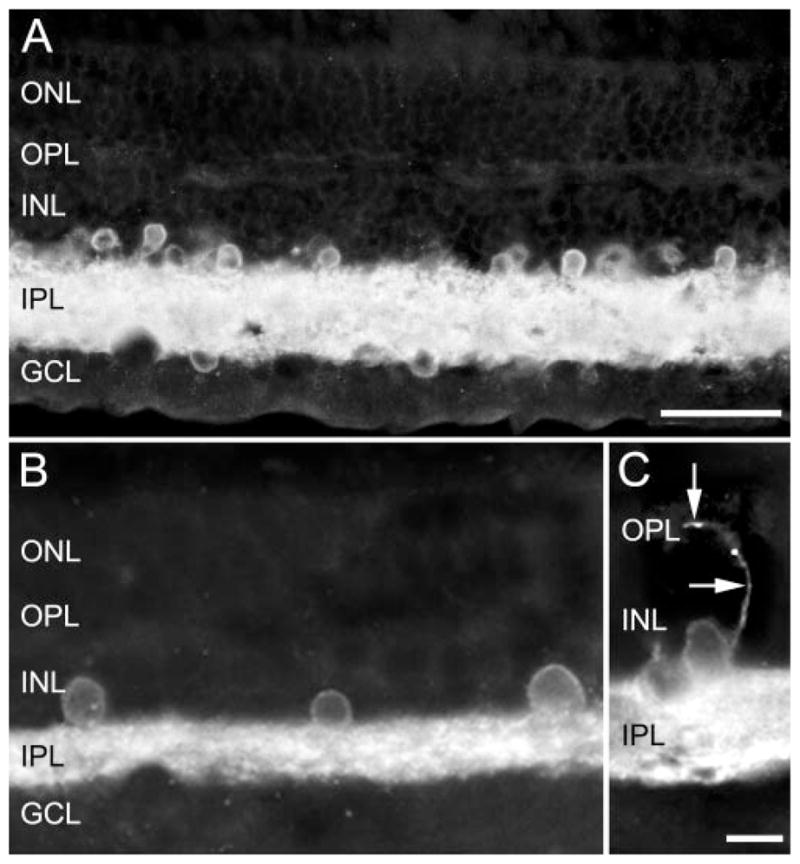
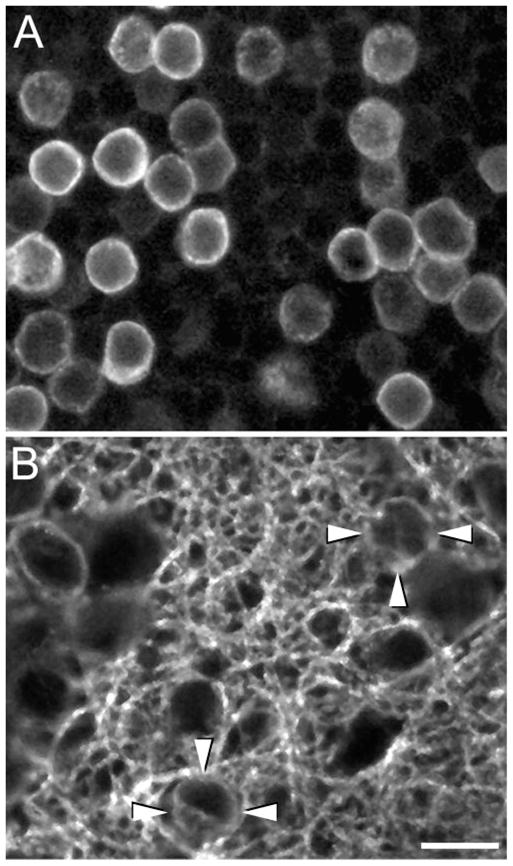
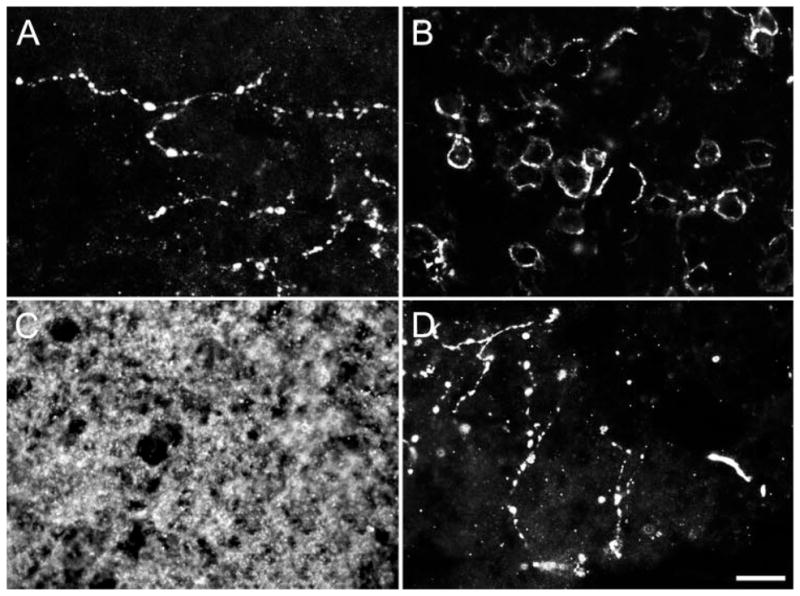
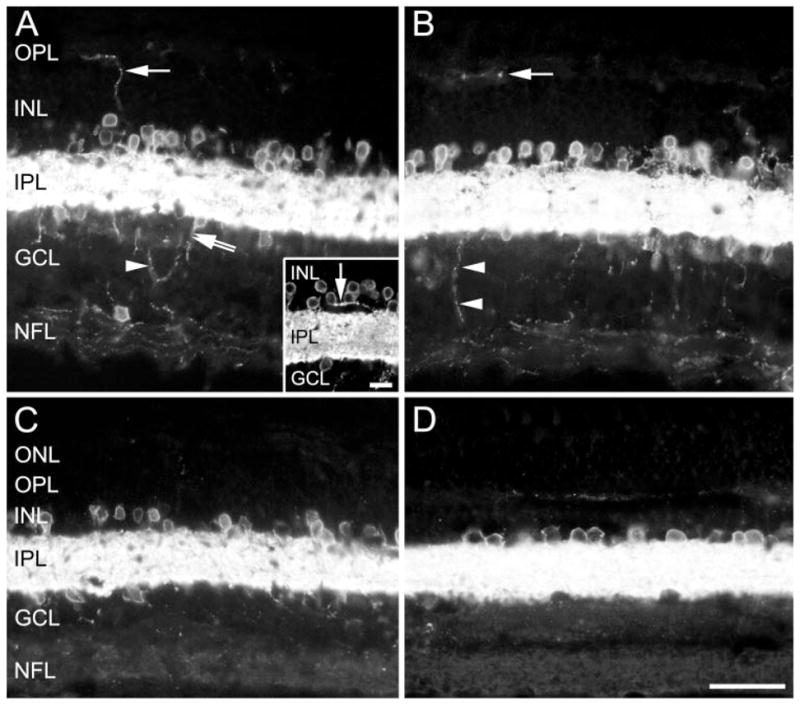
The pattern of GAT-1 immunostaining was similar in human and monkey retinas. Numerous small immunoreactive somata were in the inner nuclear layer (INL) and were present rarely in the inner plexiform layer (IPL) of all retinal regions. Medium GAT-1 somata were in the ganglion cell layer in the parafoveal and peripheral retinal regions. GAT-1 fibers were densely distributed throughout the IPL. Varicose processes, originating from both the IPL and somata in the INL, arborized in the outer plexiform layer (OPL), forming a sparse network in all retinal regions, except the fovea. Sparsely occurring GAT-1 processes were in the nerve fiber layer in parafoveal regions and near the optic nerve head but not in the optic nerve. In the INL, 99% of the GAT-1 somata contained GABA, and 66% of the GABA immunoreactive somata expressed GAT-1. GAT-1 immunoreactivity was in all VIP-containing cells, but it was absent in TH-immunoreactive amacrine cells and in Mab115A10 immunoreactive bipolar cells.
GAT-1 in primate retinas is expressed by amacrine and displaced amacrine cells. The predominant expression of GAT-1 in the inner retina is consistent with the idea that GABA transporters influence neurotransmission and thus participate in visual information processing in the retina.
确定旧世界猴(猕猴)和人类视网膜中主要的γ-氨基丁酸(GABA)质膜转运体GAT-1的表达模式。
采用免疫组织化学技术结合荧光和共聚焦显微镜,将GAT-1定位在视网膜切片中。使用针对GABA、血管活性肠肽(VIP)、酪氨酸羟化酶(TH)和双极细胞标志物Mab115A10的抗体,对GAT-1抗体进行双标记研究。
人类和猴视网膜中GAT-1免疫染色模式相似。在内核层(INL)中有许多小的免疫反应性胞体,在所有视网膜区域的内网状层(IPL)中很少出现。中等大小的GAT-1胞体位于中央凹旁和周边视网膜区域的神经节细胞层。GAT-1纤维密集分布于整个IPL。起源于IPL和INL中胞体的曲张突起在外网状层(OPL)中分支,在除中央凹外的所有视网膜区域形成稀疏网络。在中央凹旁区域的神经纤维层和视神经乳头附近有少量GAT-1突起,但在视神经中没有。在INL中,99%的GAT-1胞体含有GABA,66%的GABA免疫反应性胞体表达GAT-1。GAT-1免疫反应性存在于所有含VIP的细胞中,但在TH免疫反应性无长突细胞和Mab115A10免疫反应性双极细胞中不存在。
灵长类视网膜中的GAT-1由无长突细胞和移位无长突细胞表达。GAT-1在内视网膜中的主要表达与GABA转运体影响神经传递并因此参与视网膜视觉信息处理的观点一致。