Harrop Todd C, Olmstead Marilyn M, Mascharak Pradip K
Department of Chemistry and Biochemistry, University of California, Santa Cruz, California 95064, USA.
Inorg Chem. 2006 Apr 17;45(8):3424-36. doi: 10.1021/ic0520465.
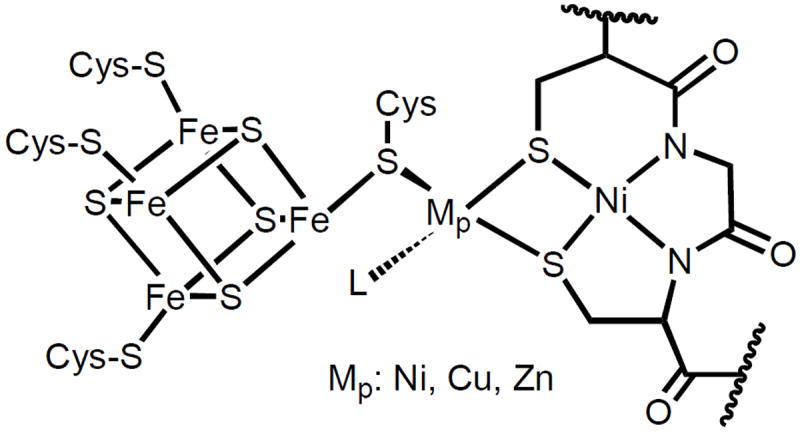
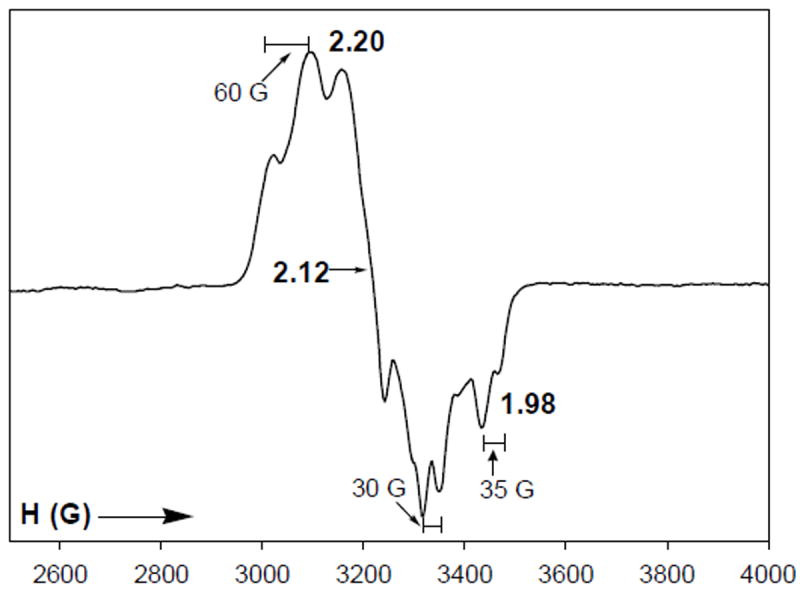
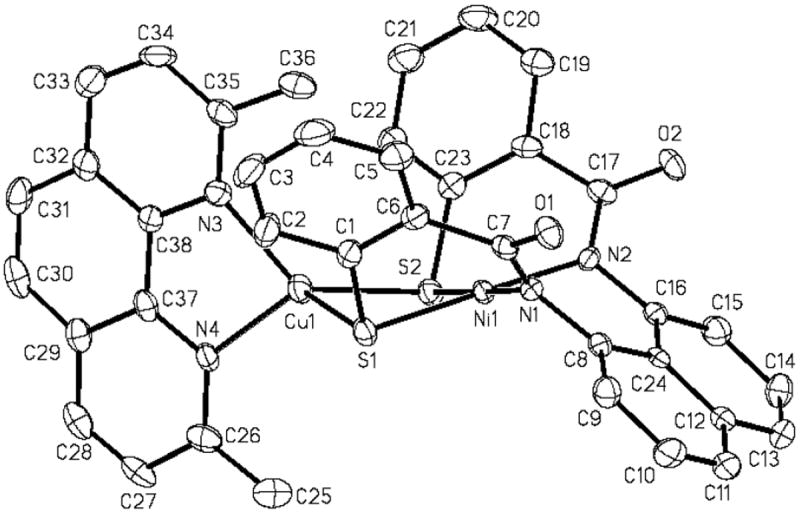
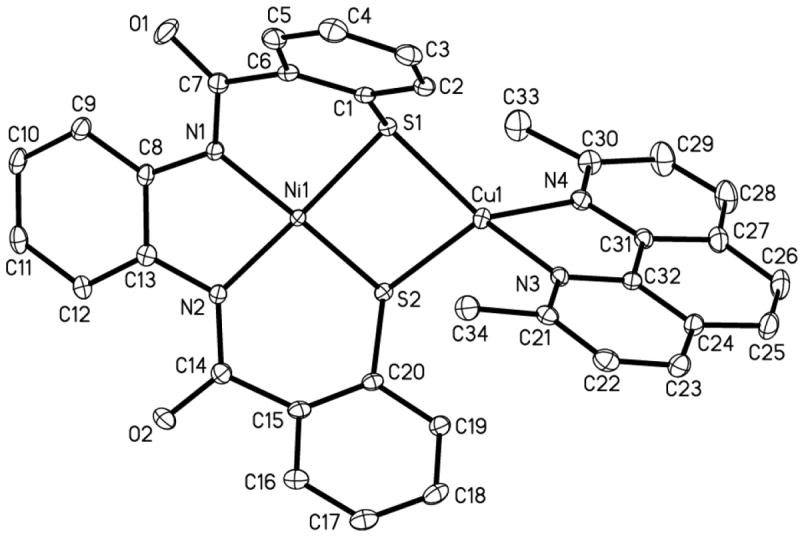
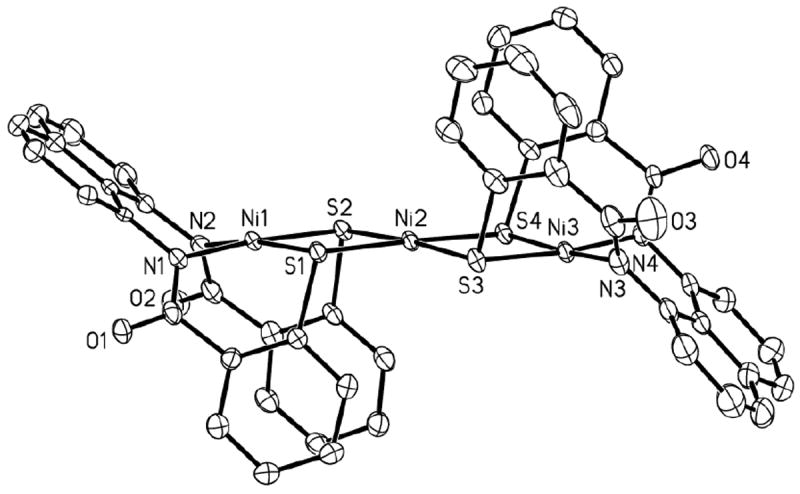
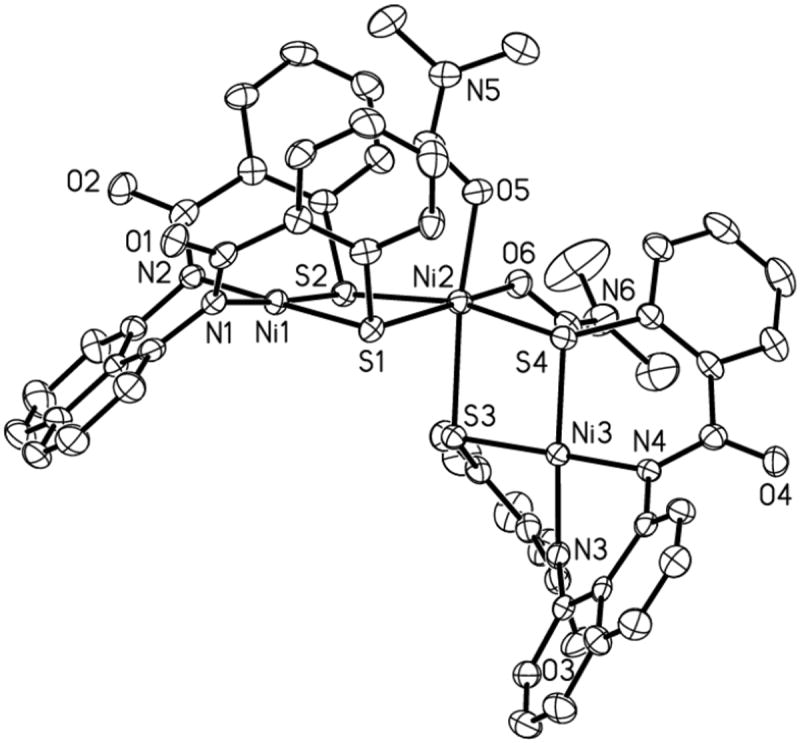
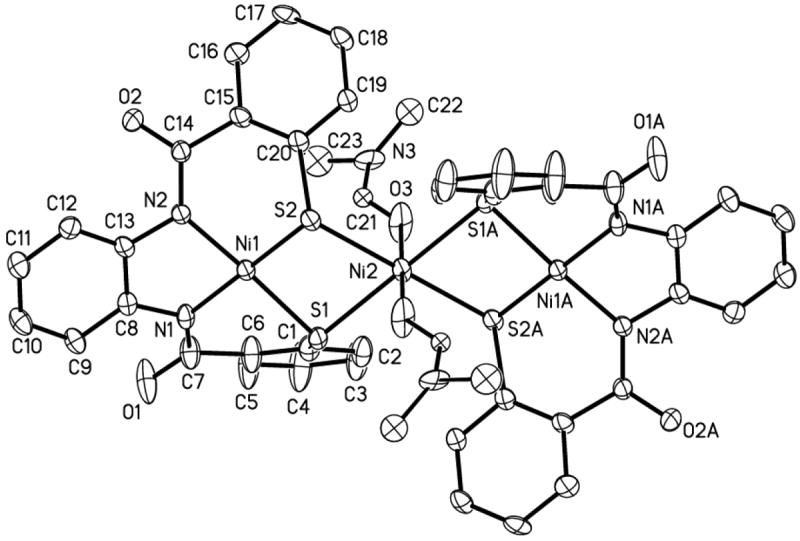
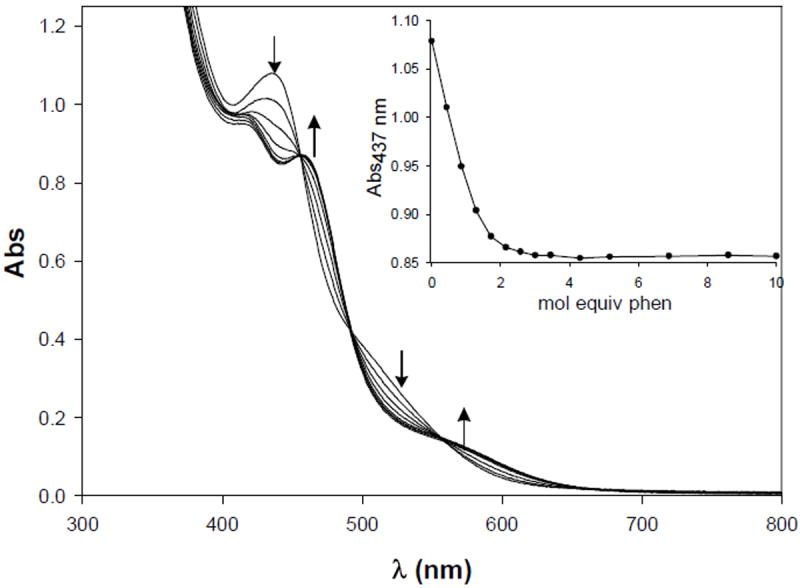
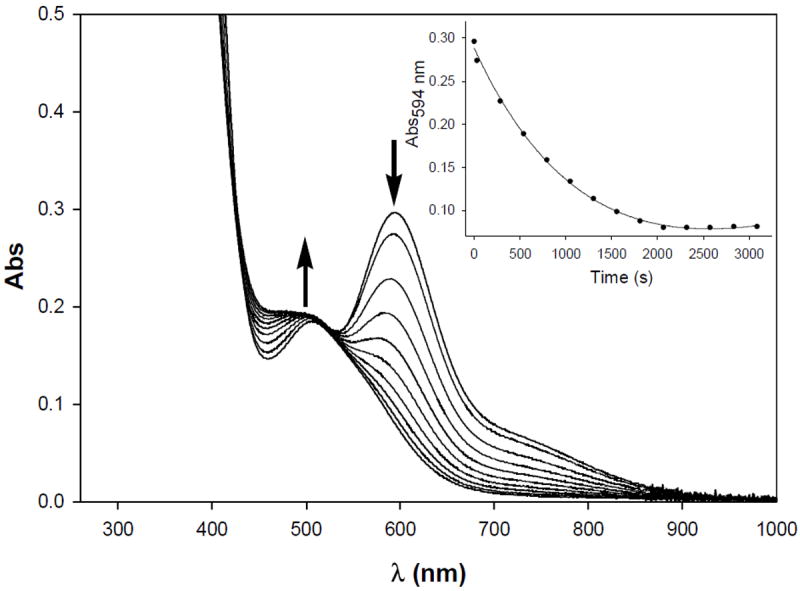
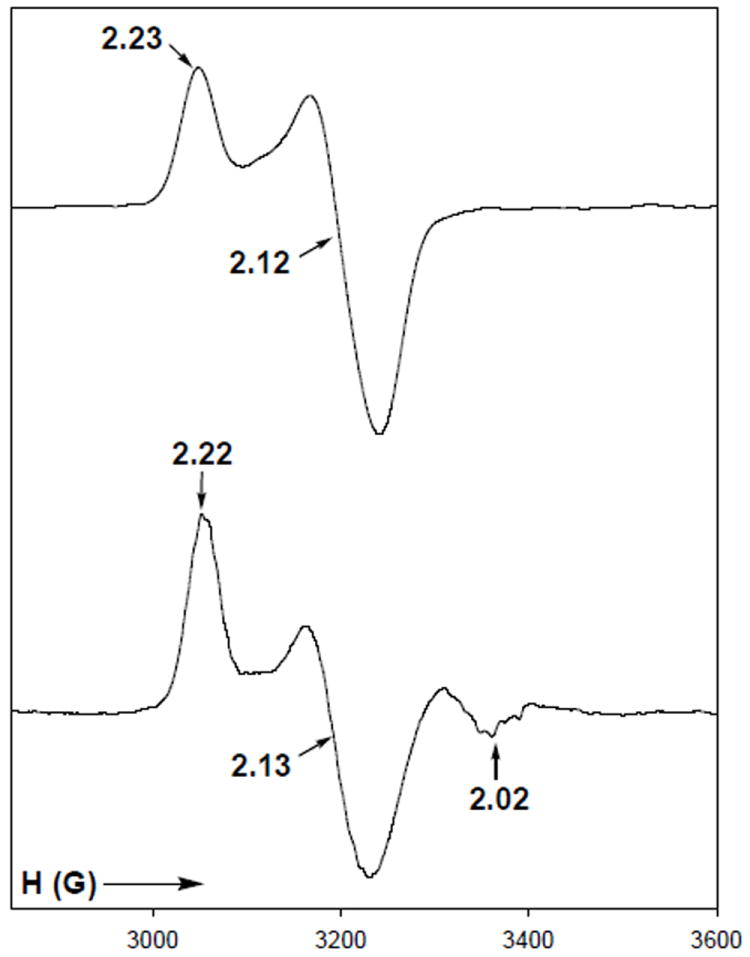
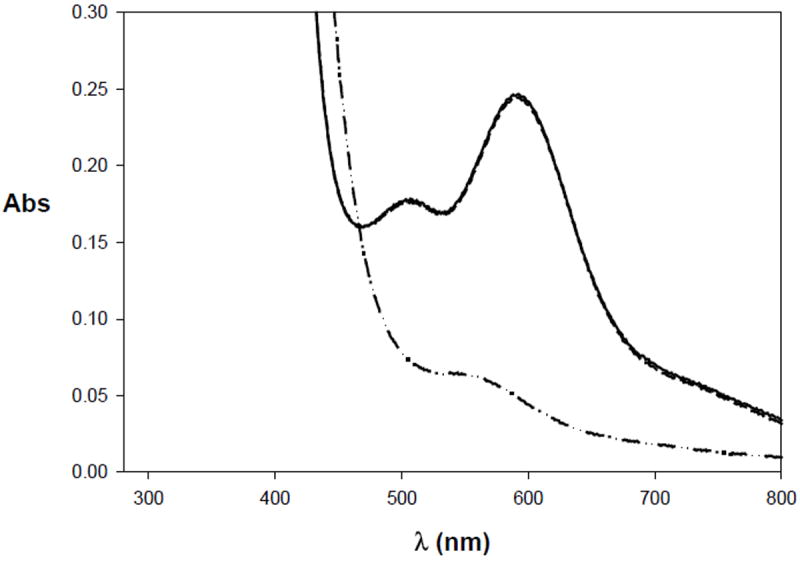
Two metallosynthons, namely (Et4N)2[Ni(NpPepS)] (1) and (Et4N)2[Ni(PhPepS)] (2) containing carboxamido-N and thiolato-S as donors have been used to model the bimetallic M(p)-Ni(d) subsite of the A-cluster of the enzyme acetyl coenzyme A synthase/CO dehydrogenase. A series of sulfur-bridged Ni/Cu dinuclear and trinuclear complexes (3-10) have been synthesized to explore their redox properties and affinity of the metal centers toward CO. The structures of (Et4N)2[Ni(PhPepS)] (2), (Et4N)[Cu(neo)Ni(NpPepS)] x 0.5 Et2O x 0.5 H2O (3 x 0.5 Et2O x 0.5 H2O), (Et4N)[Cu(neo)Ni(PhPepS)] x H2O (4 x H2O), (Et4N)2[Ni{Ni(NpPepS)}2] x DMF (5 x DMF), (Et4N)2[Ni(DMF)2{Ni(NpPepS)}2] x 3 DMF (6 x 3 DMF), (Et4N)2[Ni(DMF)2{Ni(PhPepS)}2] (8), and [Ni(dppe)Ni(PhPepS)] x CH2Cl2 (10 x CH2Cl2) have been determined by crystallography. The Ni(d) mimics 1 and 2 resist reduction and exhibit no affinity toward CO. In contrast, the sulfur-bridged Ni center (designated Ni(C)) in the trinuclear models 5-8 are amenable to reduction and binds CO in the Ni(I) state. Also, the sulfur-bridged Ni(C) center can be removed from the trimers (5-8) by treatment with 1,10-phenanthroline much like the "labile Ni" from the enzyme. The dinuclear Ni-Ni models 9 and 10 resemble the Ni(p)-Ni(d) subsite of the A-cluster more closely, and only the modeled Ni(p) site of the dimers can be reduced. The Ni(I)-Ni(II) species display EPR spectra typical of a Ni(I) center in distorted trigonal bipyramidal and distorted tetrahedral geometries for 9(red) and 10(red), respectively. Both species bind CO, and the CO-adducts 9(red)-CO and 10(red)-CO display strong nu(co) at 2044 and 1997 cm(-1), respectively. The reduction of 10 is reversible. The CO-affinity of 10 in the reduced state and the nu(co) value of 10(red)-CO closely resemble the CO-bound reduced A-cluster (nu(co) = 1996 cm(-1)).
两种金属合成子,即含有羧酰胺基 - N和硫醇盐 - S作为供体的(Et4N)2[Ni(NpPepS)](1)和(Et4N)2[Ni(PhPepS)](2),已被用于模拟乙酰辅酶A合成酶/CO脱氢酶A簇的双金属M(p)-Ni(d)亚位点。已合成了一系列硫桥连的Ni/Cu双核和三核配合物(3 - 10),以探索它们的氧化还原性质以及金属中心对CO的亲和力。已通过晶体学确定了(Et4N)2[Ni(PhPepS)](2)、(Et4N)[Cu(neo)Ni(NpPepS)]·0.5 Et2O·0.5 H2O(3·0.5 Et2O·0.5 H2O)、(Et4N)[Cu(neo)Ni(PhPepS)]·H2O(4·H2O)、(Et4N)2[Ni{Ni(NpPepS)}2]·DMF(5·DMF)、(Et4N)2[Ni(DMF)2{Ni(NpPepS)}2]·3 DMF(6·3 DMF)、(Et4N)2[Ni(DMF)2{Ni(PhPepS)}2](8)和[Ni(dppe)Ni(PhPepS)]·CH2Cl2(10·CH2Cl2)的结构。Ni(d)模拟物1和2难以还原,且对CO无亲和力。相比之下,三核模型5 - 8中的硫桥连Ni中心(称为Ni(C))易于还原,并在Ni(I)状态下结合CO。此外,通过用1,10 - 菲咯啉处理,硫桥连Ni(C)中心可以从三聚体(5 - 8)中去除,这与酶中的“不稳定Ni”非常相似。双核Ni - Ni模型9和10更紧密地类似于A簇的Ni(p)-Ni(d)亚位点,并且只有二聚体的模拟Ni(p)位点可以被还原。Ni(I)-Ni(II)物种分别在9(red)和10(red)的扭曲三角双锥和扭曲四面体几何构型中显示出典型的Ni(I)中心的EPR光谱。两种物种都结合CO,并且CO加合物9(red)-CO和10(red)-CO分别在2044和1997 cm(-1)处显示出强的ν(co)。10的还原是可逆的。还原态下10的CO亲和力和10(red)-CO的ν(co)值与结合CO的还原A簇(ν(co)=1996 cm(-1))非常相似。