Deibert Peter, Allgaier Hans-Peter, Loesch Stefanie, Müller Claudia, Olschewski Manfred, Hamm Hinrich, Maier Klaus-Peter, Blum Hubert Erich
Department of Medicine VII, University Freiburg, Germany.
BMC Gastroenterol. 2006 Apr 25;6:15. doi: 10.1186/1471-230X-6-15.
Hepatopulmonary syndrome (HPS) is a rare complication of liver diseases of different etiologies and may indicate a poor prognosis. Therefore, a simple non-invasive screening method to detect HPS would be highly desirable. In this study pulse oximetry was evaluated to identify patients with HPS.
In 316 consecutive patients with liver cirrhosis (n = 245), chronic hepatitis (n = 69) or non-cirrhotic portal hypertension (n = 2) arterial oxygen saturation (SaO2) was determined using a pulse oximeter. In patients with SaO2 < or = 92% in supine position and/or a decrease of > or = 4% after change from supine to upright position further diagnostic procedures were performed, including contrast-enhanced echocardiography and perfusion lung scan.
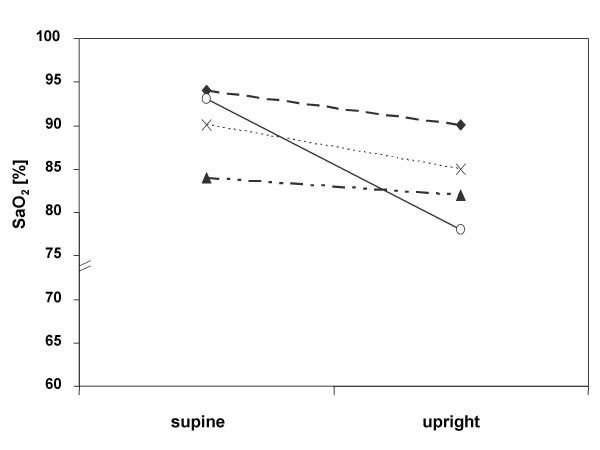
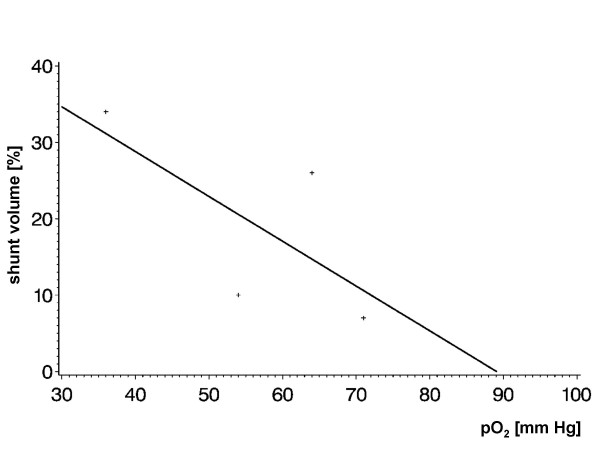
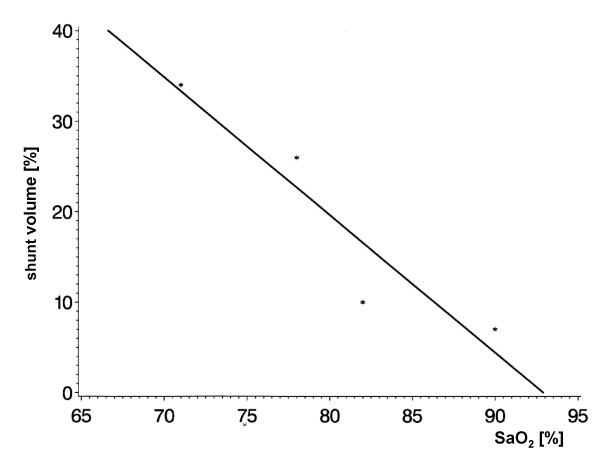
Seventeen patients (5.4%) had a pathological SaO2. Four patients (1.3%) had HPS. HPS patients had a significant lower mean SaO2 in supine (89.7%, SD 5.4 vs. 96.0%, SD 2.3; p = 0.003) and upright position (84.3%, SD 5.0 vs. 96.0%, SD 2.4; p = 0.001) and had a lower mean PaO2 (56.2 mm Hg, SD 15.2 vs. 71.2 mm Hg, SD 20.2; p = 0.02) as compared to patients without HPS. The mean deltaSaO2 (difference between supine and upright position) was 5.50 (SD 7) in HPS patients compared to non-HPS patients who showed no change (p = 0.001). There was a strong correlation between shunt volume and the SaO2 values (R = -0.94).
Arterial SaO2 determination in supine and upright position is a useful non-invasive screening test for HPS and correlates well with the intrapulmonary shunt volume.
肝肺综合征(HPS)是不同病因肝脏疾病的一种罕见并发症,可能预示预后不良。因此,非常需要一种简单的非侵入性筛查方法来检测HPS。在本研究中,对脉搏血氧测定法进行评估以识别HPS患者。
对316例连续性肝硬化患者(n = 245)、慢性肝炎患者(n = 69)或非肝硬化门静脉高压患者(n = 2)使用脉搏血氧仪测定动脉血氧饱和度(SaO2)。对于仰卧位SaO2≤92%和/或从仰卧位改为直立位后下降≥4%的患者,进行进一步诊断程序,包括对比增强超声心动图和灌注肺扫描。
17例患者(5.4%)SaO2异常。4例患者(1.3%)患有HPS。HPS患者仰卧位(89.7%,标准差5.4 vs. 96.0%,标准差2.3;p = 0.003)和直立位(84.3%,标准差5.0 vs. 96.0%,标准差2.4;p = 0.001)的平均SaO2显著更低,与无HPS患者相比,平均动脉血氧分压(PaO2)也更低(56.2 mmHg,标准差15.2 vs. 71.2 mmHg,标准差20.2;p = 0.02)。HPS患者的平均SaO2差值(仰卧位与直立位之间的差异)为5.50(标准差7),而非HPS患者无变化(p = 0.001)。分流体积与SaO2值之间存在强相关性(R = -0.94)。
仰卧位和直立位动脉SaO2测定是一种用于HPS的有用非侵入性筛查试验,并与肺内分流体积密切相关。