Gordon J C
Institute of Forest Genetics, North Central Forest Experiment Station, United States Department of Agriculture Forest Service, Rhinelander, Wisconsin 54501.
Plant Physiol. 1971 May;47(5):595-9. doi: 10.1104/pp.47.5.595.
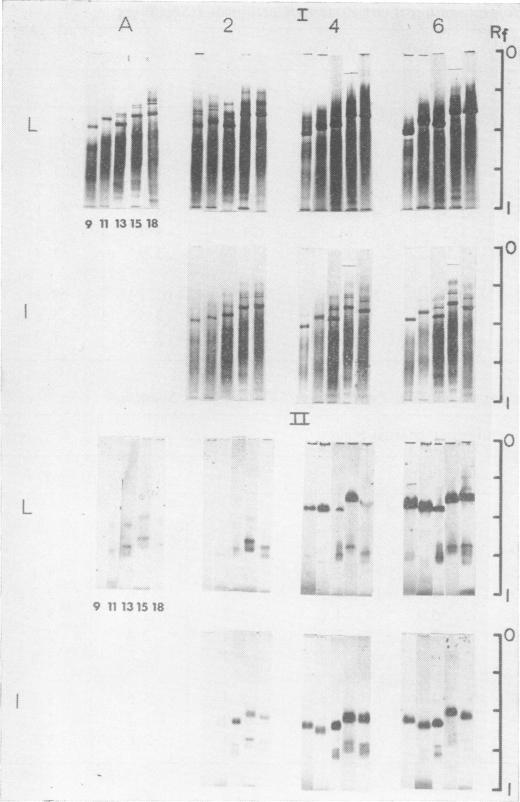
Nitrogen content and soluble protein and anodal peroxidase banding in acrylamide gel changed with leaf and internode development in the expanding leaf zone of eastern cottonwood (Populus deltoides Bartr.). Nitrogen per unit leaf area was high near the apex and decreased to a constant value at the sixth node below it. Soluble protein banding was qualitatively similar for leaves and internodes in this zone, but anodal peroxidases differed between leaves and internodes. The major leaf peroxidase band was absent from the second leaf below the apex but present in the fourth and sixth leaves; its appearance and intensification seemed to parallel the development of photosynthetic activity. The major internode peroxidase band was present in the apex, second, fourth, and sixth internodes, and intensified during internodal development. It is suggested that these two "isoenzymes" may have different functions in vivo.
在东部杨属毛白杨(Populus deltoides Bartr.)叶片伸展区,随着叶片和节间的发育,氮含量、可溶性蛋白以及丙烯酰胺凝胶中的阳极过氧化物酶条带发生了变化。单位叶面积的氮含量在叶尖附近较高,并在其下方第六节处降至恒定值。该区域叶片和节间的可溶性蛋白条带在定性上相似,但叶片和节间的阳极过氧化物酶不同。叶尖下方第二片叶中不存在主要的叶片过氧化物酶条带,但在第四片和第六片叶中存在;其出现和增强似乎与光合活性的发育平行。主要的节间过氧化物酶条带出现在叶尖、第二节、第四节和第六节间,并在节间发育过程中增强。有人认为这两种“同工酶”在体内可能具有不同的功能。