J. Tuzo Wilson Research Laboratories, Department of Botany, Erindale College, University of Toronto, Mississauga, Ontario, Canada L5L 1L6.
Plant Physiol. 1984 Mar;74(3):481-6. doi: 10.1104/pp.74.3.481.
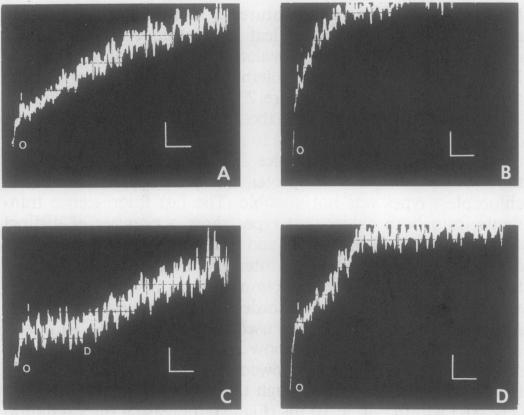
The chlorophyll fluorescence induction curves from mesophyll and guard cell chloroplasts of Saxifraga cernua, including both the fast (O to P, the transients involved in the rise in variable fluorescence) and slow (P to steady state fluorescence due to quenching) components, were characterized over a range of excitation intensities using microspectrophotometry (with epi-lumination) equipped with apertures designed to eliminate cross contamination of the fluorescence signal between the two chloroplast types. At low excitation intensities, the fast fluorescence kinetics from guard cell plastids showed an extended I to D phase and a more rapid appearance of P while minimal quenching from P to steady state fluorescence was observed compared to the transients from mesophyll chloroplasts suggesting a lower activity of photochemical (electron movement via carriers between donor and acceptor sites) and nonphotochemical (such as membrane conformational changes) events which regulate the fluorescence induction curve kinetics. As the excitation intensity was increased, the quenching rates of guard cells were faster at initiating conditions for photophosphorylation and the fast and slow fluorescence kinetics from guard cells resembled those of the mesophyll cells.Guard cell chloroplasts of S. cernua from intact epidermal peels showed a low temperature (77 K) fluorescence emission spectrum having three major peaks (at 685, 695, and 730 nanometers when excited at 440 nanometers) which were qualitatively similar to those in the spectrum obtained from mesophyll tissue.These data suggest that S. cernua guard cell chloroplast photosystems I and II contribute to light-dependent stomatal activity only at high light intensities.
薹草属虎耳草,其叶肉和保卫细胞叶绿体的叶绿素荧光诱导曲线,包括快速(O 到 P,可变荧光上升涉及的瞬变)和慢速(P 到由于淬灭而稳定的荧光)成分,在一系列激发强度下用配备有用于消除两种叶绿体类型之间荧光信号交叉污染的光阑的微分光光度计(用 epi 照明)进行了表征。在低激发强度下,保卫细胞质体的快速荧光动力学显示出扩展的 I 到 D 相和更快的 P 出现,而与质体相比,从 P 到稳定的荧光的淬灭最小,这表明光化学(电子通过载体在供体和受体位点之间移动)和非光化学(例如膜构象变化)事件的活性较低,这些事件调节荧光诱导曲线动力学。随着激发强度的增加,在光磷酸化的起始条件下,保卫细胞的淬灭速率更快,并且从保卫细胞的快速和慢速荧光动力学类似于叶肉细胞的动力学。从完整表皮薄片中分离出的薹草属虎耳草保卫细胞叶绿体在低温(77 K)下显示出荧光发射光谱,具有三个主要峰(在 440 纳米激发时分别为 685、695 和 730 纳米),与从叶肉组织获得的光谱相似。这些数据表明,薹草属虎耳草保卫细胞的光系统 I 和 II 仅在高光强下对依赖光的气孔活动有贡献。