Wu M X, Wedding R T
Department of Biochemistry, University of California, Riverside, California 92521.
Plant Physiol. 1985 Mar;77(3):667-75. doi: 10.1104/pp.77.3.667.
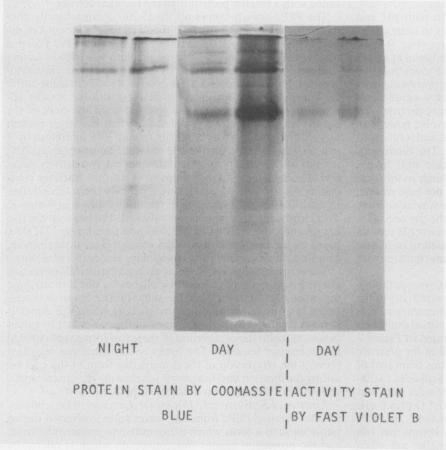
Phosphoenolpyruvate carboxylase appears to be located in or associated with the chloroplasts of Crassula. As has been found with this enzyme in other CAM plants, a crude extract of leaves gathered during darkness and rapidly assayed for phosphoenolpyruvate carboxylase (PEPc) activity is relatively insensitive to inhibition by malate. After illumination begins, the PEPc activity becomes progressively more sensitive to malate. This enzyme also shows a diurnal change in activation by glucose-6-phosphate, with the enzyme from dark leaves more strongly activated than that from leaves in the light.When the enzyme is partially purified in the presence of malate, the characteristic sensitivity of the day leaf enzyme is largely retained. Partial purification of the enzyme from dark leaves results in a small increase in sensitivity to malate inhibition.Partially purified enzyme is found by polyacrylamide gel electrophoresis analysis to have two bands of PEPc activity. In enzymes from dark leaves, the slower moving band predominates, but in the light, the faster moving band is preponderant. Both of these bands are shown by sodium dodecyl sulfate-polyacrylamide gel electrophoresis to be composed of the same subunit of 103,000 daltons.The enzyme partially purified from night leaves has a pH optimum of 5.6, and is relatively insensitive to malate inhibition over the range from pH 4.5 to 8. The enzyme from day leaves has a pH optimum of 6.6 and is strongly inhibited by malate at pH values below 7, but becomes insensitive at higher pH values.Gel filtration of partially purified PEPc showed two activity peaks, one corresponding approximately to a dimer of the single subunit, and the other twice as large. The larger protein was relatively insensitive to malate inhibition, the smaller was strongly inhibited by malate.Kinetic studies showed that malate is a mixed type inhibitor of the sensitive, day, enzyme, increasing K(m) for phosphoenolpyruvate and reducing V(max). With the insensitive, night, enzyme, malate is a K type inhibitor, reducing the K(m) for phosphoenolpyruvate, but having little effect on V(max). The inhibition of the insensitive enzyme by malate appears to be hysteretic, taking several minutes to be expressed during assay, probably indicating a change in the conformation or aggregation state of the enzyme.Activation by glucose-6-phosphate is of the mixed type for the day form of the enzyme, causing both a decreased K(m) for phosphoenolpyruvate and an increased V(max), but the night, or insensitive, form shows only an increase in V(max) in response to glucose-6-phosphate.
磷酸烯醇式丙酮酸羧化酶似乎位于景天科植物的叶绿体中或与叶绿体相关联。正如在其他景天酸代谢植物中发现的这种酶一样,在黑暗中采集并迅速测定磷酸烯醇式丙酮酸羧化酶(PEPc)活性的叶片粗提物对苹果酸抑制相对不敏感。光照开始后,PEPc活性对苹果酸的敏感性逐渐增加。这种酶还表现出6-磷酸葡萄糖激活的昼夜变化,黑暗叶片中的酶比光照叶片中的酶激活更强。当在苹果酸存在下对该酶进行部分纯化时,白天叶片酶的特征敏感性在很大程度上得以保留。从黑暗叶片中对该酶进行部分纯化导致对苹果酸抑制的敏感性略有增加。通过聚丙烯酰胺凝胶电泳分析发现,部分纯化的酶有两条PEPc活性带。在黑暗叶片的酶中,迁移较慢的带占主导,但在光照下,迁移较快的带占优势。十二烷基硫酸钠-聚丙烯酰胺凝胶电泳显示,这两条带均由相同的103,000道尔顿亚基组成。从夜间叶片中部分纯化的酶的最适pH为5.6,在pH 4.5至8的范围内对苹果酸抑制相对不敏感。白天叶片的酶最适pH为6.6,在pH值低于7时受到苹果酸的强烈抑制,但在较高pH值时变得不敏感。对部分纯化的PEPc进行凝胶过滤显示有两个活性峰,一个约对应于单个亚基的二聚体,另一个是其两倍大。较大的蛋白质对苹果酸抑制相对不敏感,较小的则受到苹果酸的强烈抑制。动力学研究表明,苹果酸是敏感的白天酶的混合型抑制剂,增加了磷酸烯醇式丙酮酸的K(m)并降低了V(max)。对于不敏感的夜间酶,苹果酸是K型抑制剂,降低了磷酸烯醇式丙酮酸的K(m),但对V(max)影响很小。苹果酸对不敏感酶的抑制似乎具有滞后性,在测定过程中需要几分钟才能表现出来,这可能表明酶的构象或聚集状态发生了变化。对于酶的白天形式,6-磷酸葡萄糖的激活是混合型的,导致磷酸烯醇式丙酮酸的K(m)降低和V(max)增加,但夜间或不敏感形式对6-磷酸葡萄糖的反应仅表现为V(max)增加。