Marcus Y, Schuster G, Michaels A, Kaplan A
Department of Botany, The Hebrew University of Jerusalem, Jerusalem, 91904, Israel.
Plant Physiol. 1986 Feb;80(2):604-7. doi: 10.1104/pp.80.2.604.
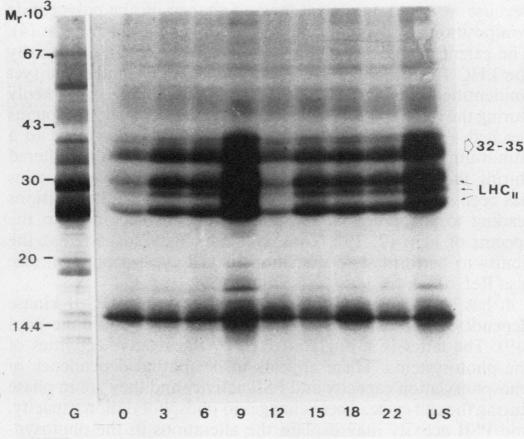
The photosynthetic performance of synchronously grown Chlamydomonas reinhardtii alternated rhythmically during the cell cycle. The activity of the "CO(2) concentrating mechanism" including the ability to accumulate CO(2) internally and the activity of carbonic anhydrase peaked after 6 to 9 hours of light and reached minimum after 6 to 9 hours of dark. Consequently, the apparent photosynthetic affinity to extracellular CO(2) alternated rhythmically. At the end of the dark period the cells behaved as if they were adapted to high CO(2) even though they were continuously aerated with air. Results from experiments in which the light or dark periods were extended bear on the interaction between the internal (cell cycle or biological clock) and the external (light) signal. The observed rhythmical alterations in photosynthetic V(max) may result from changes in PSII activity. The latter may be partly explained by the capacity for phosphorylation of thylakoid proteins, which reached maximum after 9 hours of light and decreased toward the dark period.
同步生长的莱茵衣藻的光合性能在细胞周期中呈节律性交替变化。“二氧化碳浓缩机制”的活性,包括在细胞内积累二氧化碳的能力和碳酸酐酶的活性,在光照6至9小时后达到峰值,在黑暗6至9小时后降至最低。因此,对细胞外二氧化碳的表观光合亲和力呈节律性交替变化。在黑暗期结束时,即使细胞持续通空气,它们的行为也好像适应了高浓度二氧化碳。延长光照或黑暗期的实验结果与内部(细胞周期或生物钟)和外部(光照)信号之间的相互作用有关。观察到的光合V(max)的节律性变化可能是由于PSII活性的变化所致。后者可能部分由类囊体蛋白的磷酸化能力来解释,该能力在光照9小时后达到最大值,并在黑暗期逐渐下降。