Wu A, Harriman R W, Frost D J, Read S M, Wasserman B P
Department of Food Science, New Jersey Agricultural Experiment Station, Cook College, Rutgers University, New Brunswick, New Jersey 08903-0231.
Plant Physiol. 1991 Oct;97(2):684-92. doi: 10.1104/pp.97.2.684.
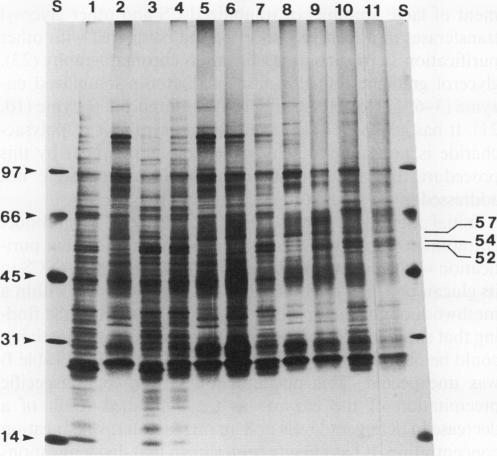
Rapid enrichment of CHAPS-solubilized UDP-glucose:(1,3)-beta-glucan (callose) synthase from storage tissue of red beet (Beta vulgaris L.) is obtained when the preparation is incubated with an enzyme assay mixture, then centrifuged and the enzyme released from the callose pellet with a buffer containing EDTA and CHAPS (20-fold purification relative to microsomes). When centrifuged at high speed (80,000g), the enzyme can also be pelleted in the absence of substrate (UDP-Glc) or synthesis of callose, due to nonspecific aggregation of proteins caused by excess cations and insufficient detergent in the assay buffer. True time-dependent and substrate-dependent product-entrapment of callose synthase is obtained by low-speed centrifugation (7,000-11,000g) of enzyme incubated in reaction mixtures containing low levels of cations (0.5 millimolar Mg(2+), 1 millimolar Ca(2+)) and sufficient detergent (0.02% digitonin, 0.12% CHAPS), together with cellobiose, buffer, and UDP-Glc. Entrapment conditions, therefore, are a compromise between preventing nonspecific precipitation of proteins and permitting sufficient enzyme activity for callose synthesis. Further enrichment of the enzyme released from the callose pellet was not obtained by rate-zonal glycerol gradient centrifugation, although its sedimentation rate was greatly enhanced by inclusion of divalent cations in the gradient. Preparations were markedly cleaner when product-entrapment was conducted on enzyme solubilized from plasma membranes isolated by aqueous two-phase partitioning rather than by gradient centrifugation. Product-entrapped preparations consistently contained polypeptides or groups of closely-migrating polypeptides at molecular masses of 92, 83, 70, 57, 43, 35, 31/29, and 27 kilodaltons. This polypeptide profile is in accordance with the findings of other callose synthase enrichment studies using a variety of tissue sources, and is consistent with the existence of a multi-subunit enzyme complex.
当红甜菜(Beta vulgaris L.)贮藏组织的制备物与酶分析混合物一起孵育,然后离心,并用含有EDTA和CHAPS的缓冲液从胼胝质沉淀中释放酶时(相对于微粒体有20倍的纯化),可快速富集CHAPS增溶的UDP - 葡萄糖:(1,3)-β-葡聚糖(胼胝质)合酶。当在高速(80,000g)下离心时,由于分析缓冲液中阳离子过量和去污剂不足导致蛋白质非特异性聚集,该酶在没有底物(UDP - Glc)或胼胝质合成的情况下也可沉淀。通过在含有低水平阳离子(0.5毫摩尔Mg(2+),1毫摩尔Ca(2+))和足够去污剂(0.02%洋地黄皂苷,0.12% CHAPS)的反应混合物中孵育的酶进行低速离心(7,000 - 11,000g),同时加入纤维二糖、缓冲液和UDP - Glc,可实现胼胝质合酶真正的时间依赖性和底物依赖性产物截留。因此,截留条件是在防止蛋白质非特异性沉淀和允许足够的酶活性进行胼胝质合成之间的一种折衷。尽管通过在梯度中加入二价阳离子可大大提高其沉降速率,但通过速率区带甘油梯度离心并未进一步富集从胼胝质沉淀中释放的酶。当对通过水相两相分配而非梯度离心分离的质膜增溶的酶进行产物截留时,制备物明显更纯净。产物截留的制备物始终含有分子量为92、83、70、57、43、35、31/29和27千道尔顿的多肽或紧密迁移的多肽组。该多肽图谱与使用多种组织来源的其他胼胝质合酶富集研究结果一致,并且与多亚基酶复合物的存在相符。