Campbell M M, Ellis B E
Department of Chemistry and Biochemistry, University of Guelph, Guelph, Ontario N1G 2W1, Canada.
Plant Physiol. 1992 Jan;98(1):62-70. doi: 10.1104/pp.98.1.62.
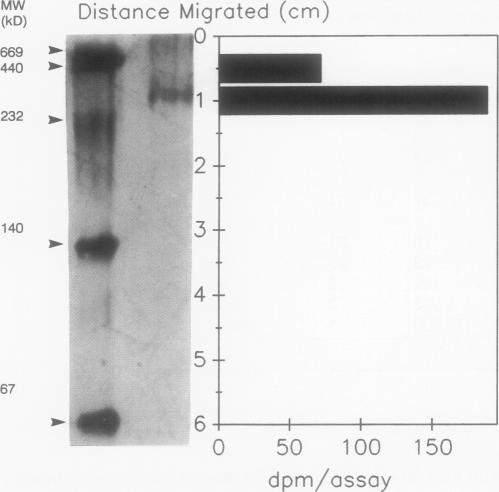
Phenylalanine ammonia-lyase (PAL, EC 4.3.1.5) is involved in the lignification of pine suspension cultures in response to an elicitor prepared from an ectomycorrhizal fungus. To elucidate the molecular basis of this response, PAL was purified to homogeneity from jack pine (Pinus banksiana) suspension cultures using anion-exchange and chromatofocussing fast protein liquid chromatography. Physical characterization of the enzyme revealed that pine PAL was similar to PAL from other plant sources. Pine PAL had a pH optimum of 8.8, an isoelectric point of 5.75, and a native molecular mass of 340 kilodaltons. The enzyme appears to be a tetramer composed of 77 kilodalton subunits. Chromatographic and western blot analyses were used to identify possible isoenzymic changes in pine PAL in response to elicitation and to determine the nature of the increase in PAL activity associated with inducible lignification in these cultures. Only one species of PAL was detected in P. banksiana cell cultures and increased quantities of this protein were correlated with the enhanced enzyme activity observed in elicited cultures. P. banksiana PAL was not feedback-inhibited by a wide range of phenolic compounds at micromolar concentrations, including the reaction product cinnamic acid. Our data suggest that a different set of metabolic and molecular controls must be in place for the regulation of PAL in pine.
苯丙氨酸解氨酶(PAL,EC 4.3.1.5)参与了松树悬浮培养物在响应由外生菌根真菌制备的激发子时的木质化过程。为了阐明这种响应的分子基础,使用阴离子交换和聚焦色谱快速蛋白质液相色谱法从短叶松(Pinus banksiana)悬浮培养物中纯化出了均一的PAL。该酶的物理特性表明,松树PAL与其他植物来源的PAL相似。松树PAL的最适pH为8.8,等电点为5.75,天然分子量为340千道尔顿。该酶似乎是由77千道尔顿亚基组成的四聚体。色谱分析和蛋白质印迹分析被用于鉴定松树PAL在响应激发时可能的同工酶变化,并确定与这些培养物中诱导木质化相关的PAL活性增加的性质。在短叶松细胞培养物中仅检测到一种PAL,并且这种蛋白质数量的增加与在激发培养物中观察到的酶活性增强相关。短叶松PAL在微摩尔浓度下不受多种酚类化合物的反馈抑制,包括反应产物肉桂酸。我们的数据表明,对于松树中PAL的调节,必须存在一套不同的代谢和分子控制机制。