Lua Rhonald C, Grosberg Alexander Y
Department of Physics, University of Minnesota, Minneapolis, Minnesota, USA.
PLoS Comput Biol. 2006 May;2(5):e45. doi: 10.1371/journal.pcbi.0020045. Epub 2006 May 19.
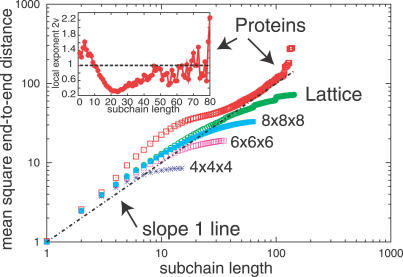
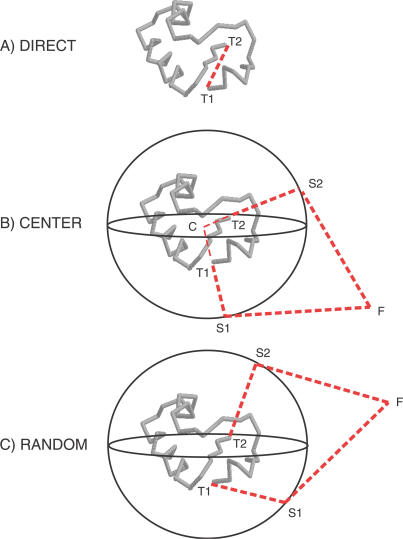
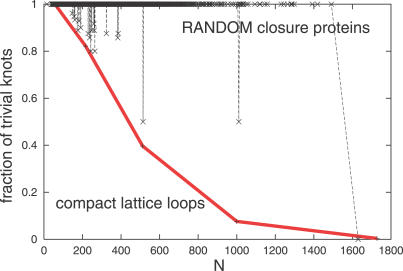
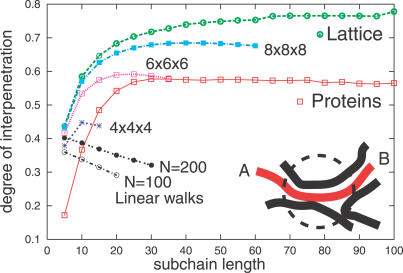
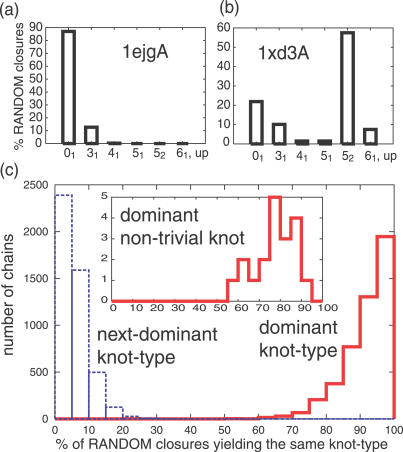
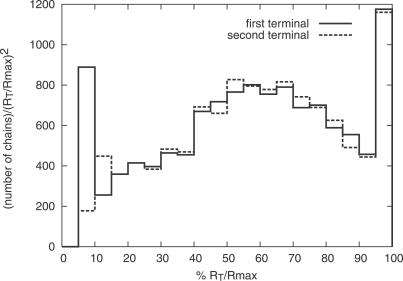
Like shoelaces, the backbones of proteins may get entangled and form knots. However, only a few knots in native proteins have been identified so far. To more quantitatively assess the rarity of knots in proteins, we make an explicit comparison between the knotting probabilities in native proteins and in random compact loops. We identify knots in proteins statistically, applying the mathematics of knot invariants to the loops obtained by complementing the protein backbone with an ensemble of random closures, and assigning a certain knot type to a given protein if and only if this knot dominates the closure statistics (which tells us that the knot is determined by the protein and not by a particular method of closure). We also examine the local fractal or geometrical properties of proteins via computational measurements of the end-to-end distance and the degree of interpenetration of its subchains. Although we did identify some rather complex knots, we show that native conformations of proteins have statistically fewer knots than random compact loops, and that the local geometrical properties, such as the crumpled character of the conformations at a certain range of scales, are consistent with the rarity of knots. From these, we may conclude that the known "protein universe" (set of native conformations) avoids knots. However, the precise reason for this is unknown--for instance, if knots were removed by evolution due to their unfavorable effect on protein folding or function or due to some other unidentified property of protein evolution.
就像鞋带一样,蛋白质的主链可能会缠结并形成结。然而,到目前为止,仅在天然蛋白质中发现了少数几种结。为了更定量地评估蛋白质中结的稀有性,我们对天然蛋白质和随机紧密环中的打结概率进行了明确比较。我们通过将结不变量的数学应用于通过用随机封闭集合补充蛋白质主链而获得的环来统计识别蛋白质中的结,并且当且仅当该结在封闭统计中占主导地位时(这告诉我们该结由蛋白质决定而非由特定的封闭方法决定)才将特定的结类型赋予给定的蛋白质。我们还通过计算测量蛋白质的端到端距离及其子链的相互穿透程度来研究蛋白质的局部分形或几何性质。尽管我们确实识别出了一些相当复杂的结,但我们表明蛋白质的天然构象在统计上比随机紧密环中的结要少,并且局部几何性质,例如在一定尺度范围内构象的褶皱特征,与结的稀有性是一致的。由此,我们可以得出结论,已知的“蛋白质宇宙”(天然构象集合)避免形成结。然而,其确切原因尚不清楚——例如,结是否由于对蛋白质折叠或功能有不利影响而在进化过程中被去除,或者是由于蛋白质进化的其他未确定特性。