• 文献检索
  • 文档翻译
  • 深度研究
  • 学术资讯
  • Suppr Zotero 插件Zotero 插件
  • 邀请有礼
  • 套餐&价格
  • 历史记录
应用&插件
Suppr Zotero 插件Zotero 插件浏览器插件Mac 客户端Windows 客户端微信小程序
定价
高级版会员购买积分包购买API积分包
服务
文献检索文档翻译深度研究API 文档MCP 服务
关于我们
关于 Suppr公司介绍联系我们用户协议隐私条款
关注我们

Suppr 超能文献

核心技术专利:CN118964589B侵权必究
粤ICP备2023148730 号-1Suppr @ 2026

文献检索

告别复杂PubMed语法,用中文像聊天一样搜索,搜遍4000万医学文献。AI智能推荐,让科研检索更轻松。

立即免费搜索

文件翻译

保留排版,准确专业,支持PDF/Word/PPT等文件格式,支持 12+语言互译。

免费翻译文档

深度研究

AI帮你快速写综述,25分钟生成高质量综述,智能提取关键信息,辅助科研写作。

立即免费体验

大鼠触须神经中的纹理辨别与多单元记录

Texture discrimination and multi-unit recording in the rat vibrissal nerve.

作者信息

Albarracín Ana L, Farfán Fernando D, Felice Carmelo J, Décima Emilio E

机构信息

Laboratorio de Neurociencia, Facultad de Medicina (FM), Universidad Nacional de Tucumán (UNT)--Tucumán--Argentina.

出版信息

BMC Neurosci. 2006 May 23;7:42. doi: 10.1186/1471-2202-7-42.

DOI:10.1186/1471-2202-7-42
PMID:16719904
原文链接:https://pmc.ncbi.nlm.nih.gov/articles/PMC1525197/
Abstract

BACKGROUND

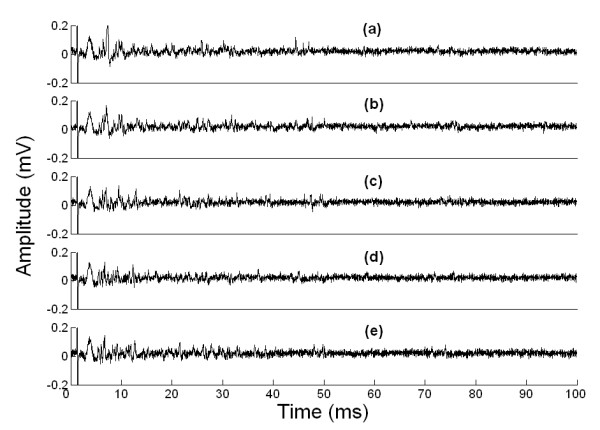
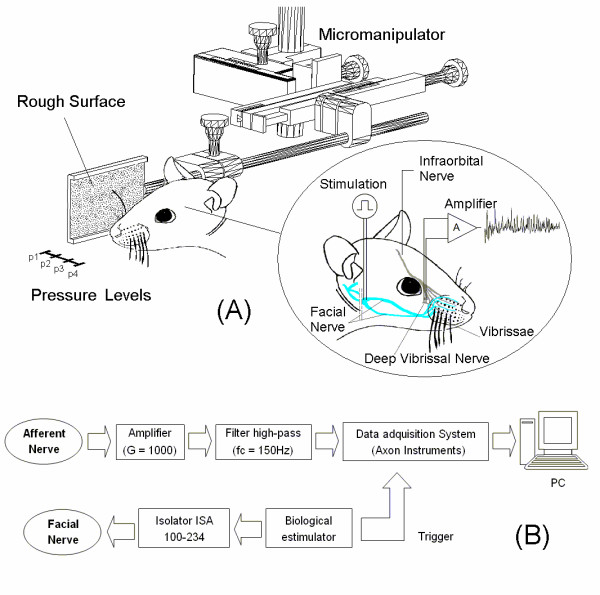
Rats distinguish objects differing in surface texture by actively moving their vibrissae. In this paper we characterized some aspects of texture sensing in anesthetized rats during active touch. We analyzed the multifiber discharge from a deep vibrissal nerve when the vibrissa sweeps materials (wood, metal, acrylic, sandpaper) having different textures. We polished these surfaces with sandpaper (P1000) to obtain close degrees of roughness and we induced vibrissal movement with two-branch facial nerve stimulation. We also consider the change in pressure against the vibrissa as a way to improve the tactile information acquisition. The signals were compared with a reference signal (control)--vibrissa sweeping the air--and were analyzed with the Root Mean Square (RMS) and the Power Spectrum Density (PSD).

RESULTS

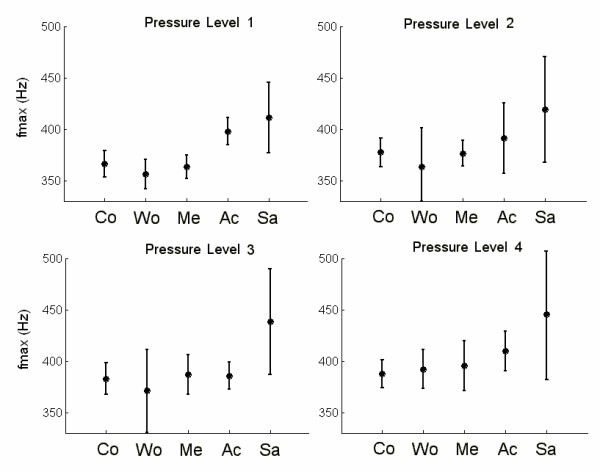
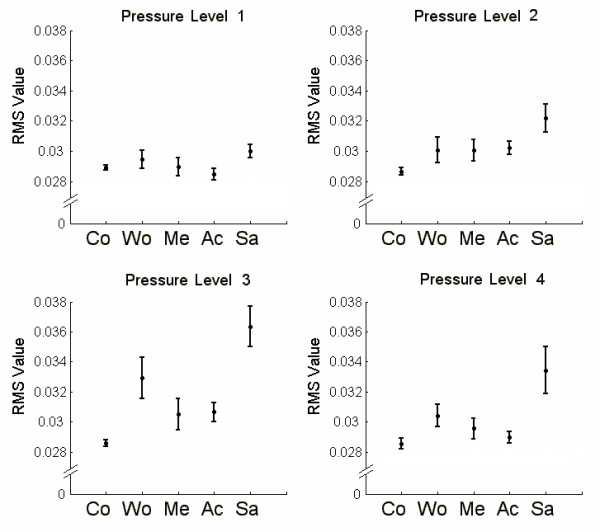
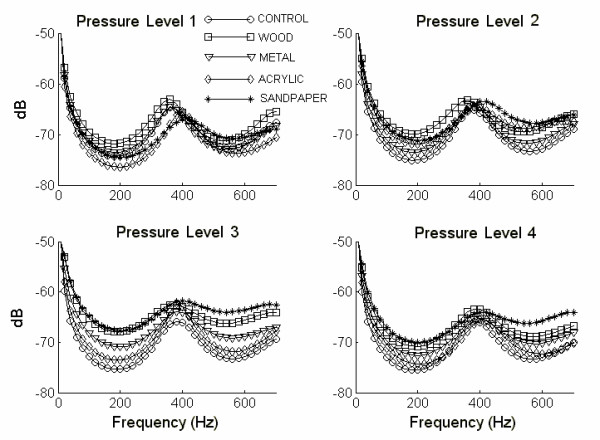
We extracted the information about texture discrimination hidden in the population activity of one vibrissa innervation, using the RMS values and the PSD. The pressure level 3 produced the best differentiation for RMS values and it could represent the "optimum" vibrissal pressure for texture discrimination. The frequency analysis (PSD) provided information only at low-pressure levels and showed that the differences are not related to the roughness of the materials but could be related to other texture parameters.

CONCLUSION

Our results suggest that the physical properties of different materials could be transduced by the trigeminal sensory system of rats, as are shown by amplitude and frequency changes. Likewise, varying the pressure could represent a behavioral strategy that improves the information acquisition for texture discrimination.

摘要

背景

大鼠通过主动移动触须来区分表面纹理不同的物体。在本文中,我们对麻醉大鼠在主动触摸过程中的纹理感知的一些方面进行了表征。当触须扫过具有不同纹理的材料(木材、金属、丙烯酸、砂纸)时,我们分析了来自深部触须神经的多纤维放电情况。我们用砂纸(P1000)对这些表面进行打磨以获得相近的粗糙度,并通过双分支面神经刺激诱导触须运动。我们还将触须所受压力的变化视为一种改善触觉信息获取的方式。将这些信号与参考信号(对照)——触须扫过空气——进行比较,并用均方根(RMS)和功率谱密度(PSD)进行分析。

结果

我们利用RMS值和PSD从一根触须神经支配的群体活动中提取了隐藏的纹理辨别信息。压力水平3对RMS值产生了最佳区分效果,它可能代表了纹理辨别时的“最佳”触须压力。频率分析(PSD)仅在低压水平下提供了信息,且表明差异与材料的粗糙度无关,而可能与其他纹理参数有关。

结论

我们的结果表明,不同材料的物理特性可通过大鼠的三叉神经感觉系统进行转换,如振幅和频率变化所示。同样,改变压力可能是一种行为策略,可改善纹理辨别时的信息获取。
https://cdn.ncbi.nlm.nih.gov/pmc/blobs/bbf6/1525197/01f2824872a4/1471-2202-7-42-5.jpg
https://cdn.ncbi.nlm.nih.gov/pmc/blobs/bbf6/1525197/cbc7892b1bbd/1471-2202-7-42-1.jpg
https://cdn.ncbi.nlm.nih.gov/pmc/blobs/bbf6/1525197/a9b9cd908fa9/1471-2202-7-42-2.jpg
https://cdn.ncbi.nlm.nih.gov/pmc/blobs/bbf6/1525197/733bd39fbba4/1471-2202-7-42-3.jpg
https://cdn.ncbi.nlm.nih.gov/pmc/blobs/bbf6/1525197/2702a3412551/1471-2202-7-42-4.jpg
https://cdn.ncbi.nlm.nih.gov/pmc/blobs/bbf6/1525197/01f2824872a4/1471-2202-7-42-5.jpg
https://cdn.ncbi.nlm.nih.gov/pmc/blobs/bbf6/1525197/cbc7892b1bbd/1471-2202-7-42-1.jpg
https://cdn.ncbi.nlm.nih.gov/pmc/blobs/bbf6/1525197/a9b9cd908fa9/1471-2202-7-42-2.jpg
https://cdn.ncbi.nlm.nih.gov/pmc/blobs/bbf6/1525197/733bd39fbba4/1471-2202-7-42-3.jpg
https://cdn.ncbi.nlm.nih.gov/pmc/blobs/bbf6/1525197/2702a3412551/1471-2202-7-42-4.jpg
https://cdn.ncbi.nlm.nih.gov/pmc/blobs/bbf6/1525197/01f2824872a4/1471-2202-7-42-5.jpg

相似文献

1
Texture discrimination and multi-unit recording in the rat vibrissal nerve.大鼠触须神经中的纹理辨别与多单元记录
BMC Neurosci. 2006 May 23;7:42. doi: 10.1186/1471-2202-7-42.
2
Electrophysiological characterization of texture information slip-resistance dependent in the rat vibrissal nerve.纹理信息防滑依赖性大鼠触须神经的电生理学特征。
BMC Neurosci. 2011 Apr 16;12:32. doi: 10.1186/1471-2202-12-32.
3
Mechanical resonance enhances the sensitivity of the vibrissa sensory system to near-threshold stimuli.机械共振增强了触须感觉系统对接近阈值刺激的敏感性。
Brain Res. 2008 Oct 15;1235:74-81. doi: 10.1016/j.brainres.2008.06.054. Epub 2008 Jun 24.
4
Behavioral properties of the trigeminal somatosensory system in rats performing whisker-dependent tactile discriminations.在进行依赖触须的触觉辨别任务的大鼠中三叉神经体感系统的行为特性。
J Neurosci. 2001 Aug 1;21(15):5752-63. doi: 10.1523/JNEUROSCI.21-15-05752.2001.
5
Discriminability measures and time-frequency features: an application to vibrissal tactile discrimination.可辨别性度量与时频特征:在触须触觉辨别中的应用
J Neurosci Methods. 2014 Aug 15;233:78-88. doi: 10.1016/j.jneumeth.2014.06.007. Epub 2014 Jun 14.
6
Positive feedback in a brainstem tactile sensorimotor loop.脑干触觉感觉运动环路中的正反馈
Neuron. 2005 Feb 3;45(3):447-57. doi: 10.1016/j.neuron.2004.12.042.
7
'Where' and 'what' in the whisker sensorimotor system.胡须感觉运动系统中的“何处”与“何物”
Nat Rev Neurosci. 2008 Aug;9(8):601-12. doi: 10.1038/nrn2411.
8
Texture signals in whisker vibrations.触须振动中的纹理信号
J Neurophysiol. 2006 Mar;95(3):1792-9. doi: 10.1152/jn.01104.2005. Epub 2005 Dec 7.
9
Rats can learn a roughness discrimination using only their vibrissal system.大鼠仅通过其触须系统就能学会粗糙度辨别。
Behav Brain Res. 1989 Jan 1;31(3):285-9. doi: 10.1016/0166-4328(89)90011-9.
10
Vibrissal roughness discrimination is barrelcortex-dependent.触须粗糙度辨别依赖于桶状皮层。
Behav Brain Res. 1992 Jun 8;48(2):145-52. doi: 10.1016/s0166-4328(05)80150-0.

引用本文的文献

1
Toward an Improvement of the Analysis of Neural Coding.迈向神经编码分析的改进。
Front Neuroinform. 2018 Jan 10;11:77. doi: 10.3389/fninf.2017.00077. eCollection 2017.
2
Study of the cortical representation of whisker frequency selectivity using voltage-sensitive dye optical imaging.使用电压敏感染料光学成像研究触须频率选择性的皮质表征。
Intravital. 2016 Feb 18;5(1):e1142637. doi: 10.1080/21659087.2016.1142637. eCollection 2016.
3
Functional specificity of rat vibrissal primary afferents.大鼠触须初级传入神经的功能特异性

本文引用的文献

1
The innervation of the mystacial region of the white mouse: A topographical study.小白鼠触须区的神经支配:一项局部解剖学研究。
J Anat. 1985 Oct;142:173-84.
2
Neuronal encoding of texture in the whisker sensory pathway.触须感觉通路中纹理的神经元编码
PLoS Biol. 2005 Jan;3(1):e17. doi: 10.1371/journal.pbio.0030017. Epub 2005 Jan 11.
3
Empirically inspired simulated electro-mechanical model of the rat mystacial follicle-sinus complex.基于经验的大鼠触须毛囊-鼻窦复合体的模拟机电模型。
Physiol Rep. 2016 Jun;4(11). doi: 10.14814/phy2.12810.
4
Neural encoding schemes of tactile information in afferent activity of the vibrissal system.触须系统传入活动中触觉信息的神经编码模式。
J Comput Neurosci. 2013 Feb;34(1):89-101. doi: 10.1007/s10827-012-0408-6. Epub 2012 Jun 22.
5
Electrophysiological characterization of texture information slip-resistance dependent in the rat vibrissal nerve.纹理信息防滑依赖性大鼠触须神经的电生理学特征。
BMC Neurosci. 2011 Apr 16;12:32. doi: 10.1186/1471-2202-12-32.
6
Neuronal activity in rat barrel cortex underlying texture discrimination.大鼠桶状皮层中与纹理辨别相关的神经元活动。
PLoS Biol. 2007 Nov;5(11):e305. doi: 10.1371/journal.pbio.0050305.
Proc Biol Sci. 2004 Dec 7;271(1556):2509-16. doi: 10.1098/rspb.2004.2882.
4
Frisking the whiskers: patterned sensory input in the rat vibrissa system.轻触触须:大鼠触须系统中的模式化感觉输入。
Neuron. 2004 Jan 22;41(2):181-4. doi: 10.1016/s0896-6273(04)00002-9.
5
Encoding of vibrissal active touch.触须主动触觉的编码
Neuron. 2003 Oct 30;40(3):621-30. doi: 10.1016/s0896-6273(03)00671-8.
6
Mechanical characteristics of rat vibrissae: resonant frequencies and damping in isolated whiskers and in the awake behaving animal.大鼠触须的力学特性:离体触须及清醒行为动物中的共振频率和阻尼
J Neurosci. 2003 Jul 23;23(16):6510-9. doi: 10.1523/JNEUROSCI.23-16-06510.2003.
7
Vibrissa resonance as a transduction mechanism for tactile encoding.触须共振作为触觉编码的一种转导机制。
J Neurosci. 2003 Jul 23;23(16):6499-509. doi: 10.1523/JNEUROSCI.23-16-06499.2003.
8
Unilateral vibrissa contact: changes in amplitude but not timing of rhythmic whisking.单侧触须接触:节律性触须摆动的幅度变化而非时间变化。
Somatosens Mot Res. 2003;20(2):163-9. doi: 10.1080/08990220311000405208.
9
Rhythmic whisking by rat: retraction as well as protraction of the vibrissae is under active muscular control.大鼠的节律性触须摆动:触须的回缩以及前伸均受主动肌肉控制。
J Neurophysiol. 2003 Jan;89(1):104-17. doi: 10.1152/jn.00600.2002.
10
Discriminative whisking in the head-fixed rat: optoelectronic monitoring during tactile detection and discrimination tasks.头部固定大鼠的辨别性触须运动:触觉检测和辨别任务中的光电监测
Somatosens Mot Res. 2001;18(3):211-22. doi: 10.1080/01421590120072204.