Buettner R, Yim S O, Hong Y S, Boncinelli E, Tainsky M A
Department of Tumor Biology, University of Texas M.D. Anderson Cancer Center, Houston 77030.
Mol Cell Biol. 1991 Jul;11(7):3573-83. doi: 10.1128/mcb.11.7.3573-3583.1991.
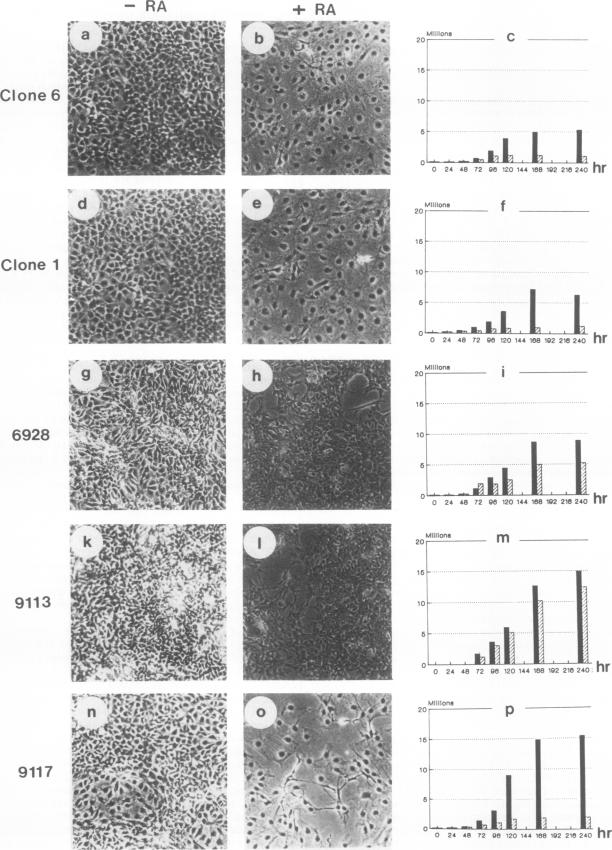
We used a series of cell clones from a human teratocarcinoma cell line, PA-1, to study the effect of transformation by an activated N-ras oncogene on the expression of genes involved in retinoic acid (RA)-induced differentiation and growth regulation. Recently, it has been shown that expression of human HOX 2 genes is sequentially activated by RA beginning from Hox 2.9 at the 3' end of the HOX 2 cluster (A. Simeone, D. Acampora, L. Arcioni, P. W. Andrews, E. Boncinelli, and F. Mavilio, Nature [London] 346:763-766, 1990). We now report that six different genes of the cluster HOX 1 are sequentially induced by RA in a similar temporal pattern, beginning with genes at the 3' end of the cluster. However, in N-ras-transformed cell clones, RA-induced expression of these homeobox genes is delayed. Hox 1.4 and Hox 1.3, genes abundantly induced in nontransformed clones after 3 days of RA treatment, are expressed in N-ras-transformed cells only after 10 days of RA treatment. At this time, the cells' growth is arrested at very high density, and no differentiated morphologic characteristics are observed. Constitutive expression of a transfected Hox 1.4 gene under the control of a simian virus 40 promotor leads to differentiated cell morphology similar to that of the RA-induced phenotype and restores the growth-inhibitory effects of RA in N-ras-transformed cells. These observations provide evidence that enhanced proliferation in N-ras-transformed cells compromises teratocarcinoma cell differentiation by a mechanism that transiently suppresses homeobox gene induction and implies a central role for homeobox genes in RA-induced cell differentiation. We conclude that stimulation of a putative growth factor signal pathway, associated with ras-induced proliferation, transiently suppresses the induction of transcription factors functionally involved in cell growth and differentiation.
我们使用了来自人畸胎瘤细胞系PA-1的一系列细胞克隆,来研究激活的N-ras癌基因转化对参与视黄酸(RA)诱导分化和生长调节的基因表达的影响。最近的研究表明,人HOX 2基因的表达从HOX 2基因簇3'端的Hox 2.9开始,被RA依次激活(A. Simeone、D. Acampora、L. Arcioni、P. W. Andrews、E. Boncinelli和F. Mavilio,《自然》[伦敦]346:763 - 766,1990)。我们现在报告,HOX 1基因簇的六个不同基因以类似的时间模式被RA依次诱导,从基因簇3'端的基因开始。然而,在N-ras转化的细胞克隆中,RA诱导的这些同源框基因的表达被延迟。Hox 1.4和Hox 1.3基因,在未转化的克隆中经RA处理3天后大量诱导表达,在N-ras转化的细胞中仅在RA处理10天后才表达。此时,细胞生长在非常高的密度下停滞,并且未观察到分化的形态特征。在猿猴病毒40启动子控制下转染的Hox 1.4基因的组成型表达导致了类似于RA诱导表型的分化细胞形态,并恢复了RA在N-ras转化细胞中的生长抑制作用。这些观察结果提供了证据,表明N-ras转化细胞中增殖的增强通过一种暂时抑制同源框基因诱导的机制损害了畸胎瘤细胞的分化,并暗示同源框基因在RA诱导的细胞分化中起核心作用。我们得出结论,与ras诱导的增殖相关的假定生长因子信号通路的激活,暂时抑制了在功能上参与细胞生长和分化的转录因子的诱导。