Kang Jin Oh, Kim Sang Ki, Hong Seong Eon, Lee Taeck Hyun, Kim Chang Ju
Department of Radiation Oncology, School of Medicine, Kyung Hee University, Seoul, Korea.
J Korean Med Sci. 2006 Jun;21(3):500-5. doi: 10.3346/jkms.2006.21.3.500.
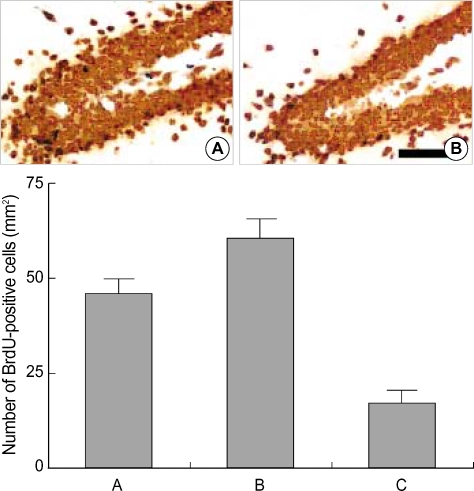
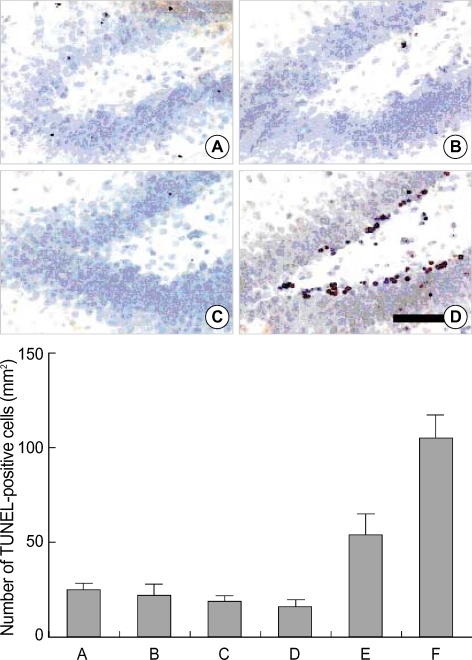
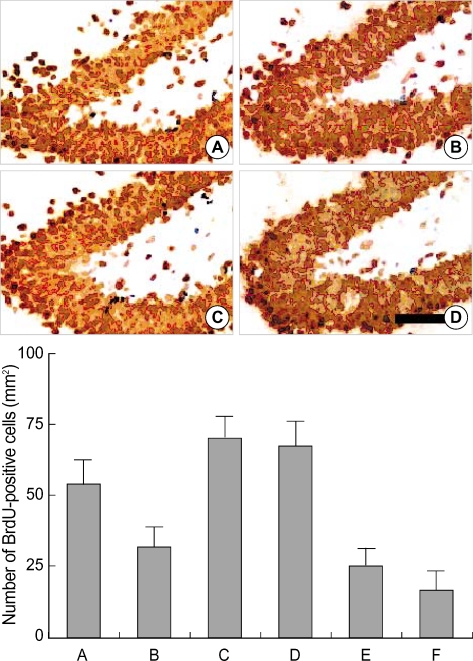
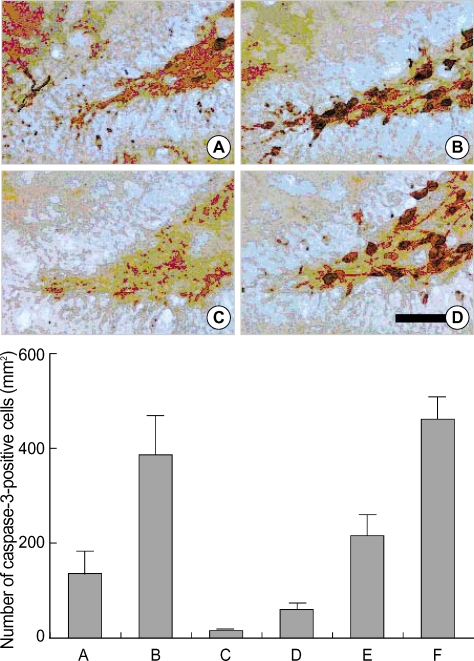
We investigated the effect of low dose radiation on diabetes induced suppression of neurogenesis in the hippocampal dentate gyrus of rat. After 0.01 Gy, 0.1 Gy, 1 Gy and 10 Gy radiation was delivered, the dentate gyrus of hippocampus of streptozotocin (STZ)-induced diabetic rats were evaluated using immunohistochemistry for 5-bromo-2-deoxyuridine (BrdU), caspase-3, and terminal deoxynucleotidyl transferase-mediated nick end-labeling (TUNEL) staining. The number of BrdU positive cells in the non-diabetic rats, diabetic rats without radiation, diabetic rats with 0.01 Gy radiation, diabetic rats with 0.1 Gy radiation, diabetic rats with 1 Gy radiation and diabetic rats with 10 Gy radiation were 55.4+/-8.5/mm2, 33.3+/-6.4/mm2, 67.7+/-10.5/mm2, 66.6+/-10.0/mm2, 23.5+/-6.3/mm2 and 14.3+/-7.2/mm2, respectively. The number of caspase-3 positive cells was 132.6+/-37.4/mm2, 378.6+/-99.1/mm2, 15.0+/-2.8/mm2, 57.1+/-16.9/mm2, 191.8+/-44.8/mm2 and 450.4+/-58.3/mm2, respectively. The number of TUNEL-positive cells was 24.5+/-2.0/mm2, 21.7+/-4.0/mm2, 20.4+/-2.0/mm2, 18.96+/-2.1/mm2, 58.3+/-7.9/mm2, and 106.0+/-9.8/mm2, respectively. These results suggest low doses of radiation paradoxically improved diabetes induced neuronal cell suppression in the hippocampal dentate gyrus of rat.
我们研究了低剂量辐射对链脲佐菌素(STZ)诱导的糖尿病大鼠海马齿状回神经发生抑制的影响。给予0.01 Gy、0.1 Gy、1 Gy和10 Gy辐射后,采用免疫组织化学法对5-溴-2-脱氧尿苷(BrdU)、半胱天冬酶-3和末端脱氧核苷酸转移酶介导的缺口末端标记(TUNEL)染色,评估STZ诱导的糖尿病大鼠海马齿状回情况。非糖尿病大鼠、未接受辐射的糖尿病大鼠、接受0.01 Gy辐射的糖尿病大鼠、接受0.1 Gy辐射的糖尿病大鼠、接受1 Gy辐射的糖尿病大鼠和接受10 Gy辐射的糖尿病大鼠中,BrdU阳性细胞数分别为55.4±8.5/mm²、33.3±6.4/mm²、67.7±10.5/mm²、66.6±10.0/mm²、23.5±6.3/mm²和14.3±7.2/mm²。半胱天冬酶-3阳性细胞数分别为132.6±37.4/mm²、378.6±99.1/mm²、15.0±2.8/mm²、57.1±16.9/mm²、191.8±44.8/mm²和450.4±58.3/mm²。TUNEL阳性细胞数分别为24.5±2.0/mm²、21.7±4.0/mm²、20.4±2.0/mm²、18.96±2.1/mm²、58.3±7.9/mm²和106.0±9.8/mm²。这些结果表明,低剂量辐射反而改善了糖尿病诱导的大鼠海马齿状回神经元细胞抑制。