Ramcharan Joseph, Colleluori Diana M, Merkel George, Andrake Mark D, Skalka Anna Marie
The Institute for Cancer Research, Fox Chase Cancer Center, 333 Cottman Avenue, Philadelphia, PA 19111, USA.
Retrovirology. 2006 Jun 21;3:34. doi: 10.1186/1742-4690-3-34.
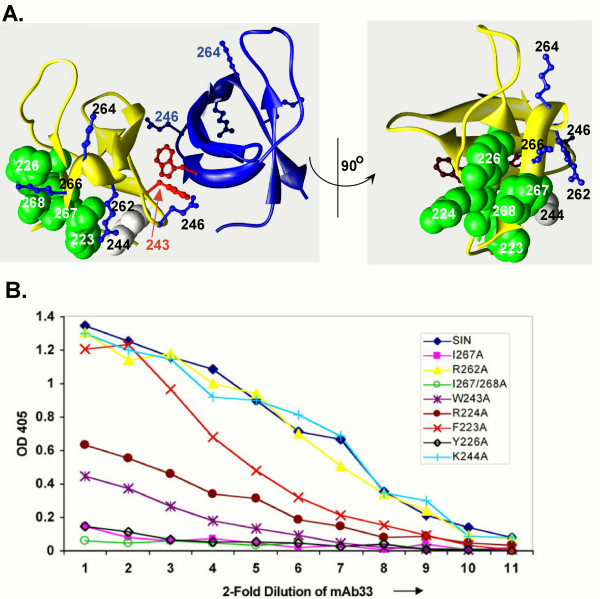
To further our understanding of the structure and function of HIV-1 integrase (IN) we developed and characterized a library of monoclonal antibodies (mAbs) directed against this protein. One of these antibodies, mAb33, which is specific for the C-terminal domain, was found to inhibit HIV-1 IN processing activity in vitro; a corresponding Fv fragment was able to inhibit HIV-1 integration in vivo. Our subsequent studies, using heteronuclear nuclear magnetic resonance spectroscopy, identified six solvent accessible residues on the surface of the C-terminal domain that were immobilized upon binding of the antibody, which were proposed to comprise the epitope. Here we test this hypothesis by measuring the affinity of mAb33 to HIV-1 proteins that contain Ala substitutions in each of these positions. To gain additional insight into the mode of inhibition we also measured the DNA binding capacity and enzymatic activities of the Ala substituted proteins.
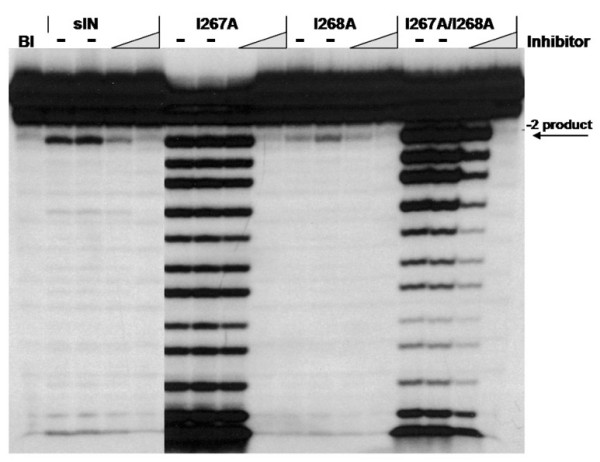
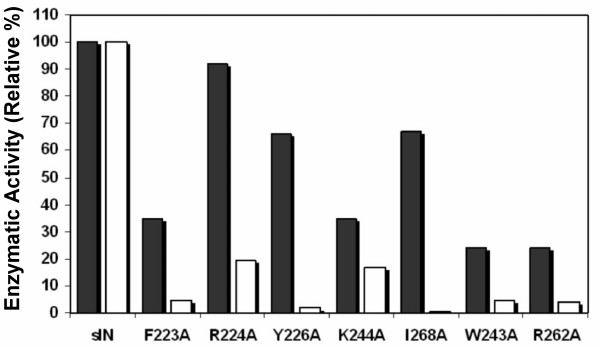
We found that Ala substitution of any one of five of the putative epitope residues, F223, R224, Y226, I267, and I268, caused a decrease in the affinity of the mAb33 for HIV-1 IN, confirming the prediction from NMR data. Although IN derivatives with Ala substitutions in or near the mAb33 epitope exhibited decreased enzymatic activity, none of the epitope substitutions compromised DNA binding to full length HIV-1 IN, as measured by surface plasmon resonance spectroscopy. Two of these derivatives, IN (I276A) and IN (I267A/I268A), exhibited both increased DNA binding affinity and uncharacteristic dissociation kinetics; these proteins also exhibited non-specific nuclease activity. Results from these investigations are discussed in the context of current models for how the C-terminal domain interacts with substrate DNA.
It is unlikely that inhibition of HIV-1 IN activity by mAb33 is caused by direct interaction with residues that are essential for substrate binding. Rather our findings are most consistent with a model whereby mAb33 binding distorts or constrains the structure of the C-terminal domain and/or blocks substrate binding indirectly. The DNA binding properties and non-specific nuclease activity of the I267A derivatives suggest that the C-terminal domain of IN normally plays an important role in aligning the viral DNA end for proper processing.
为了进一步了解HIV-1整合酶(IN)的结构和功能,我们开发并鉴定了一个针对该蛋白的单克隆抗体(mAb)文库。其中一种抗体mAb33对C末端结构域具有特异性,被发现可在体外抑制HIV-1 IN的加工活性;相应的Fv片段能够在体内抑制HIV-1整合。我们随后利用异核核磁共振光谱进行的研究,在C末端结构域表面鉴定出六个溶剂可及的残基,这些残基在抗体结合后被固定,推测它们构成了表位。在此,我们通过测量mAb33与在这些位置上含有丙氨酸替代的HIV-1蛋白的亲和力来检验这一假设。为了更深入了解抑制模式,我们还测量了丙氨酸替代蛋白的DNA结合能力和酶活性。
我们发现,五个假定表位残基F223、R224、Y226、I267和I268中的任何一个被丙氨酸替代,都会导致mAb33对HIV-1 IN的亲和力降低,这证实了核磁共振数据的预测。尽管在mAb33表位内或附近有丙氨酸替代的IN衍生物表现出酶活性降低,但通过表面等离子体共振光谱测量,没有一个表位替代会损害DNA与全长HIV-1 IN的结合。其中两种衍生物IN(I276A)和IN(I267A/I268A)表现出DNA结合亲和力增加和非典型的解离动力学;这些蛋白还表现出非特异性核酸酶活性。在当前关于C末端结构域如何与底物DNA相互作用的模型背景下讨论了这些研究结果。
mAb33对HIV-1 IN活性的抑制不太可能是由与底物结合所必需残基的直接相互作用引起的。相反,我们的发现最符合这样一种模型,即mAb33结合会扭曲或限制C末端结构域的结构和/或间接阻断底物结合。I267A衍生物的DNA结合特性和非特异性核酸酶活性表明,IN的C末端结构域通常在排列病毒DNA末端以进行适当加工方面发挥重要作用。