Checinska Agnieszka, Giaccone Giuseppe, Hoogeland Bas S J, Ferreira Carlos G, Rodriguez Jose A, Kruyt Frank A E
Department of Medical Oncology, VU University Medical Center, 1081 HV Amsterdam, The Netherlands.
BMC Cancer. 2006 Jun 23;6:166. doi: 10.1186/1471-2407-6-166.
Activation of caspase-9 in response to treatment with cytotoxic drugs is inhibited in NSCLC cells, which may contribute to the clinical resistance to chemotherapy shown in this type of tumor. The aim of the present study was to investigate the mechanism of caspase-9 inhibition, with a focus on a possible role of TUCAN as caspase-9 inhibitor and a determinant of chemosensitivity in NSCLC cells.
Caspase-9 processing and activation were investigated by Western blot and by measuring the cleavage of the fluorogenic substrate LEHD-AFC. Proteins interaction assays, and RNA interference in combination with cell viability and apoptosis assays were used to investigate the involvement of TUCAN in inhibition of caspase-9 and chemosensitivity NSCLC.
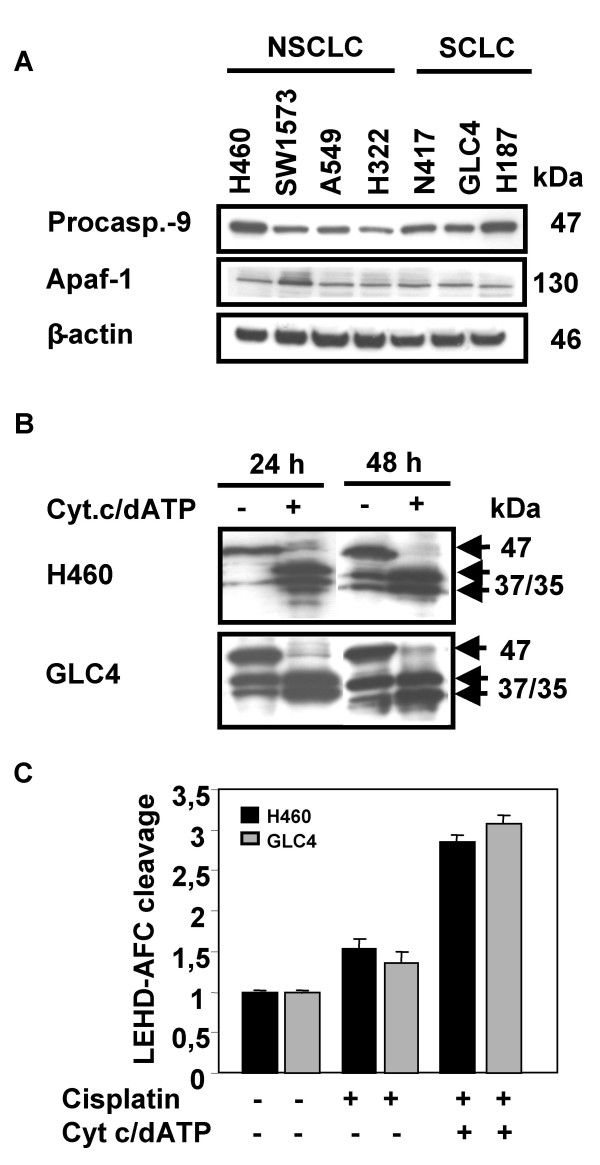
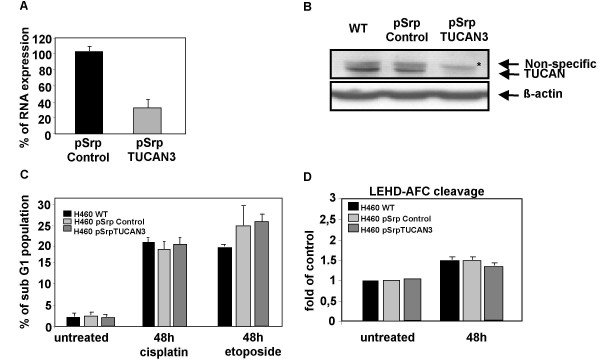
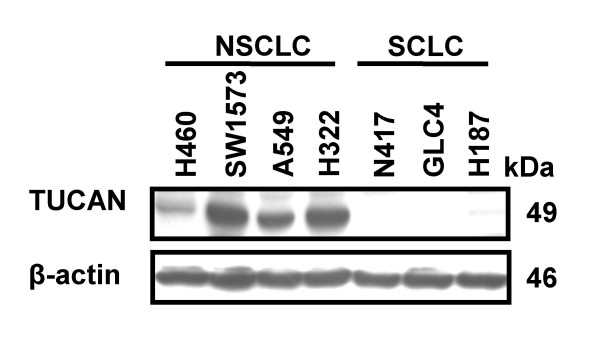
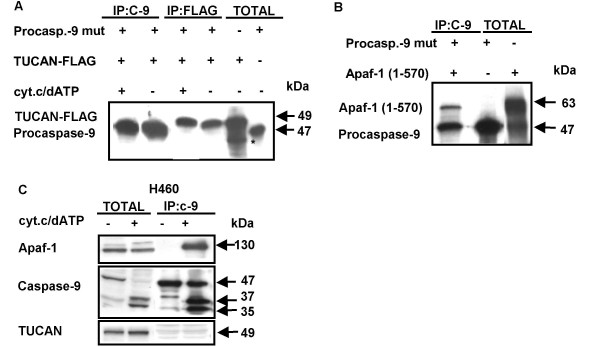
Analysis of the components of the caspase-9 activation pathway in a panel of NSCLC and SCLC cells revealed no intrinsic defects. In fact, exogenously added cytochrome c and dATP triggered procaspase-9 cleavage and activation in lung cancer cell lysates, suggesting the presence of an inhibitor. The reported inhibitor of caspase-9, TUCAN, was exclusively expressed in NSCLC cells. However, interactions between TUCAN and procaspase-9 could not be demonstrated by any of the assays used. Furthermore, RNA interference-mediated down-regulation of TUCAN did not restore cisplatin-induced caspase-9 activation or affect cisplatin sensitivity in NSCLC cells.
These results indicate that procaspase-9 is functional and can undergo activation and full processing in lung cancer cell extracts in the presence of additional cytochrome c/dATP. However, the inhibitory protein TUCAN does not play a role in inhibition of procaspase-9 and in determining the sensitivity to cisplatin in NSCLC.
在非小细胞肺癌(NSCLC)细胞中,细胞毒性药物治疗引发的半胱天冬酶 - 9(caspase - 9)激活受到抑制,这可能是导致这类肿瘤出现临床化疗耐药性的原因之一。本研究旨在探究caspase - 9抑制的机制,重点关注TUCAN作为caspase - 9抑制剂的可能作用以及其作为NSCLC细胞化疗敏感性决定因素的作用。
通过蛋白质免疫印迹法以及测量荧光底物LEHD - AFC的裂解来研究caspase - 9的加工和激活过程。采用蛋白质相互作用分析以及RNA干扰结合细胞活力和凋亡分析,来研究TUCAN在抑制caspase - 9和NSCLC化疗敏感性中的作用。
对一组NSCLC和小细胞肺癌(SCLC)细胞中caspase - 9激活途径的成分分析显示,不存在内在缺陷。事实上,外源添加的细胞色素c和dATP可引发肺癌细胞裂解液中procaspase - 9的裂解和激活,这表明存在一种抑制剂。已报道的caspase - 9抑制剂TUCAN仅在NSCLC细胞中表达。然而,所采用的任何分析方法均未证实TUCAN与procaspase - 9之间存在相互作用。此外,RNA干扰介导的TUCAN下调并未恢复顺铂诱导的caspase - 9激活,也未影响NSCLC细胞对顺铂的敏感性。
这些结果表明,在存在额外的细胞色素c/dATP的情况下,procaspase - 9在肺癌细胞提取物中具有功能,能够发生激活和完全加工。然而,抑制蛋白TUCAN在抑制procaspase - 9以及决定NSCLC对顺铂的敏感性方面不起作用。