Campanacci Valérie, Bishop Russell E, Blangy Stéphanie, Tegoni Mariella, Cambillau Christian
Architecture et Fonction des Macromolecules Biologiques, UMR 6098, CNRS-Universités Aix-Marseille I & II, Campus de Luminy, Case 932, 163 Avenue de Luminy, 13288 Marseille Cedex 09, France.
FEBS Lett. 2006 Sep 4;580(20):4877-83. doi: 10.1016/j.febslet.2006.07.086. Epub 2006 Aug 10.
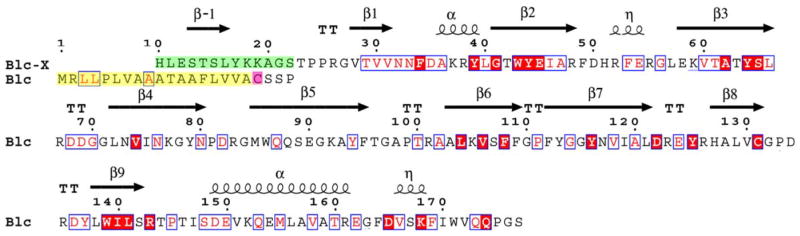
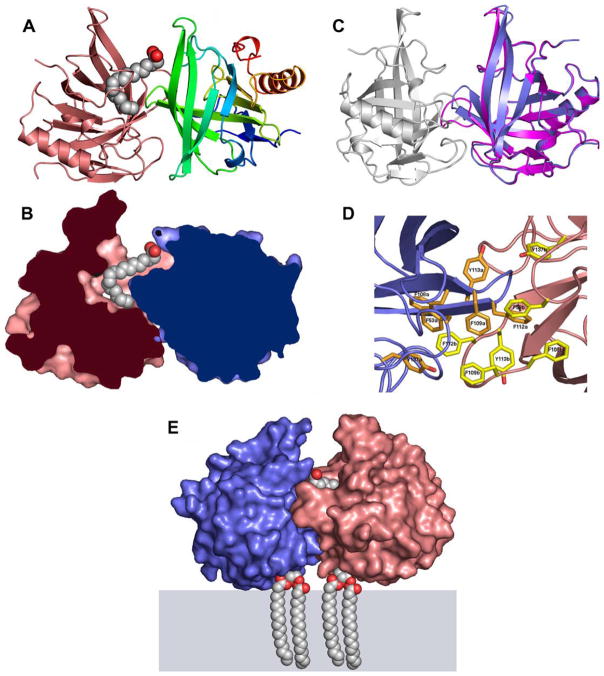
Lipocalins, a widespread multifunctional family of small proteins (15-25kDa) have been first described in eukaryotes and more recently in Gram-negative bacteria. Bacterial lipocalins belonging to class I are outer membrane lipoproteins, among which Blc from E. coli is the better studied. Blc is expressed under conditions of starvation and high osmolarity, conditions known to exert stress on the cell envelope. The structure of Blc that we have previously solved (V. Campanacci, D. Nurizzo, S. Spinelli, C. Valencia, M. Tegoni, C. Cambillau, FEBS Lett. 562 (2004) 183-188.) suggested its possible role in binding fatty acids or phospholipids. Both physiological and structural data on Blc, therefore, point to a role in storage or transport of lipids necessary for membrane maintenance. In order to further document this hypothesis for Blc function, we have performed binding studies using fluorescence quenching experiments. Our results indicate that dimeric Blc binds fatty acids and phospholipids in a micromolar K(d) range. The crystal structure of Blc with vaccenic acid, an unsaturated C18 fatty acid, reveals that the binding site spans across the Blc dimer, opposite to its membrane anchored face. An exposed unfilled pocket seemingly suited to bind a polar group attached to the fatty acid prompted us to investigate lyso-phospholipids, which were found to bind in a nanomolar K(d) range. We discuss these findings in terms of a potential role for Blc in the metabolism of lysophospholipids generated in the bacterial outer membrane.
脂质运载蛋白是一类广泛存在的多功能小蛋白家族(15 - 25千道尔顿),最初在真核生物中被描述,最近在革兰氏阴性细菌中也有发现。属于I类的细菌脂质运载蛋白是外膜脂蛋白,其中大肠杆菌的Blc研究得较为深入。Blc在饥饿和高渗透压条件下表达,已知这些条件会对细胞膜造成压力。我们之前解析的Blc结构(V. Campanacci、D. Nurizzo、S. Spinelli、C. Valencia、M. Tegoni、C. Cambillau,《欧洲生物化学学会联合会快报》562 (2004) 183 - 188)表明其可能在结合脂肪酸或磷脂方面发挥作用。因此,关于Blc的生理和结构数据均指向其在储存或运输维持细胞膜所需脂质方面的作用。为了进一步证实关于Blc功能的这一假设,我们利用荧光猝灭实验进行了结合研究。我们的结果表明,二聚体Blc以微摩尔级的解离常数(K(d))范围结合脂肪酸和磷脂。Blc与一种不饱和C18脂肪酸——vaccenic酸的晶体结构显示,结合位点横跨Blc二聚体,与其膜锚定面相对。一个看似适合结合附着在脂肪酸上的极性基团的暴露空穴促使我们研究溶血磷脂,结果发现它们以纳摩尔级的K(d)范围结合。我们根据Blc在细菌外膜中产生的溶血磷脂代谢中的潜在作用来讨论这些发现。