Schaefer Ulrich, Machida Takuji, Vorlova Sandra, Strickland Sidney, Levi Roberto
Department of Pharmacology, Weill Medical College of Cornell University, New York, NY 10021, USA.
J Exp Med. 2006 Sep 4;203(9):2191-200. doi: 10.1084/jem.20060077. Epub 2006 Aug 28.
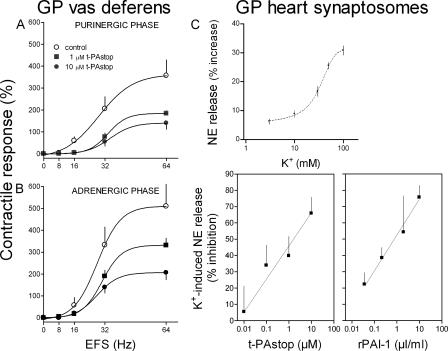
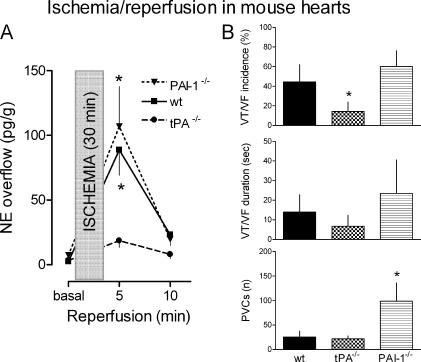
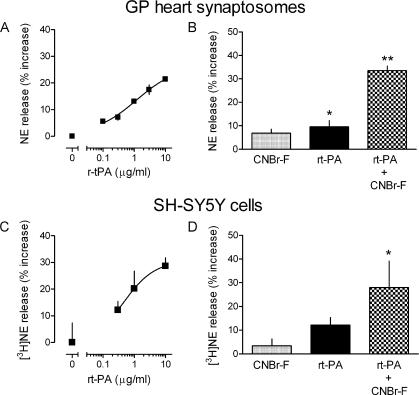
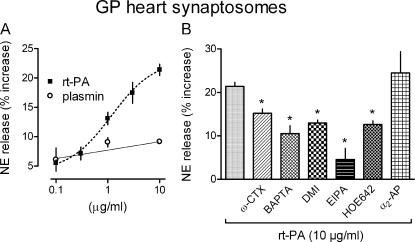
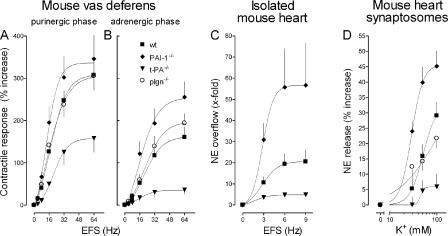
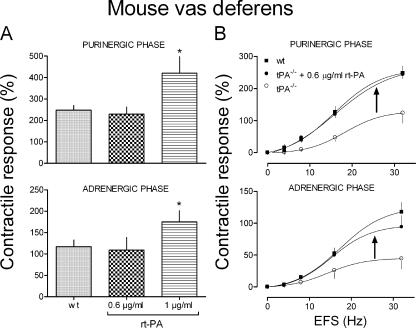
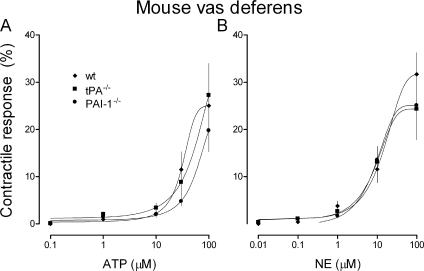
Sympathetic neurons synthesize and release tissue plasminogen activator (t-PA). We investigated whether t-PA modulates sympathetic activity. t-PA inhibition markedly reduced contraction of the guinea pig vas deferens to electrical field stimulation (EFS) and norepinephrine (NE) exocytosis from cardiac synaptosomes. Recombinant t-PA (rt-PA) induced exocytotic and carrier-mediated NE release from cardiac synaptosomes and cultured neuroblastoma cells; this was a plasmin-independent effect but was potentiated by a fibrinogen cleavage product. Notably, hearts from t-PA-null mice released much less NE upon EFS than their wild-type (WT) controls (i.e., a 76.5% decrease; P<0.01), whereas hearts from plasminogen activator inhibitor-1 (PAI-1)-null mice released much more NE (i.e., a 275% increase; P<0.05). Furthermore, vasa deferentia from t-PA-null mice were hyporesponsive to EFS (P<0.0001) but were normalized by the addition of rt-PA. In contrast, vasa from PAI-1-null mice were much more responsive (P<0.05). Coronary NE overflow from hearts subjected to ischemia/reperfusion was much smaller in t-PA-null than in WT control mice (P<0.01). Furthermore, reperfusion arrhythmias were significantly reduced (P<0.05) in t-PA-null hearts. Thus, t-PA enhances NE release from sympathetic nerves and contributes to cardiac arrhythmias in ischemia/reperfusion. Because the risk of arrhythmias and sudden cardiac death is increased in hyperadrenergic conditions, targeting the NE-releasing effect of t-PA may have valuable therapeutic potential.
交感神经元合成并释放组织型纤溶酶原激活物(t-PA)。我们研究了t-PA是否调节交感神经活动。t-PA抑制显著降低了豚鼠输精管对电场刺激(EFS)的收缩以及心脏突触体中去甲肾上腺素(NE)的胞吐作用。重组t-PA(rt-PA)诱导心脏突触体和培养的神经母细胞瘤细胞发生胞吐作用和载体介导的NE释放;这是一种不依赖纤溶酶的效应,但被纤维蛋白原裂解产物增强。值得注意的是,与野生型(WT)对照相比,t-PA基因敲除小鼠心脏在EFS刺激下释放的NE要少得多(即减少76.5%;P<0.01),而纤溶酶原激活物抑制剂-1(PAI-1)基因敲除小鼠心脏释放的NE则多得多(即增加275%;P<0.05)。此外,t-PA基因敲除小鼠的输精管对EFS反应低下(P<0.0001),但添加rt-PA后恢复正常。相比之下,PAI-1基因敲除小鼠的输精管反应性更强(P<0.05)。与WT对照小鼠相比,t-PA基因敲除小鼠心脏在缺血/再灌注时冠状动脉NE溢出量要小得多(P<0.01)。此外,t-PA基因敲除小鼠心脏的再灌注心律失常明显减少(P<0.05)。因此,t-PA增强交感神经释放NE,并在缺血/再灌注时导致心律失常。由于在高肾上腺素能状态下心律失常和心源性猝死的风险增加,针对t-PA释放NE的作用可能具有重要的治疗潜力。