Momcilović Berislav, Lykken Glenn I, Cooley Marvin
Institute for Medical Research and Occupational Health, PO Box 291, 10001 Zagreb, Croatia.
Mol Neurodegener. 2006 Sep 11;1:11. doi: 10.1186/1750-1326-1-11.
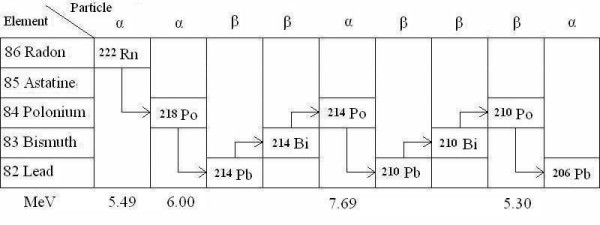
Radon is a ubiquitous noble gas in the environment and a primary source of harmful radiation exposure for humans; it decays in a cascade of daughters (RAD) by releasing the cell damaging high energy alpha particles.
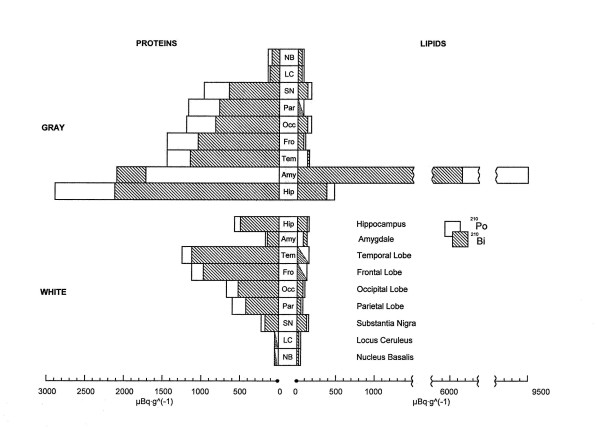
We studied natural distribution of RAD 210Po and 210Bi in the different parts of the postmortem brain of 86-year-old woman who had suffered from Alzheimer's disease (AD). A distinct brain map emerged, since RAD distribution was different among the analyzed brain areas. The highest RAD irradiation (mSv x year(-1)) occurred in the decreasing order of magnitude: amygdala (Amy) >> hippocampus (Hip) > temporal lobe (Tem) approximately = frontal lobe (Fro) > occipital lobe (Occ) approximately = parietal lobe (Par) > substantia nigra (SN) >> locus ceruleus (LC) approximately = nucleus basalis (NB); generally more RAD accumulated in the proteins than lipids of gray and white (gray > white) brain matter. Amy and Hip are particularly vulnerable brain structure targets to significant RAD internal radiation damage in AD (5.98 and 1.82 mSv x year(-1), respectively). Next, naturally occurring RAD radiation for Tem and Fro, then Occ and Par, and SN was an order of magnitude higher than that in LC and NB; the later was within RAD we observed previously in the healthy control brains.
Naturally occurring environmental RAD exposure may dramatically enhance AD deterioration by selectively targeting brain areas of emotions (Amy) and memory (Hip).