Martin D, Hamel J, Brodeur B R, Musser J M
Connaught Centre for Biotechnology Research, Toronto, Ontario, Canada.
J Clin Microbiol. 1990 Aug;28(8):1720-4. doi: 10.1128/jcm.28.8.1720-1724.1990.
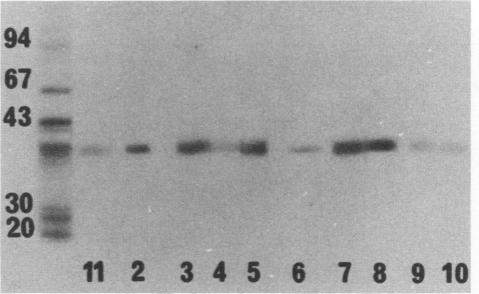
Monoclonal antibodies (Mabs) specific for Haemophilus influenzae were generated to identify antigenic determinants shared among encapsulated H. influenzae clones. Sixteen MAbs reacted by Western immunoblot with a protein of an approximate molecular size of 40 kilodaltons corresponding to the P2 major outer membrane protein (porin). These MAbs also reacted with purified and recombinant H. influenzae porin. Fourteen of the MAbs recognized cell surface-exposed epitopes, and two of the MAbs, P2-16 and P2-17, identified epitopes that are not present or are not accessible on the cell surface. The reactivity spectrum of the MAb panel was studied by dot immunoassay against 32 serologically nontypeable and 119 encapsulated H. influenzae strains recovered worldwide, representing the major serotype a, b, and d clone families. MAbs P2-4 and P2-6 recognized only serotype b clones assigned to primary phylogenetic division I. These clones account for more than 99% of all invasive episodes worldwide. MAbs P2-3, P2-8, and P2-11 reacted with division I serotype b isolates and also identified all genetically allied strains expressing serotype a and d polysaccharide capsules. In contrast, none of the 16 MAbs reacted with genetically divergent serotype a or b clones assigned to primary phylogenetic division II. These results demonstrate that, in general, the patterns of P2 protein surface epitope exposure are cognate with genetic lineages of encapsulated H. influenzae strains and support the hypothesis that the population structure of encapsulated H. influenzae is predominantly clonal.
制备了针对流感嗜血杆菌的单克隆抗体(Mab),以鉴定包膜化流感嗜血杆菌克隆之间共有的抗原决定簇。16种单克隆抗体通过蛋白质免疫印迹法与一种分子量约为40千道尔顿的蛋白质发生反应,该蛋白质对应于P2主要外膜蛋白(孔蛋白)。这些单克隆抗体也与纯化的和重组的流感嗜血杆菌孔蛋白发生反应。其中14种单克隆抗体识别细胞表面暴露的表位,另外两种单克隆抗体P2-16和P2-17鉴定出细胞表面不存在或无法接近的表位。通过斑点免疫测定法研究了该单克隆抗体组对全球范围内回收的32株血清学不可分型和119株包膜化流感嗜血杆菌菌株的反应谱,这些菌株代表了主要的血清型a、b和d克隆家族。单克隆抗体P2-4和P2-6仅识别属于主要系统发育分支I的b型血清型克隆。这些克隆占全球所有侵袭性病例的99%以上。单克隆抗体P2-3、P2-8和P2-11与分支I的b型血清型分离株发生反应,并且还鉴定出所有表达a型和d型多糖荚膜的遗传相关菌株。相比之下,16种单克隆抗体中没有一种与属于主要系统发育分支II的遗传差异较大的a型或b型克隆发生反应。这些结果表明,一般来说,P2蛋白表面表位暴露模式与包膜化流感嗜血杆菌菌株的遗传谱系相关,并支持包膜化流感嗜血杆菌的群体结构主要为克隆性的假说。