Hepler J R, Jeffs R A, Huckle W R, Outlaw H E, Rhee S G, Earp H S, Harden T K
Department of Pharmacology, School of Medicine, University of North Carolina, Chapel Hill 27599.
Biochem J. 1990 Sep 1;270(2):337-44. doi: 10.1042/bj2700337.
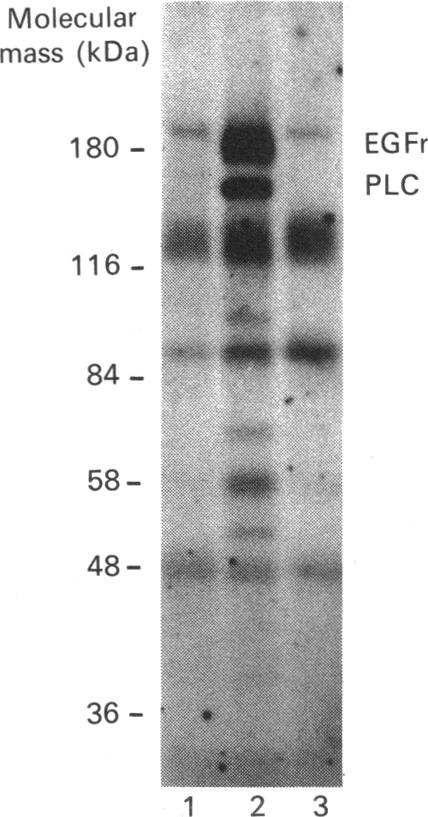
We have shown previously that exposure of a non-transformed continuous line of rat liver epithelial (WB) cells to epidermal growth factor (EGF), adrenaline, angiotensin II or [Arg8]vasopressin results in an accumulation of the inositol phosphates InsP1, InsP2 and InsP3 [Hepler, Earp & Harden (1988) J. Biol. Chem. 263, 7610-7619]. Studies were carried out with WB cells to determine whether the EGF receptor and other, non-tyrosine kinase, hormone receptors stimulate phosphoinositide hydrolysis by common, overlapping or separate pathways. The time courses for accumulation of inositol phosphates in response to angiotensin II and EGF were markedly different. Whereas angiotensin II stimulated a very rapid accumulation of inositol phosphates (maximal by 30 s), increases in the levels of inositol phosphates in response to EGF were measurable only following a 30 s lag period; maximal levels were attained by 7-8 min. Chelation of extracellular Ca2+ with EGTA did not modify this relative difference between angiotensin II and EGF in the time required to attain maximal phospholipase C activation. Under experimental conditions in which agonist-induced desensitization no longer occurred in these cells, the inositol phosphate responses to EGF and angiotensin II were additive, whereas those to angiotensin II and [Arg8]vasopressin were not additive. In crude WB lysates, angiotensin II, [Arg8]vasopressin and adrenaline each stimulated inositol phosphate formation in a guanine-nucleotide-dependent manner. In contrast, EGF failed to stimulate inositol phosphate formation in WB lysates in the presence or absence of guanosine 5'-[gamma-thio]triphosphate (GTP[S]), even though EGF retained the capacity to bind to and stimulate tyrosine phosphorylation of its own receptor. Pertussis toxin, at concentrations that fully ADP-ribosylate and functionally inactivate the inhibitory guanine-nucleotide regulatory protein of adenylate cyclase (Gi), had no effect on the capacity of EGF or hormones to stimulate inositol phosphate accumulation. In intact WB cells, the capacity of EGF, but not angiotensin II, to stimulate inositol phosphate accumulation was correlated with its capacity to stimulate tyrosine phosphorylation of the 148 kDa isoenzyme of phospholipase C. Taken together, these findings suggest that, whereas angiotensin II, [Arg8]vasopressin and alpha 1-adrenergic receptors are linked to activation of one or more phospholipase(s) C by an unidentified G-protein(s), the EGF receptor stimulates phosphoinositide hydrolysis by a different pathway, perhaps as a result of its capacity to stimulate tyrosine phosphorylation of phospholipase C-gamma.
我们先前已经表明,将未转化的大鼠肝上皮(WB)细胞连续系暴露于表皮生长因子(EGF)、肾上腺素、血管紧张素II或[Arg8]加压素会导致肌醇磷酸InsP1、InsP2和InsP3的积累[赫普勒、厄普 & 哈登(1988年)《生物化学杂志》263,7610 - 7619]。对WB细胞进行了研究,以确定EGF受体和其他非酪氨酸激酶激素受体是否通过共同、重叠或不同的途径刺激磷酸肌醇水解。血管紧张素II和EGF刺激后肌醇磷酸积累的时间进程明显不同。血管紧张素II刺激肌醇磷酸迅速积累(30秒时达到最大值),而EGF刺激后肌醇磷酸水平的升高仅在30秒的延迟期后才可检测到;7 - 8分钟时达到最高水平。用乙二醇双四乙酸(EGTA)螯合细胞外Ca2+并没有改变血管紧张素II和EGF在达到最大磷脂酶C激活所需时间上的这种相对差异。在这些细胞中不再发生激动剂诱导的脱敏的实验条件下,对EGF和血管紧张素II的肌醇磷酸反应是相加的,而对血管紧张素II和[Arg8]加压素的反应不是相加的。在粗制的WB裂解物中,血管紧张素II、[Arg8]加压素和肾上腺素各自以鸟嘌呤核苷酸依赖性方式刺激肌醇磷酸的形成。相比之下,无论有无鸟苷5'-[γ-硫代]三磷酸(GTP[S]),EGF都不能刺激WB裂解物中肌醇磷酸的形成,尽管EGF仍保留结合并刺激其自身受体酪氨酸磷酸化的能力。百日咳毒素在完全ADP-核糖基化并功能性灭活腺苷酸环化酶的抑制性鸟嘌呤核苷酸调节蛋白(Gi)的浓度下,对EGF或激素刺激肌醇磷酸积累的能力没有影响。在完整的WB细胞中,EGF刺激肌醇磷酸积累的能力与其刺激磷脂酶C 148 kDa同工酶酪氨酸磷酸化的能力相关,而血管紧张素II则不然。综上所述,这些发现表明,血管紧张素II、[Arg8]加压素和α1-肾上腺素能受体通过一种未确定的G蛋白与一种或多种磷脂酶C的激活相联系,而EGF受体则通过不同的途径刺激磷酸肌醇水解,这可能是由于其刺激磷脂酶C-γ酪氨酸磷酸化的能力所致。