Agostini Maura, Schoenmakers Erik, Mitchell Catherine, Szatmari Istvan, Savage David, Smith Aaron, Rajanayagam Odelia, Semple Robert, Luan Jian'an, Bath Louise, Zalin Anthony, Labib Mourad, Kumar Sudhesh, Simpson Helen, Blom Dirk, Marais David, Schwabe John, Barroso Inês, Trembath Richard, Wareham Nicholas, Nagy Laszlo, Gurnell Mark, O'Rahilly Stephen, Chatterjee Krishna
Department of Medicine, University of Cambridge, United Kingdom.
Cell Metab. 2006 Oct;4(4):303-11. doi: 10.1016/j.cmet.2006.09.003.
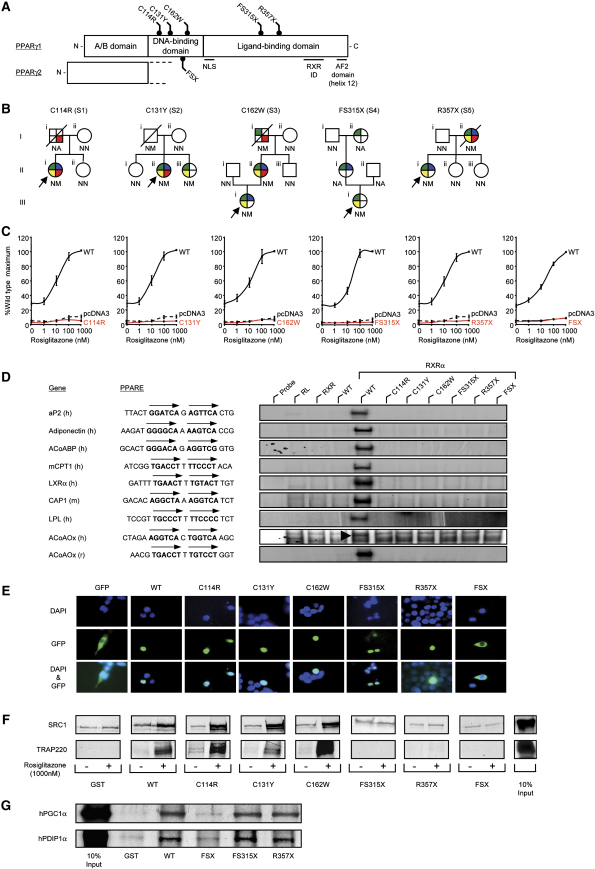
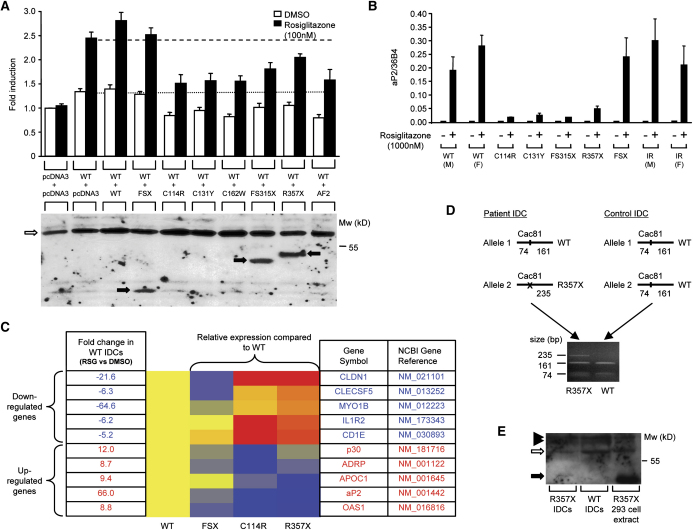
PPARgamma is essential for adipogenesis and metabolic homeostasis. We describe mutations in the DNA and ligand binding domains of human PPARgamma in lipodystrophic, severe insulin resistance. These receptor mutants lack DNA binding and transcriptional activity but can translocate to the nucleus, interact with PPARgamma coactivators and inhibit coexpressed wild-type receptor. Expression of PPARgamma target genes is markedly attenuated in mutation-containing versus receptor haploinsufficent primary cells, indicating that such dominant-negative inhibition operates in vivo. Our observations suggest that these mutants restrict wild-type PPARgamma action via a non-DNA binding, transcriptional interference mechanism, which may involve sequestration of functionally limiting coactivators.
过氧化物酶体增殖物激活受体γ(PPARγ)对于脂肪生成和代谢稳态至关重要。我们描述了在脂肪营养不良、严重胰岛素抵抗患者中人类PPARγ的DNA和配体结合域的突变。这些受体突变体缺乏DNA结合和转录活性,但能转运至细胞核,与PPARγ共激活因子相互作用并抑制共表达的野生型受体。与受体单倍体不足的原代细胞相比,含突变的原代细胞中PPARγ靶基因的表达明显减弱,表明这种显性负性抑制在体内起作用。我们的观察结果表明,这些突变体通过一种非DNA结合的转录干扰机制限制野生型PPARγ的作用,这可能涉及对功能上有限的共激活因子的隔离。