Panyi Gyorgy, Deutsch Carol
Department of Biophysics and Cell Biology, University of Debrecen, 4032 Debrecen, Hungary.
J Gen Physiol. 2006 Nov;128(5):547-59. doi: 10.1085/jgp.200609644. Epub 2006 Oct 16.
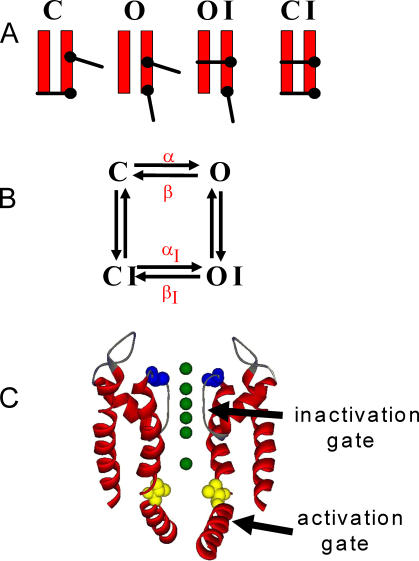
This study addresses the energetic coupling between the activation and slow inactivation gates of Shaker potassium channels. To track the status of the activation gate in inactivated channels that are nonconducting, we used two functional assays: the accessibility of a cysteine residue engineered into the protein lining the pore cavity (V474C) and the liberation by depolarization of a Cs(+) ion trapped behind the closed activation gate. We determined that the rate of activation gate movement depends on the state of the inactivation gate. A closed inactivation gate favors faster opening and slower closing of the activation gate. We also show that hyperpolarization closes the activation gate long before a channel recovers from inactivation. Because activation and slow inactivation are ubiquitous gating processes in potassium channels, the cross talk between them is likely to be a fundamental factor in controlling ion flux across membranes.
本研究探讨了Shaker钾通道激活门与慢失活门之间的能量耦合。为了追踪处于非传导性失活通道中激活门的状态,我们采用了两种功能检测方法:一是对工程改造到孔腔内衬蛋白中的半胱氨酸残基(V474C)的可及性检测,二是通过去极化使被困在关闭的激活门后的Cs(+)离子释放的检测。我们确定激活门的移动速率取决于失活门的状态。关闭的失活门有利于激活门更快地打开和更慢地关闭。我们还表明,在通道从失活状态恢复之前,超极化就会使激活门关闭。由于激活和慢失活是钾通道中普遍存在的门控过程,它们之间的相互作用可能是控制跨膜离子通量的一个基本因素。