Qi Junlin, Su Shihuang, McGuffin M Elaine, Mattox William
Department of Molecular Genetics, The University of Texas M. D. Anderson Cancer Center and Genes and Development Graduate Program, The University of Texas Graduate School of Biomedical Sciences, Houston, TX 77030-4009, USA.
Nucleic Acids Res. 2006;34(21):6256-63. doi: 10.1093/nar/gkl755. Epub 2006 Nov 10.
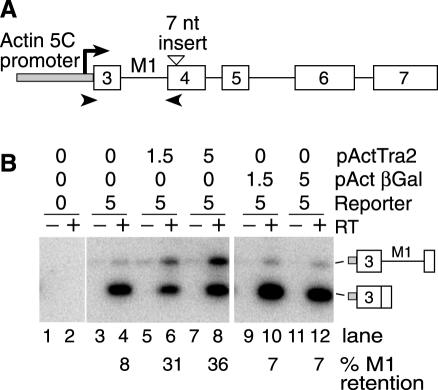
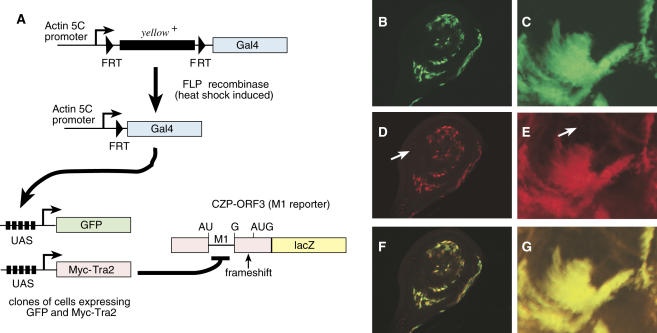
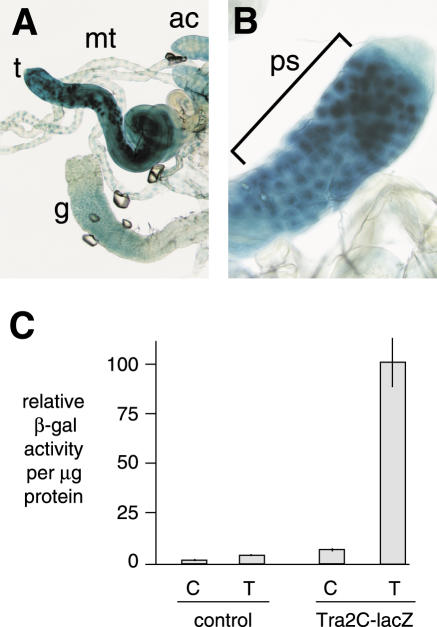
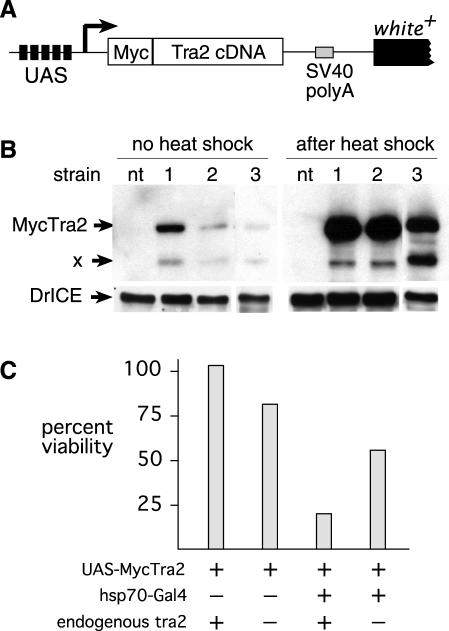
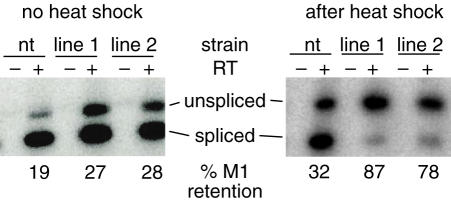
The splicing factor Transformer-2 (Tra2) is expressed almost ubiquitously in Drosophila adults, but participates in the tissue-specific regulation of splicing in several RNAs. In somatic tissues Tra2 participates in the activation of sex-specific splice sites in doublesex and fruitless pre-mRNAs. In the male germline it affects splicing of other transcripts and represses removal of the M1 intron from its own pre-mRNA. Here we test the hypothesis that the germline specificity of M1 repression is determined by tissue-specific differences in Tra2 concentration. We find that Tra2 is expressed at higher levels in primary spermatocytes of males than in other cell types. Increased Tra2 expression in other tissues reduces viability in a manner consistent with known dose-dependent effects of excessive Tra2 expression in the male germline. Somatic cells were found to be competent to repress M1 splicing if the level of Tra2 transcription was raised above endogenous concentrations. This suggests not only that M1 repression is restricted to the germline by a difference in Tra2 transcription levels but also that the protein's threshold concentration for M1 regulation differs from that of doublesex and fruitless RNAs. We propose that quantitative differences in regulator expression can give rise to cell-type-specific restrictions in splicing.
剪接因子Transformer-2(Tra2)在果蝇成虫中几乎普遍表达,但参与多种RNA剪接的组织特异性调控。在体细胞组织中,Tra2参与双性基因和无果基因前体mRNA中性别特异性剪接位点的激活。在雄性生殖系中,它影响其他转录本的剪接,并抑制自身前体mRNA中M1内含子的去除。在这里,我们检验了一个假设,即M1抑制的生殖系特异性是由Tra2浓度的组织特异性差异决定的。我们发现,Tra2在雄性初级精母细胞中的表达水平高于其他细胞类型。在其他组织中增加Tra2的表达会降低活力,这与雄性生殖系中Tra2过量表达的已知剂量依赖性效应一致。如果Tra2转录水平提高到内源性浓度以上,发现体细胞能够抑制M1剪接。这不仅表明M1抑制通过Tra2转录水平的差异局限于生殖系,而且表明该蛋白对M1调控的阈值浓度与双性基因和无果基因RNA的不同。我们提出,调节因子表达的定量差异可导致剪接中的细胞类型特异性限制。