Locke James C W, Kozma-Bognár László, Gould Peter D, Fehér Balázs, Kevei Eva, Nagy Ferenc, Turner Matthew S, Hall Anthony, Millar Andrew J
Department of Biological Sciences, University of Warwick, Coventry, UK.
Mol Syst Biol. 2006;2:59. doi: 10.1038/msb4100102. Epub 2006 Nov 14.
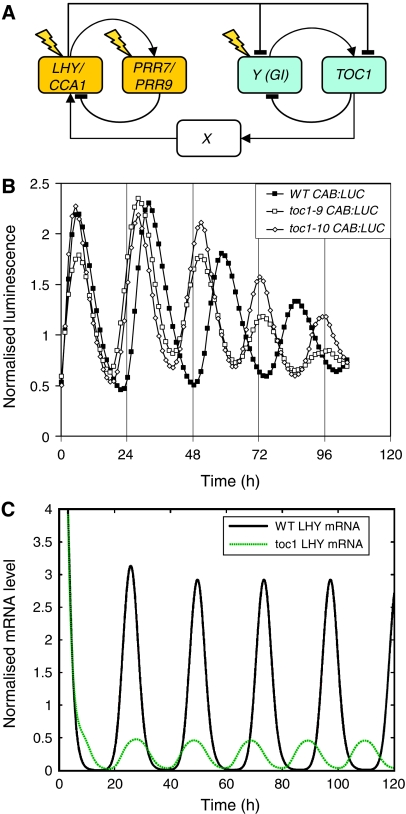
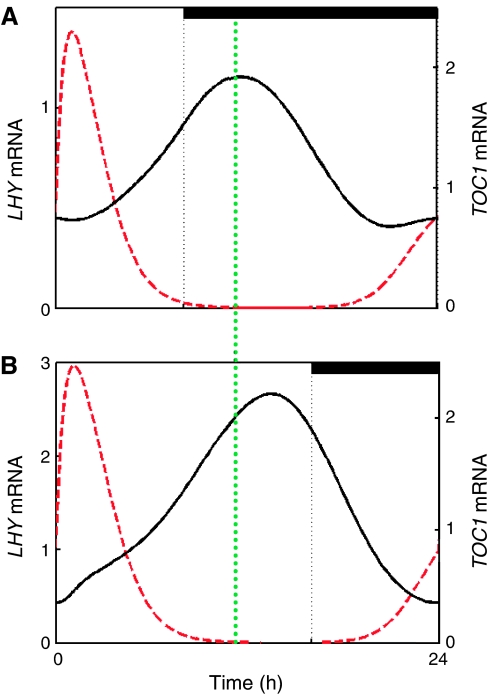
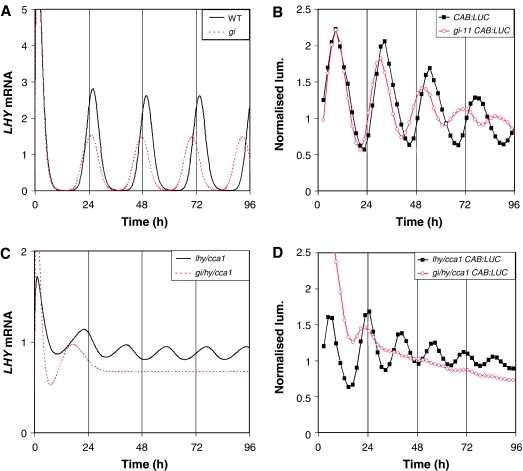
Our computational model of the circadian clock comprised the feedback loop between LATE ELONGATED HYPOCOTYL (LHY), CIRCADIAN CLOCK ASSOCIATED 1 (CCA1) and TIMING OF CAB EXPRESSION 1 (TOC1), and a predicted, interlocking feedback loop involving TOC1 and a hypothetical component Y. Experiments based on model predictions suggested GIGANTEA (GI) as a candidate for Y. We now extend the model to include a recently demonstrated feedback loop between the TOC1 homologues PSEUDO-RESPONSE REGULATOR 7 (PRR7), PRR9 and LHY and CCA1. This three-loop network explains the rhythmic phenotype of toc1 mutant alleles. Model predictions fit closely to new data on the gi;lhy;cca1 mutant, which confirm that GI is a major contributor to Y function. Analysis of the three-loop network suggests that the plant clock consists of morning and evening oscillators, coupled intracellularly, which may be analogous to coupled, morning and evening clock cells in Drosophila and the mouse.
我们的生物钟计算模型包括晚伸长下胚轴(LHY)、生物钟相关蛋白1(CCA1)和CAB表达时间1(TOC1)之间的反馈回路,以及一个涉及TOC1和假设成分Y的预测性连锁反馈回路。基于模型预测的实验表明,巨莲蛋白(GI)是Y的候选成分。我们现在扩展该模型,纳入最近证实的TOC1同源物伪响应调节因子7(PRR7)、PRR9与LHY和CCA1之间的反馈回路。这个三回路网络解释了toc1突变等位基因的节律表型。模型预测与gi;lhy;cca1突变体的新数据紧密吻合,证实GI是Y功能的主要贡献者。对三回路网络的分析表明,植物生物钟由在细胞内耦合的早晨和傍晚振荡器组成,这可能类似于果蝇和小鼠中耦合的早晨和傍晚时钟细胞。