Orend G, Kuhlmann I, Doerfler W
Institute of Genetics, University of Cologne, Germany.
J Virol. 1991 Aug;65(8):4301-8. doi: 10.1128/JVI.65.8.4301-4308.1991.
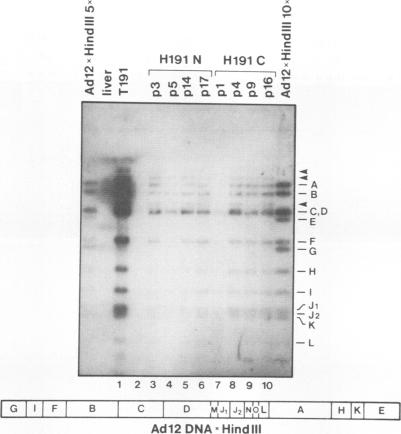
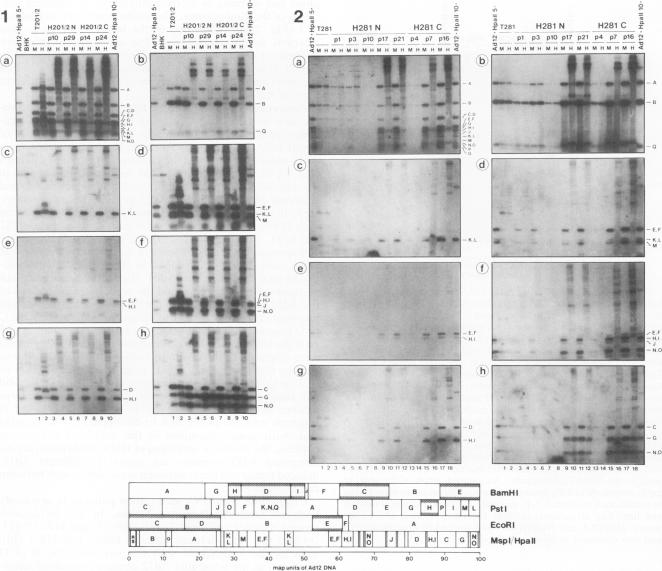
The establishment of de novo-generated patterns of DNA methylation is characterized by the gradual spreading of DNA methylation (I. Kuhlmann and W. Doerfler, J. Virol. 47:631-636, 1983; M. Toth, U. Lichtenberg, and W. Doerfler, Proc. Natl. Acad. Sci. USA 86:3728-3732, 1989; M. Toth, U. Müller, and W. Doerfler J. Mol. Biol. 214:673-683, 1990). We have used integrated adenovirus type 12 (Ad12) genomes in hamster tumor cells as a model system to study the mechanism of de novo DNA methylation. Ad12 induces tumors in neonate hamsters, and the viral DNA is integrated into the hamster genome, usually nearly intact and in an orientation that is colinear with that of the virion genome. The integrated Ad12 DNA in the tumor cells is weakly methylated at the 5'-CCGG-3' sequences. These sequences appear to be a reliable indicator for the state of methylation in mammalian DNA. Upon explantation of the tumor cells into culture medium, DNA methylation at 5'-CCGG-3' sequences gradually spreads across the integrated viral genomes with increasing passage numbers of cells in culture. Methylation is reproducibly initiated in the region between 30 and 75 map units on the integrated viral genome and progresses from there in either direction on the genome. Eventually, the genome is strongly methylated, except for the terminal 2 to 5% on either end, which remains hypomethylated. Similar observations have been made with tumor cell lines with different sites of Ad12 DNA integration. In contrast, the levels of DNA methylation do not seem to change after tumor cell explanation in several segments of hamster cell DNA of the unique or repetitive type. Restriction (HpaII) and Southern blot experiments were performed with selected cloned hamster cellular DNA probes. The data suggest that in the integrated foreign DNA, there exist nucleotide sequences or structures or chromatin arrangements that can be preferentially recognized by the system responsible for de novo DNA methylation in mammalian cells.
从头生成的DNA甲基化模式的建立具有DNA甲基化逐渐扩散的特征(I. 库尔曼和W. 多弗勒,《病毒学杂志》47:631 - 636,1983;M. 托特、U. 利希滕贝格和W. 多弗勒,《美国国家科学院院刊》86:3728 - 3732,1989;M. 托特、U. 米勒和W. 多弗勒,《分子生物学杂志》214:673 - 683,1990)。我们使用仓鼠肿瘤细胞中整合的12型腺病毒(Ad12)基因组作为模型系统来研究从头DNA甲基化的机制。Ad12可在新生仓鼠中诱发肿瘤,并且病毒DNA整合到仓鼠基因组中,通常几乎完整无缺,且其方向与病毒粒子基因组的方向共线。肿瘤细胞中整合的Ad12 DNA在5'-CCGG-3'序列处甲基化程度较弱。这些序列似乎是哺乳动物DNA甲基化状态的可靠指标。将肿瘤细胞接种到培养基中后,随着培养中细胞传代次数的增加,5'-CCGG-3'序列处的DNA甲基化会逐渐扩散至整个整合的病毒基因组。甲基化可重复性地起始于整合病毒基因组上30至75个图谱单位之间的区域,并从该区域在基因组上向两个方向推进。最终,除了两端各2%至5%的末端区域仍处于低甲基化状态外,基因组被强烈甲基化。在Ad12 DNA整合位点不同的肿瘤细胞系中也有类似的观察结果。相比之下,在仓鼠细胞独特型或重复型DNA的几个片段中,肿瘤细胞接种后DNA甲基化水平似乎没有变化。使用选定的克隆仓鼠细胞DNA探针进行了限制性(HpaII)和Southern印迹实验。数据表明,在整合的外源DNA中,存在可被负责哺乳动物细胞从头DNA甲基化的系统优先识别的核苷酸序列、结构或染色质排列。