Wa Chunling, Cerny Ron L, Hage David S
Department of Chemistry, University of Nebraska-Lincoln, Lincoln, NE 68588-0304, USA.
Anal Chem. 2006 Dec 1;78(23):7967-77. doi: 10.1021/ac0609935.
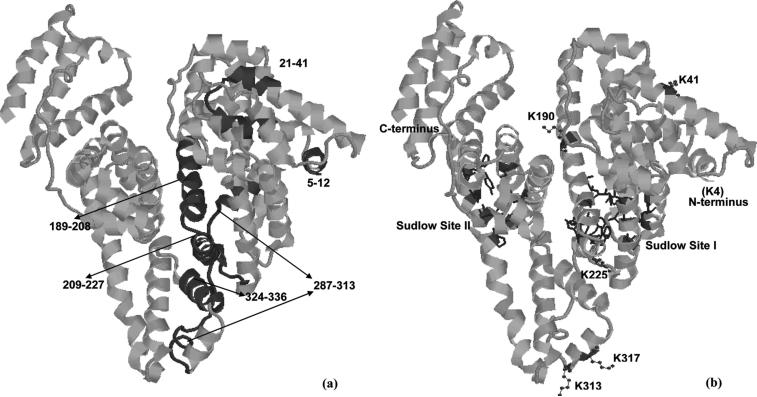
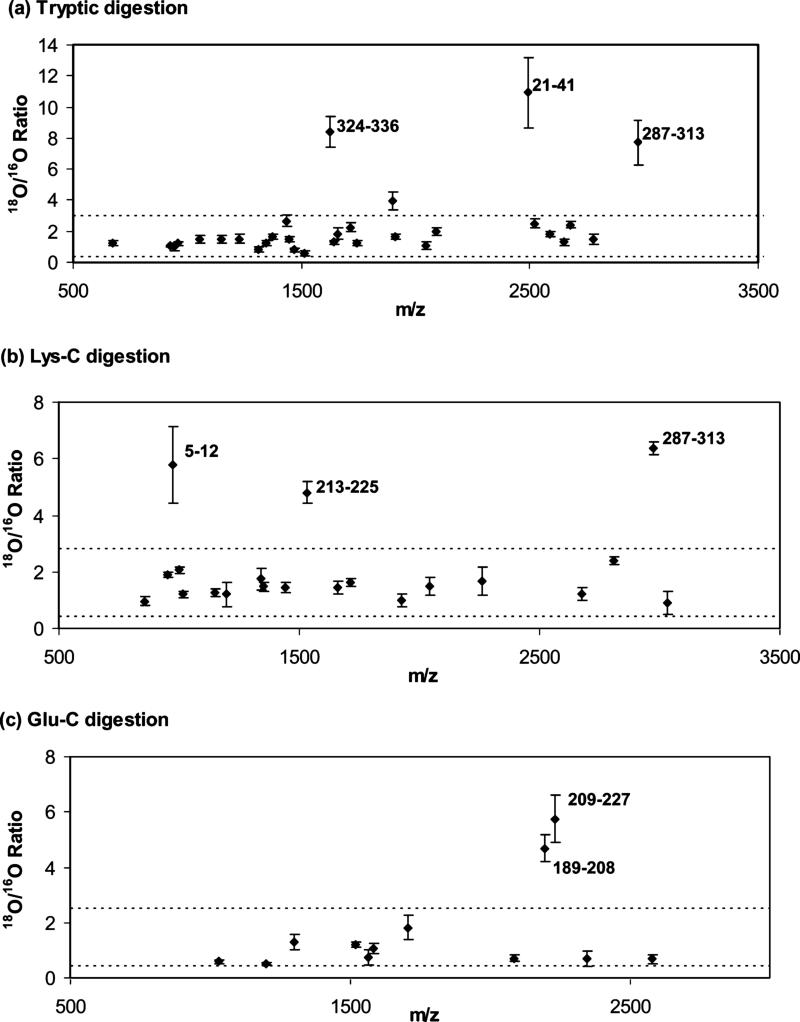
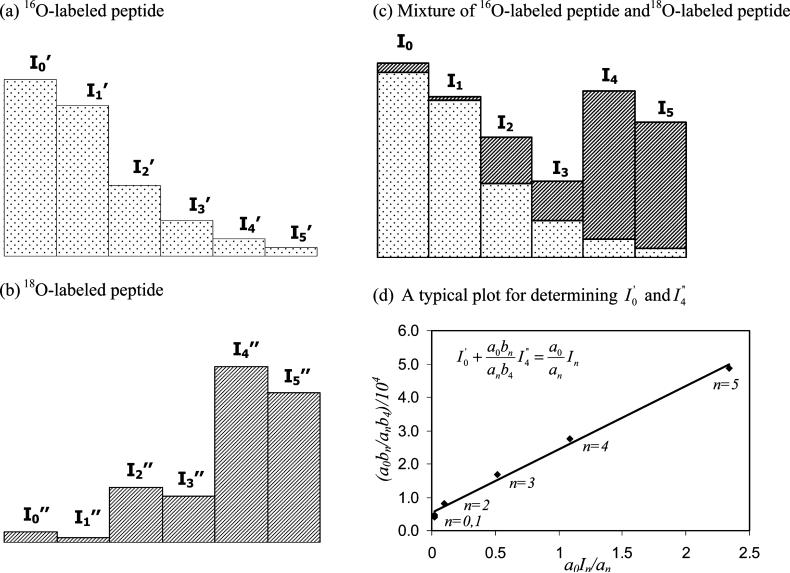
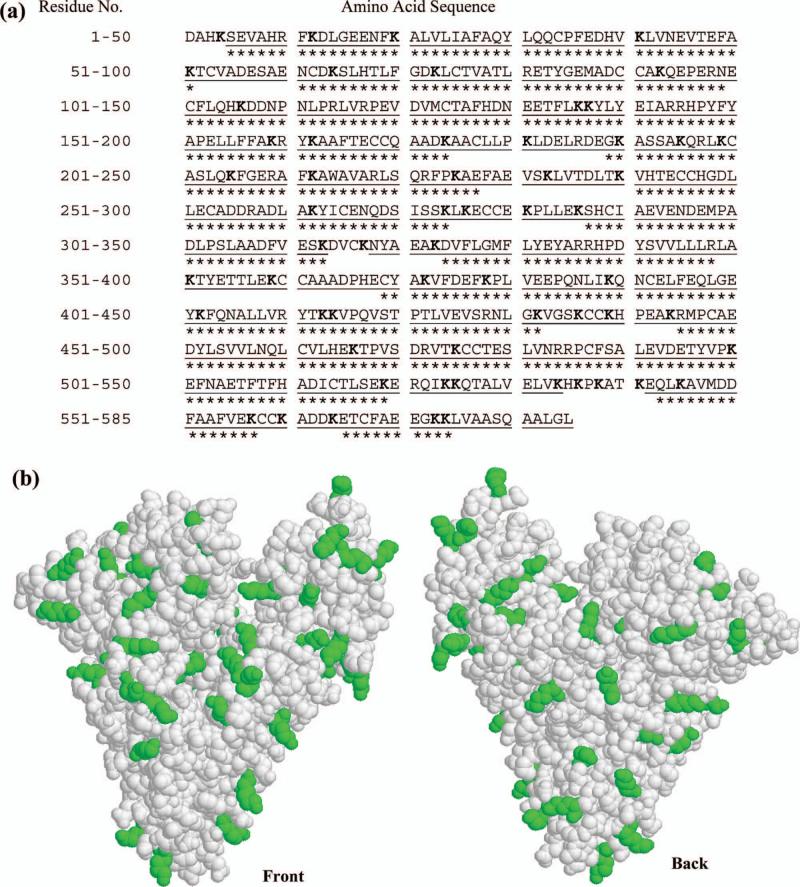
A method was developed for characterizing immobilization sites on a protein based on stable isotope labeling and MALDI-TOF mass spectrometry. The model for this work was human serum albumin (HSA) immobilized onto silica by the Schiff base method. The immobilized HSA was digested by various proteolytic enzymes in the presence of normal water, while soluble HSA was digested in (18)O-enriched water for use as an internal standard. These two digests were mixed and analyzed, with the (18)O/(16)O ratio for each detected peptide then being measured. Several peptides in the tryptic, Lys-C, and Glu-C digests gave significantly higher (18)O/(16)O ratios than other peptides in the same digests, implying their involvement in immobilization. Analysis of these results led to identification of the N-terminus and several lysines as likely immobilization sites for HSA (e.g., K4, K41, K190, K225, K313, and K317). It was also possible from these results to quantitatively rank these sites in terms of the relative degree to which each might take part in immobilization. This method is not limited to HSA and silica but can be used with other proteins and supports.
基于稳定同位素标记和基质辅助激光解吸电离飞行时间质谱(MALDI-TOF MS),开发了一种用于表征蛋白质上固定化位点的方法。这项工作的模型是通过席夫碱法固定在二氧化硅上的人血清白蛋白(HSA)。固定化的HSA在普通水中用各种蛋白水解酶消化,而可溶性HSA在富含(18)O的水中消化用作内标。将这两种消化产物混合并分析,然后测量每个检测到的肽的(18)O/(16)O比率。胰蛋白酶、Lys-C和Glu-C消化产物中的几种肽的(18)O/(16)O比率明显高于同一消化产物中的其他肽,这意味着它们参与了固定化过程。对这些结果的分析导致确定了N端和几个赖氨酸作为HSA可能的固定化位点(例如,K4、K41、K190、K225、K313和K317)。从这些结果中还可以根据每个位点可能参与固定化的相对程度对这些位点进行定量排序。该方法不仅限于HSA和二氧化硅,还可用于其他蛋白质和载体。