National Research Council (CNR), Istituto di Biofisica di Palermo, Palermo, Italy.
PLoS One. 2006 Dec 27;1(1):e111. doi: 10.1371/journal.pone.0000111.
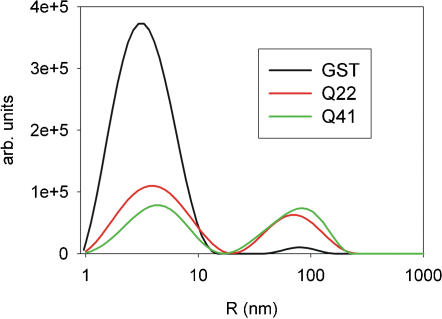
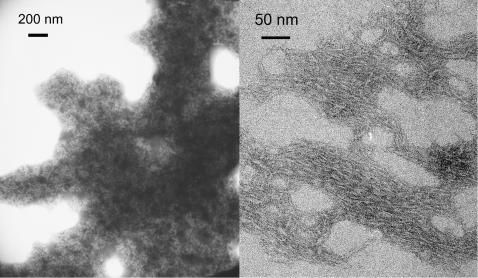
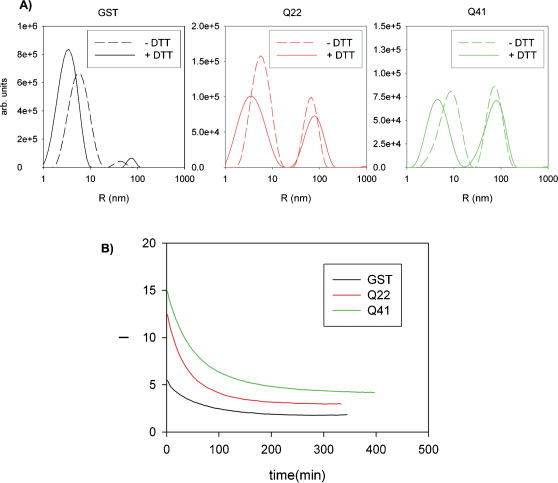
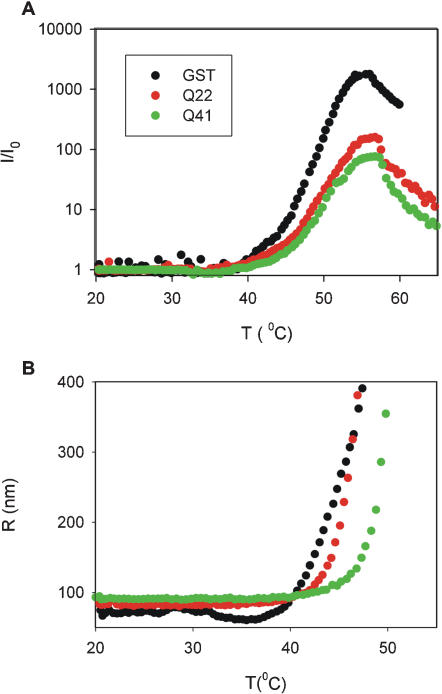
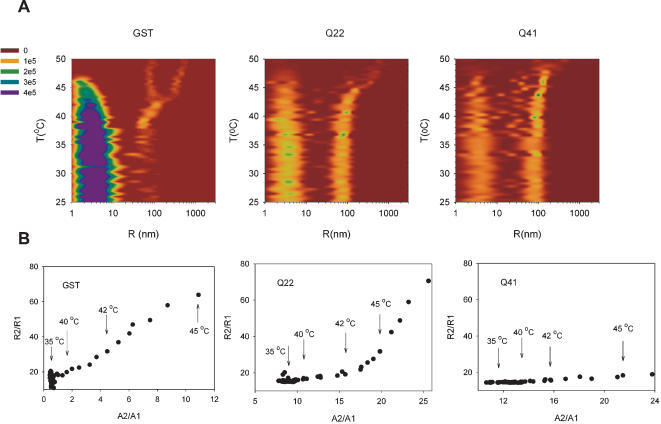
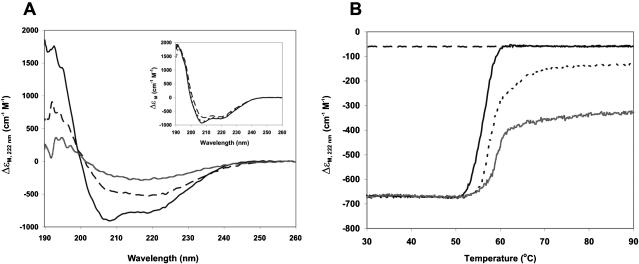
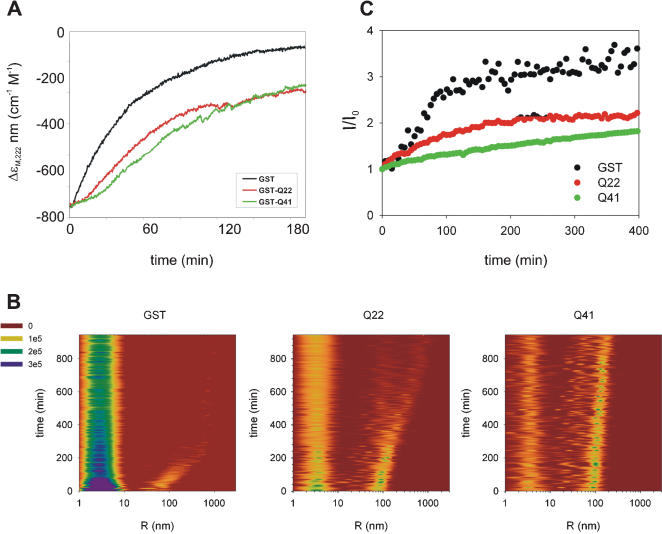
Polyglutamine (polyQ) diseases are inherited neurodegenerative disorders caused by the expansion of CAG codon repeats, which code for polyQ in the corresponding gene products. These diseases are associated with the presence of amyloid-like protein aggregates, induced by polyQ expansion. It has been suggested that the soluble aggregates rather than the mature fibrillar aggregates are the toxic species, and that the aggregation properties of polyQ can be strongly modulated by the surrounding protein context. To assess the importance of the protein carrier in polyQ aggregation, we have studied the misfolding pathway and the kinetics of aggregation of polyQ of lengths above (Q41) and below (Q22) the pathological threshold fused to the well-characterized protein carrier glutathione S-transferase (GST). This protein, chosen as a model system, is per se able to misfold and aggregate irreversibly, thus mimicking the behaviour of domains of naturally occurring polyQ proteins. We prove that, while it is generally accepted that the aggregation kinetics of polyQ depend on its length and are faster for longer polyQ tracts, the presence of GST alters the polyQ aggregation pathway and reverses this trend. Aggregation occurs through formation of a reservoir of soluble intermediates whose populations and kinetic stabilities increase with polyQ length. Our results provide a new model that explains the toxicity of expanded polyQ proteins, in which the interplay between polyQ regions and other aggregation-prone domains plays a key role in determining the aggregation pathway.
多聚谷氨酰胺(polyQ)疾病是由 CAG 密码子重复扩展引起的遗传性神经退行性疾病,这些重复在相应的基因产物中编码多聚谷氨酰胺。这些疾病与淀粉样蛋白样蛋白聚集体的存在有关,这些聚集体是由 polyQ 扩展诱导的。有人认为,可溶性聚集体而不是成熟的纤维状聚集体是有毒物质,并且 polyQ 的聚集特性可以被周围的蛋白质环境强烈调节。为了评估蛋白质载体在 polyQ 聚集中的重要性,我们研究了长度大于(Q41)和小于(Q22)病理阈值的 polyQ 的错误折叠途径和聚集动力学,这些 polyQ 与经过充分表征的蛋白质载体谷胱甘肽 S-转移酶(GST)融合。该蛋白质被选为模型系统,本身能够错误折叠并不可逆地聚集,从而模拟天然存在的 polyQ 蛋白结构域的行为。我们证明,虽然人们普遍认为 polyQ 的聚集动力学取决于其长度,并且较长的 polyQ 片段的聚集速度更快,但 GST 的存在改变了 polyQ 聚集途径,从而逆转了这一趋势。聚集通过形成可溶性中间物的储库发生,其种群和动力学稳定性随 polyQ 长度的增加而增加。我们的结果提供了一个新的模型,解释了扩展的 polyQ 蛋白的毒性,其中 polyQ 区域与其他易于聚集的结构域之间的相互作用在决定聚集途径方面起着关键作用。