Oh Sun-Young, Zheng Tao, Bailey Monica L, Barber Dwayne L, Schroeder John T, Kim Yoon-Keun, Zhu Zhou
Division of Allergy and Clinical Immunology, Johns Hopkins University School of Medicine, Baltimore, MD 21224, USA.
J Allergy Clin Immunol. 2007 Jan;119(1):123-31. doi: 10.1016/j.jaci.2006.08.029. Epub 2006 Oct 23.
Src homology 2 domain-containing inositol 5-phosphatase 1 (SHIP-1) controls the intracellular level of the phosphoinositide 3-kinase product phosphotidylinositol-3,4,5-trisphosphate and functions as a negative regulator of cytokine and immune receptor signaling. Emerging evidence suggests that the phosphoinositide 3-kinase pathway might be involved in allergic inflammation in the lung. However, the functional relevance of SHIP-1 in the T(H)2 activation pathway has not been established. SHIP-1(-/-) mice have spontaneous myeloproliferative inflammation in the lung, the nature of which has not been elucidated. We hypothesized that SHIP-1 plays an important role as a regulator in pulmonary allergic inflammation and in maintaining lung homeostasis.
To test our hypothesis, we characterized the pulmonary phenotype of SHIP-1(-/-) mice.
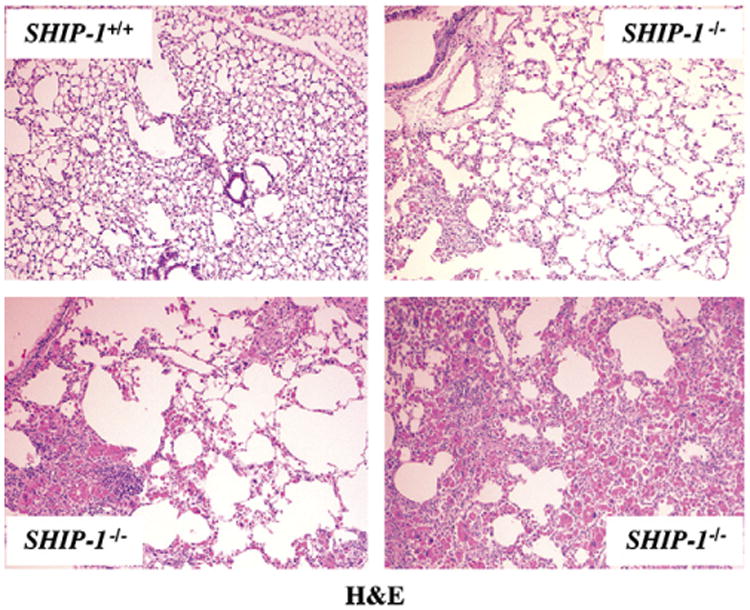
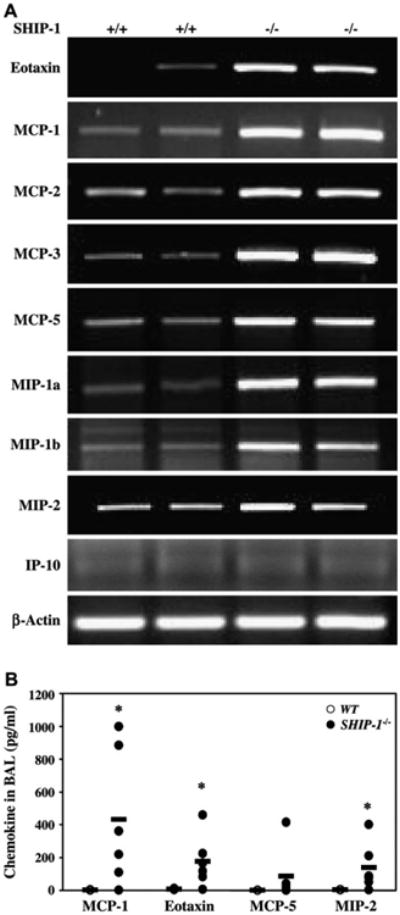
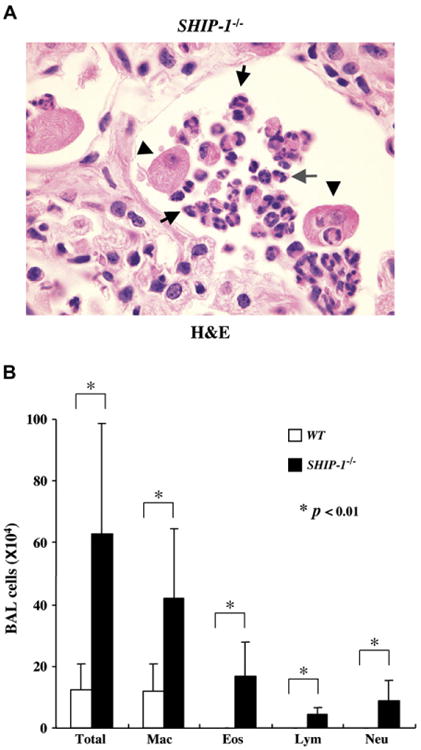
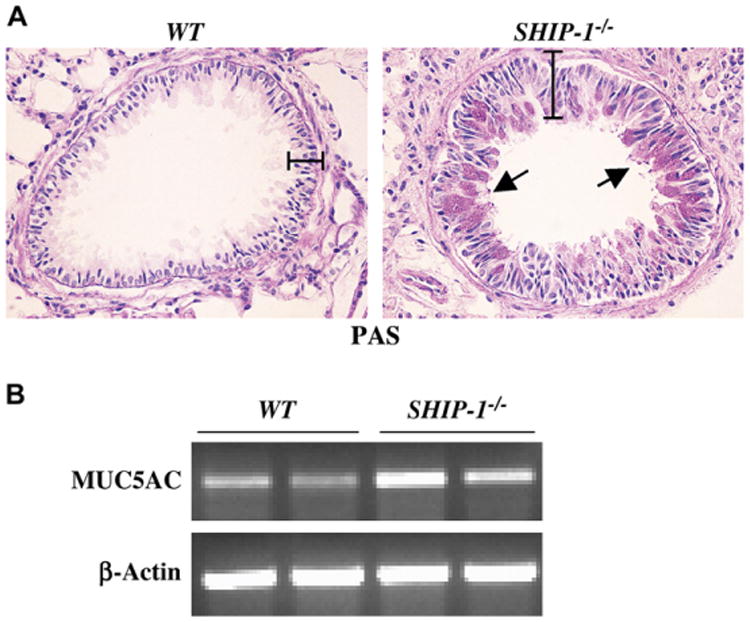
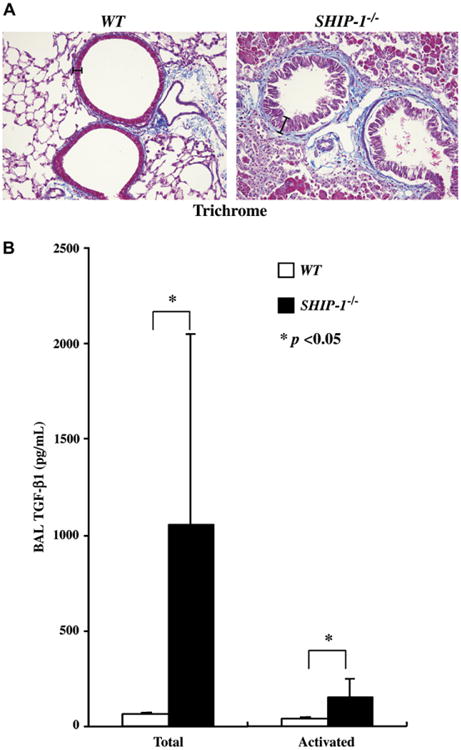
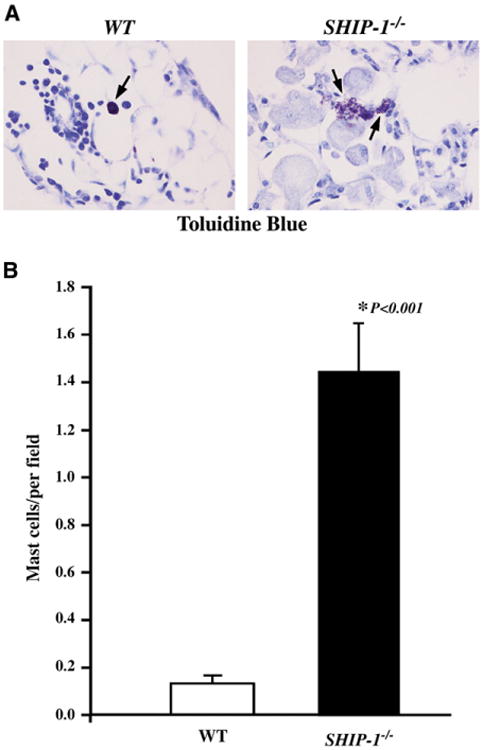
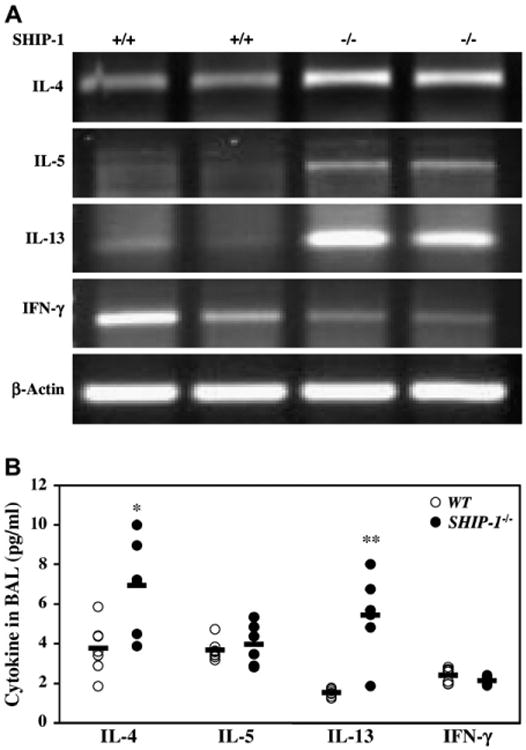
Analyses of lung histopathology and bronchoalveolar lavage cellularity revealed that the majority of SHIP-1(-/-) mice had progressive and severe pulmonary inflammation of macrophages, lymphocytes, neutrophils, and eosinophils; mucous hyperplasia; airway epithelial hypertrophy; and subepithelial fibrosis. These pathologic changes were accompanied by exaggerated production of T(H)2 cytokines and chemokines, including IL-4, IL-13, eotaxin, and monocyte chemoattractant protein 1, in the lung. Furthermore, the number of mast cells significantly increased, and many of these cells were undergoing degranulation, which was correlated with increased content and spontaneous release of histamine in the lung tissue of SHIP-1(-/-) mice.
These findings provide strong evidence that mice lacking SHIP-1 have an allergic inflammation in the lung, suggesting that SHIP-1 plays an important role in regulating the T(H)2 signaling pathway and in maintaining lung homeostasis.
SHIP-1 as a regulator might be a potential therapeutic target for controlling allergic inflammation in diseases such as asthma.
含Src同源2结构域的肌醇5-磷酸酶1(SHIP-1)可控制磷酸肌醇3激酶产物磷脂酰肌醇-3,4,5-三磷酸的细胞内水平,并作为细胞因子和免疫受体信号传导的负调节因子发挥作用。新出现的证据表明,磷酸肌醇3激酶途径可能参与肺部的过敏性炎症。然而,SHIP-1在辅助性T细胞2(TH2)激活途径中的功能相关性尚未明确。SHIP-1基因敲除(SHIP-1(-/-))小鼠肺部存在自发性骨髓增殖性炎症,但其本质尚未阐明。我们推测SHIP-1在肺部过敏性炎症调节及维持肺稳态中起重要作用。
为验证我们的假设,我们对SHIP-1(-/-)小鼠的肺部表型进行了特征描述。
对肺组织病理学和支气管肺泡灌洗细胞成分的分析显示,大多数SHIP-1(-/-)小鼠出现进行性严重肺部炎症,涉及巨噬细胞、淋巴细胞、中性粒细胞和嗜酸性粒细胞;黏液增生;气道上皮肥大;以及上皮下纤维化。这些病理变化伴随着肺部TH2细胞因子和趋化因子(包括白细胞介素-4、白细胞介素-13、嗜酸性粒细胞趋化因子和单核细胞趋化蛋白1)的过度产生。此外,肥大细胞数量显著增加,其中许多细胞正在脱颗粒,这与SHIP-1(-/-)小鼠肺组织中组胺含量增加和组胺自发释放相关。
这些发现提供了有力证据,表明缺乏SHIP-1的小鼠肺部存在过敏性炎症,提示SHIP-1在调节TH2信号通路及维持肺稳态中起重要作用。
SHIP-1作为一种调节因子,可能是控制哮喘等疾病中过敏性炎症的潜在治疗靶点。