Libertus Melissa E, Woldorff Marty G, Brannon Elizabeth M
Center for Cognitive Neuroscience, Box 90999, Duke University, NC 27708, USA.
Behav Brain Funct. 2007 Jan 10;3:1. doi: 10.1186/1744-9081-3-1.
A dominant view in numerical cognition is that numerical comparisons operate on a notation independent representation (Dehaene, 1992). Although previous human neurophysiological studies using scalp-recorded event-related potentials (ERPs) on the numerical distance effect have been interpreted as supporting this idea, differences in the electrophysiological correlates of the numerical distance effect in symbolic notations (e.g. Arabic numerals) and non-symbolic notations (e.g. a set of visually presented dots of a certain number) are not entirely consistent with this view.
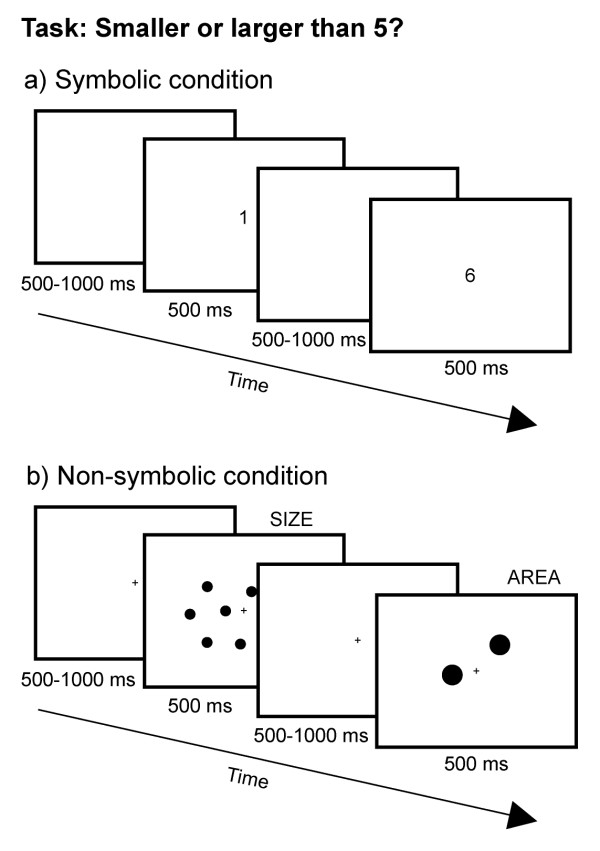
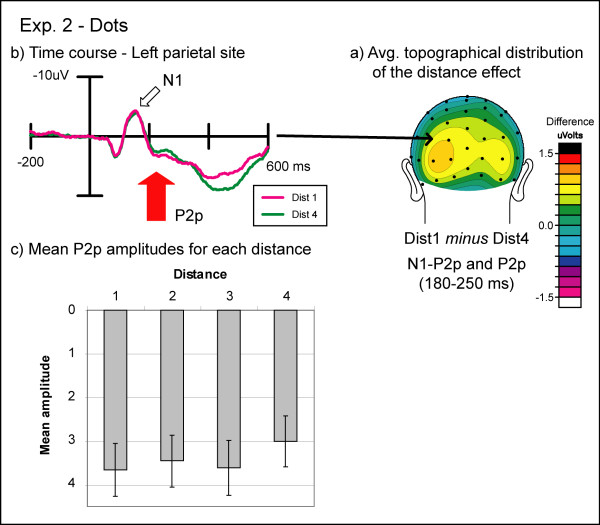
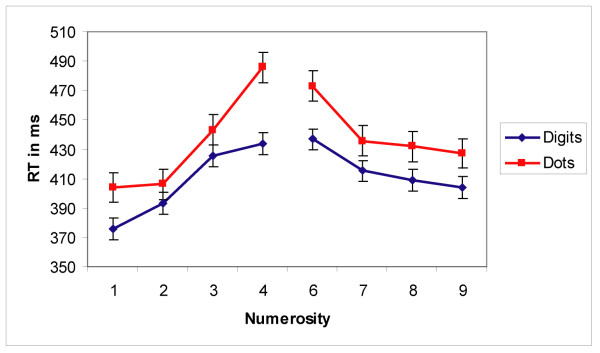
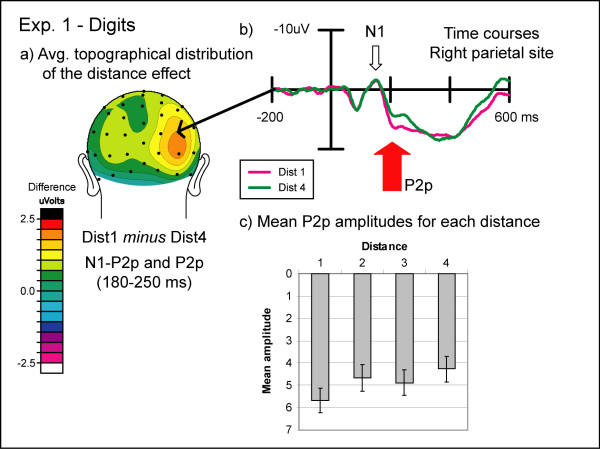
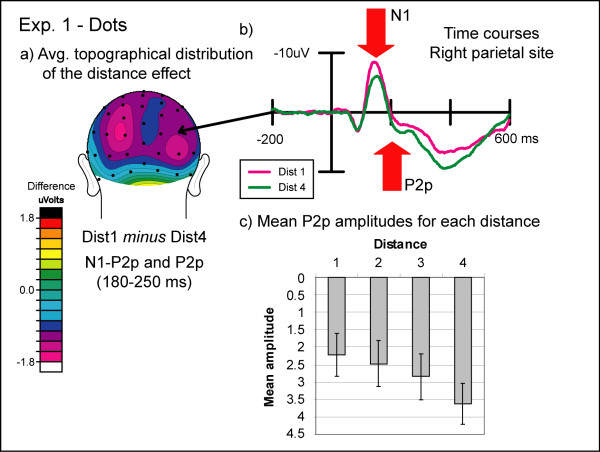
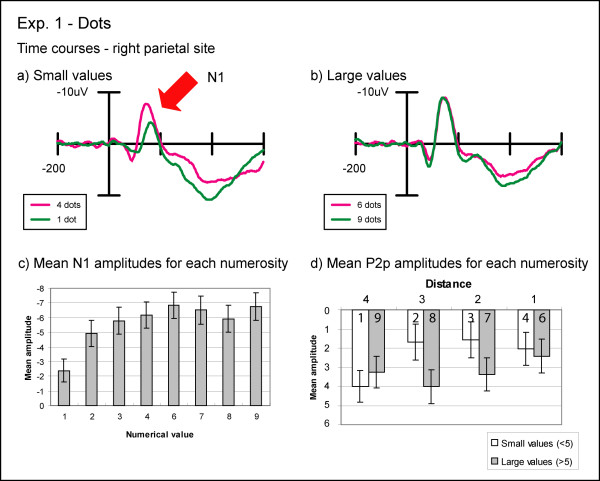
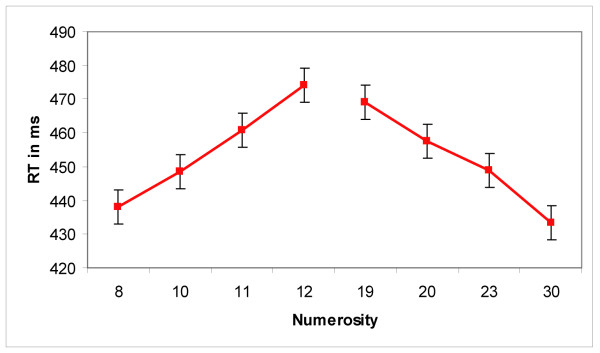
Two experiments were conducted to resolve these discrepancies. In Experiment 1, participants performed a symbolic and a non-symbolic numerical comparison task ("smaller or larger than 5?") with numerical values 1-4 and 6-9 while ERPs were recorded. Consistent with a previous report (Temple & Posner, 1998), in the symbolic condition the amplitude of the P2p ERP component (210-250 ms post-stimulus) was larger for values near to the standard than for values far from the standard whereas this pattern was reversed in the non-symbolic condition. However, closer analysis indicated that the reversal in polarity was likely due to the presence of a confounding stimulus effect on the early sensory ERP components for small versus larger numerical values in the non-symbolic condition. In Experiment 2 exclusively large numerosities (8-30) were used, thereby rendering sensory differences negligible, and with this control in place the numerical distance effect in the non-symbolic condition mirrored the symbolic condition of Experiment 1.
Collectively, the results support the claim of an abstract semantic processing stage for numerical comparisons that is independent of input notation.
数字认知领域的一个主流观点是,数字比较是在一种与符号表示无关的表征上进行的(德阿纳,1992)。尽管之前使用头皮记录的事件相关电位(ERP)对数字距离效应进行的人类神经生理学研究被解释为支持这一观点,但符号表示法(如阿拉伯数字)和非符号表示法(如一组视觉呈现的特定数量的点)中数字距离效应的电生理相关差异并不完全符合这一观点。
进行了两项实验以解决这些差异。在实验1中,参与者执行符号和非符号数字比较任务(“大于还是小于5?”),数字范围为1至4和6至9,同时记录ERP。与之前的一份报告(坦普尔和波斯纳,1998)一致,在符号条件下,对于接近标准值的数字,P2p ERP成分(刺激后210 - 250毫秒)的波幅大于远离标准值的数字,而在非符号条件下这种模式则相反。然而,进一步分析表明,极性反转可能是由于在非符号条件下,小数字与大数字对早期感觉ERP成分存在混淆的刺激效应。在实验2中只使用了较大的数字(8至30),从而使感觉差异可忽略不计,并且通过这种控制,非符号条件下的数字距离效应反映了实验1的符号条件。
总体而言,这些结果支持了数字比较存在一个独立于输入符号表示的抽象语义处理阶段的观点。