Herpin Amaury, Rohr Stefan, Riedel Dietmar, Kluever Nils, Raz Erez, Schartl Manfred
Department of Physiological Chemistry I, University of Wuerzburg, Biozentrum, Am Hubland, D-97074 Wuerzburg, Germany.
BMC Dev Biol. 2007 Jan 11;7:3. doi: 10.1186/1471-213X-7-3.
Primordial germ cells (PGCs) give rise to gametes that are responsible for the development of a new organism in the next generation. Two modes of germ line specification have been described: the inheritance of asymmetrically-localized maternally provided cytoplasmic determinants and the induction of the PGC fate by other cell types. PGCs specification in zebrafish appears to depend on inheritance of germ plasm in which several RNA molecules such as vasa and nanos reside. Whether the specification mode of PGCs found in zebrafish is general for other fish species was brought into question upon analysis of olvas expression--the vasa homologue in another teleost, medaka (Oryzias latipes). Here, in contrast to the findings in zebrafish, the PGCs are found in a predictable position relative to a somatic structure, the embryonic shield. This finding, coupled with the fact that vasa mRNA, which is localized to the germ plasm of zebrafish but does not label a similar structure in medaka opened the possibility of fundamentally different mechanisms governing PGC specification in these two fish species.
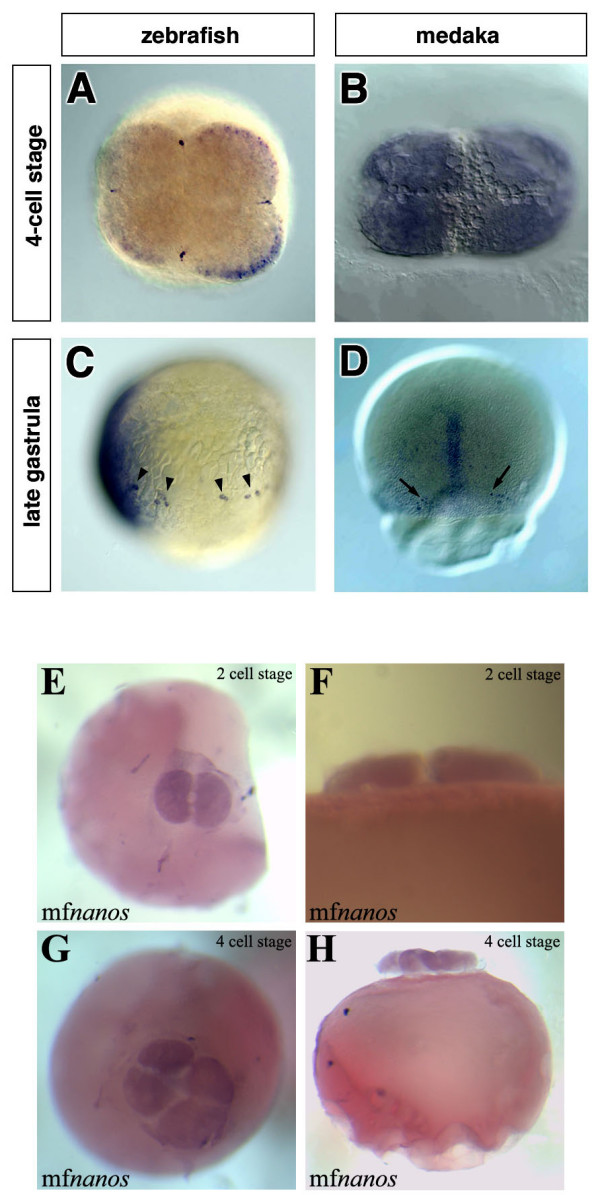
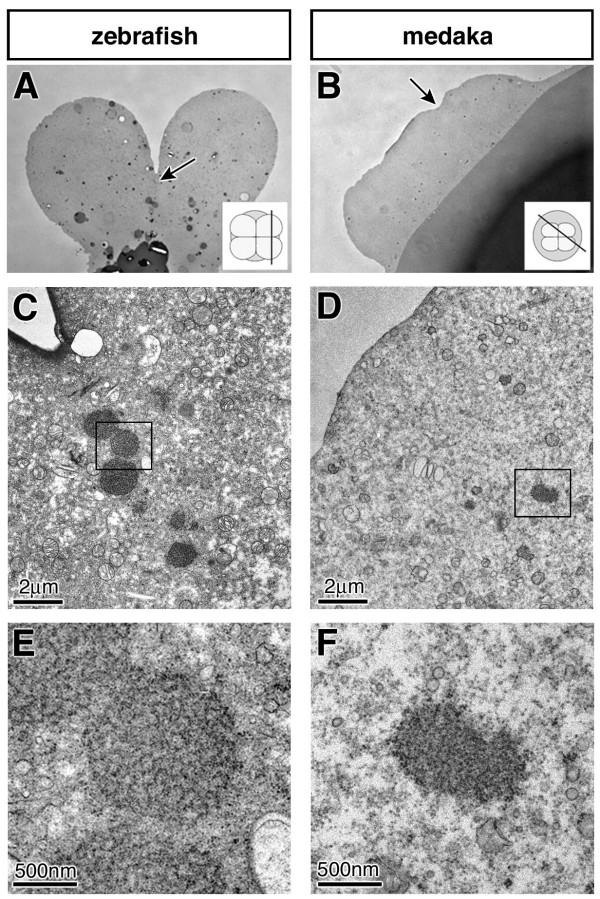
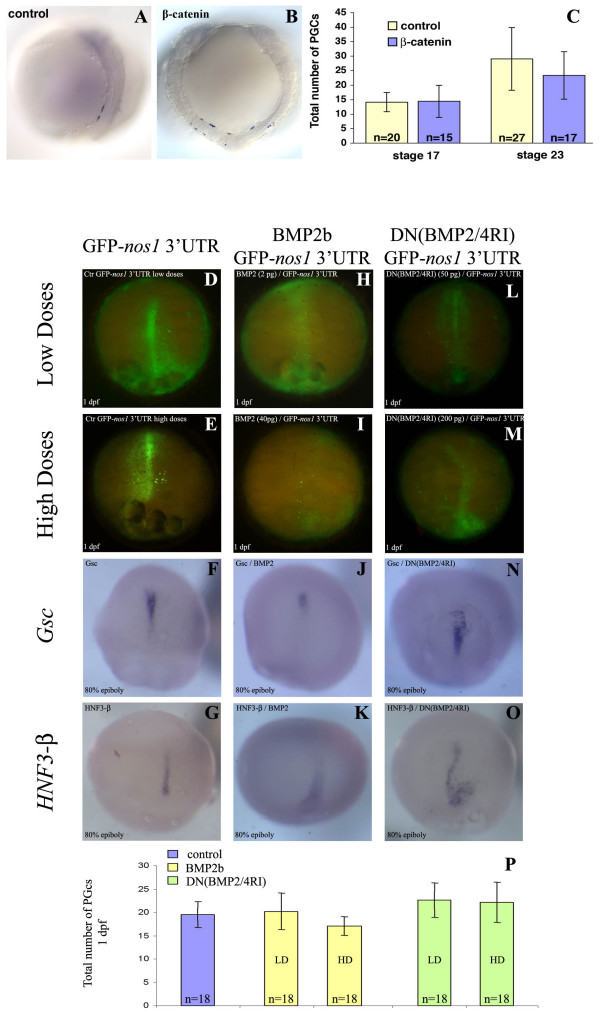
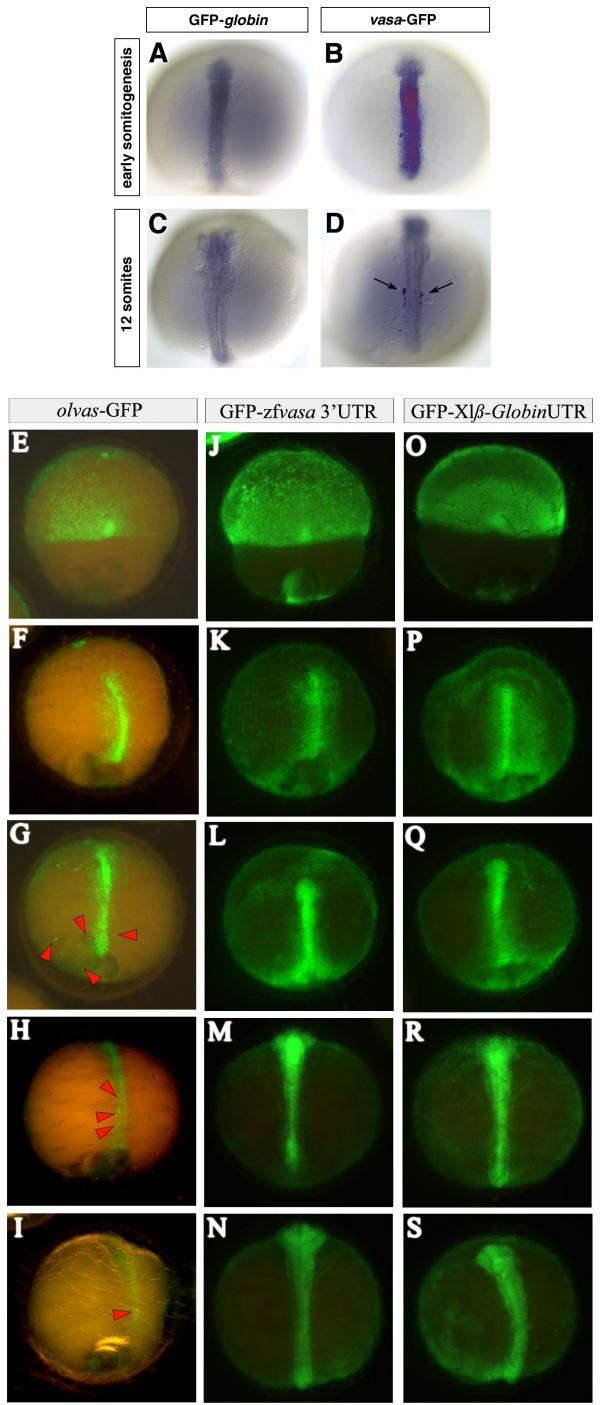
In this study we addressed the question concerning the mode of PGC specification in medaka using embryological experiments, analysis of RNA stability in the PGCs and electron microscopy observations. Dramatic alterations in the somatic environment, i.e. induction of a secondary axis or mesoderm formation alteration, did not affect the PGC number. Furthermore, the PGCs of medaka are capable of protecting specific RNA molecules from degradation and could therefore exhibit a specific mRNA expression pattern controlled by posttrancriptional mechanisms. Subsequent analysis of 4-cell stage medaka embryos using electron microscopy revealed germ plasm-like structures located at a region corresponding to that of zebrafish germ plasm.
Taken together, these results are consistent with the idea that in medaka the inheritance of maternally provided asymmetrically-localized cytoplasmic determinants directs cells to assume the germ line fate similar to zebrafish PGCs.
原始生殖细胞(PGCs)产生配子,这些配子负责下一代新生物体的发育。已经描述了两种生殖系特化模式:不对称定位的母体提供的细胞质决定因子的遗传以及其他细胞类型对PGC命运的诱导。斑马鱼中的PGC特化似乎取决于生殖质的遗传,其中存在几种RNA分子,如vasa和nanos。在分析了另一种硬骨鱼青鳉(Oryzias latipes)中的olvas表达(vasa的同源物)后,斑马鱼中发现的PGC特化模式是否适用于其他鱼类受到了质疑。在这里,与斑马鱼的研究结果相反,PGCs相对于体细胞结构胚胎盾处于可预测的位置。这一发现,再加上vasa mRNA的事实,vasa mRNA定位于斑马鱼的生殖质,但在青鳉中未标记类似结构,这为这两种鱼类中控制PGC特化的根本不同机制提供了可能性。
在本研究中,我们通过胚胎学实验、PGCs中RNA稳定性分析和电子显微镜观察,解决了关于青鳉中PGC特化模式的问题。体细胞环境的剧烈变化,即次生轴的诱导或中胚层形成的改变,并不影响PGC的数量。此外,青鳉的PGCs能够保护特定的RNA分子不被降解,因此可以表现出由转录后机制控制的特定mRNA表达模式。随后使用电子显微镜对4细胞期青鳉胚胎进行分析,发现了位于与斑马鱼生殖质相对应区域的类生殖质结构。
综上所述,这些结果与以下观点一致,即在青鳉中,母体提供的不对称定位的细胞质决定因子的遗传引导细胞承担与斑马鱼PGCs相似的生殖系命运。