Laboratory of Osteoblast Biology and Pathology, INSERM U606, 75475 Paris Cedex 10, France.
PPAR Res. 2006;2006:64807. doi: 10.1155/PPAR/2006/64807.
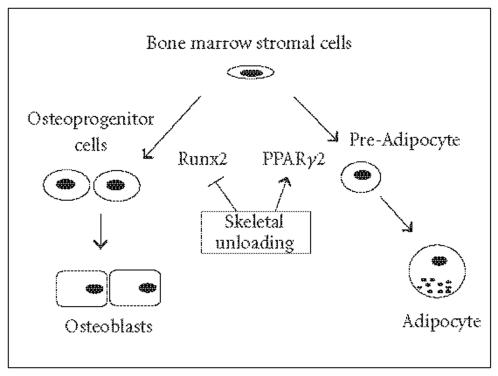
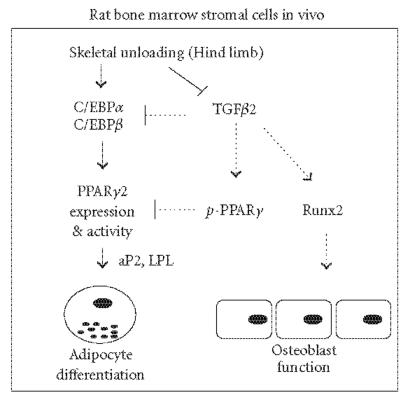
Bone loss occuring with unloading is associated with decreased osteoblastogenesis and increased bone marrow adipogenesis, resulting in bone loss and decreased bone formation. Here, we review the present knowledge on the role of PPARgamma in the control of osteoblastogenesis and bone mass in skeletal unloading. We showed that PPARgamma positively promotes adipogenesis and negatively regulates osteoblast differentiation of bone marrow stromal cells in unloading, resulting in bone loss. Manipulation of PPARgamma2 expression by exogenous TGF-beta2 inhibits the exaggerated adipogenesis and corrects the balance between osteoblastogenesis and adipogenesis induced by unloading, leading to prevention of bone loss. This shows that PPARgamma plays an important role in the control of bone mass in unloaded bone. Moreover, this opens the possibility that manipulation of PPARgamma may correct the balance between osteoblastogenesis and adipogenesis and prevent bone loss, which may have potential implications in the treatment of bone loss in clinical conditions.
去负荷导致的骨质流失与成骨细胞生成减少和骨髓脂肪生成增加有关,导致骨质流失和骨形成减少。在这里,我们综述了目前关于过氧化物酶体增殖物激活受体γ(PPARγ)在控制去负荷状态下骨形成和骨量中的作用的知识。我们表明,PPARγ 在去负荷时积极促进脂肪生成,负向调节骨髓基质细胞的成骨分化,导致骨质流失。外源性 TGF-β2 对 PPARγ2 表达的操纵抑制了脂肪生成的过度增加,并纠正了去负荷引起的成骨细胞生成和脂肪生成之间的平衡,从而防止了骨质流失。这表明 PPARγ 在控制去负荷骨的骨量中起着重要作用。此外,这为操纵 PPARγ 以纠正成骨细胞生成和脂肪生成之间的平衡并预防骨质流失提供了可能性,这可能对治疗临床条件下的骨质流失具有潜在意义。