Anderson Charles F, Oukka Mohammed, Kuchroo Vijay J, Sacks David
Laboratory of Parasitic Diseases, National Institute of Allergy and Infectious Diseases, National Institutes of Health, Bethesda, MD 20892, USA.
J Exp Med. 2007 Feb 19;204(2):285-97. doi: 10.1084/jem.20061886. Epub 2007 Feb 5.
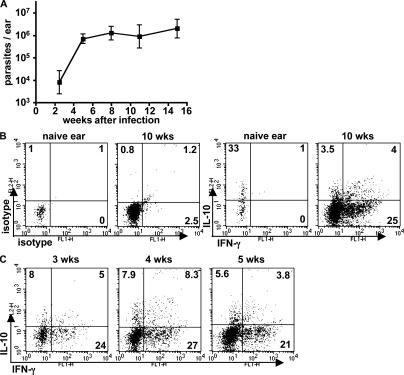
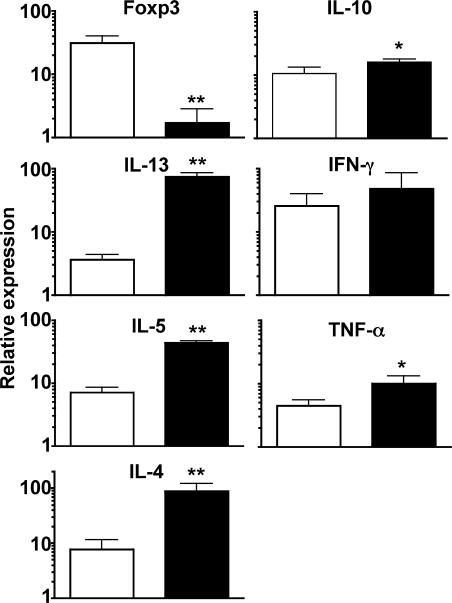
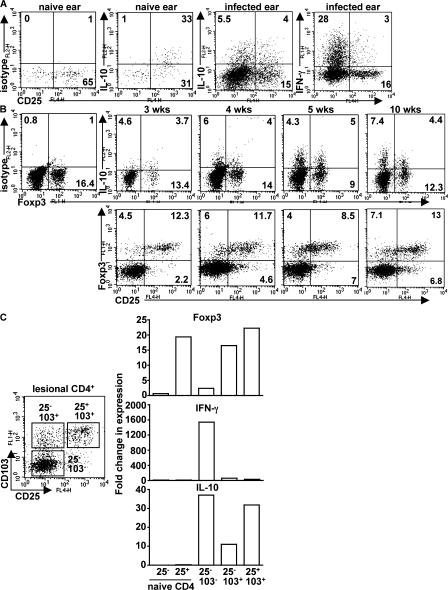
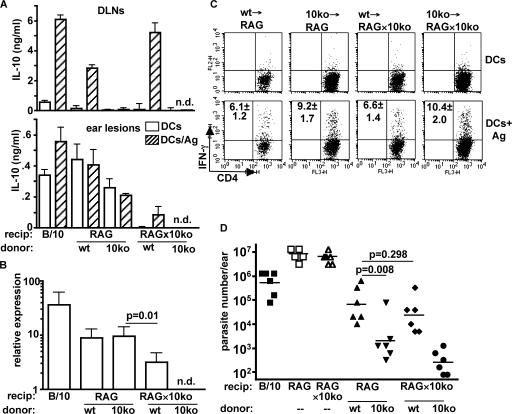
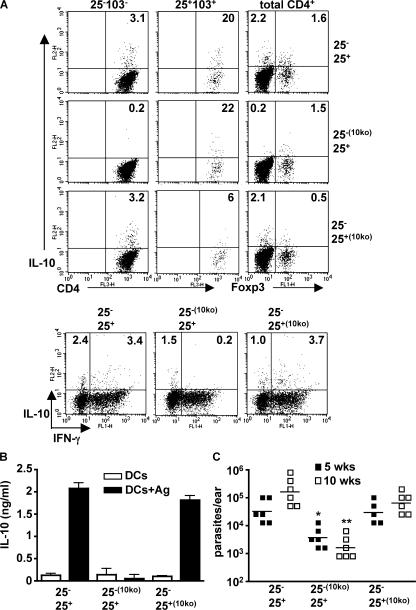
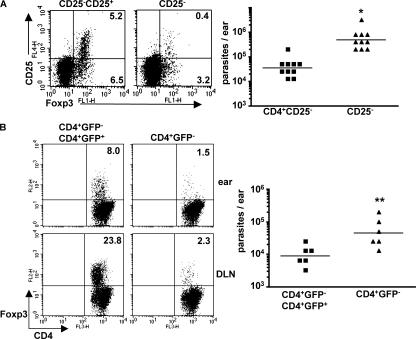
Nonhealing forms of leishmaniasis in humans are commonly associated with elevated levels of the deactivating cytokine IL-10, and in the mouse, normally chronic infections can be cleared in the absence of IL-10. Using a Leishmania major strain that produces nonhealing dermal lesions in a T helper type 1 (Th1) cell-polarized setting, we have analyzed the cellular sources of IL-10 and their relative contribution to immune suppression. IL-10 was produced by innate cells, as well as CD4(+)CD25(+)Foxp3(+) and CD4(+)CD25(-)Foxp3(-) T cells in the chronic lesion. Nonetheless, only IL-10 production by antigen-specific CD4(+)CD25(-)Foxp3(-) T cells, the majority of which also produced IFN-gamma, was necessary for suppression of acquired immunity in Rag(-/-) reconstituted mice. Surprisingly, Rag(-/-) mice reconstituted with naive CD4(+) T cells depleted of natural T regulatory cells developed more severe infections, associated with elevated levels of IL-10 and, especially, Th2 cytokines in the site. The data demonstrate that IL-10-producing Th1 cells, activated early in a strong inflammatory setting as a mechanism of feedback control, are the principal mediators of T cell-derived IL-10-dependent immune suppression in a chronic intracellular infection.
人类利什曼病的不愈合形式通常与失活细胞因子白细胞介素-10(IL-10)水平升高有关,而在小鼠中,通常慢性感染在没有IL-10的情况下可以清除。利用一种在1型辅助性T(Th1)细胞极化环境中产生不愈合皮肤病变的硕大利什曼原虫菌株,我们分析了IL-10的细胞来源及其对免疫抑制的相对贡献。IL-10由先天性细胞以及慢性病变中的CD4(+)CD25(+)Foxp3(+)和CD4(+)CD25(-)Foxp3(-) T细胞产生。尽管如此,在Rag(-/-)重构小鼠中,只有抗原特异性CD4(+)CD25(-)Foxp3(-) T细胞产生IL-10(其中大多数也产生干扰素-γ)对于抑制获得性免疫是必要的。令人惊讶的是,用耗尽天然调节性T细胞的幼稚CD4(+) T细胞重构的Rag(-/-)小鼠发生了更严重的感染,与病变部位IL-10水平升高,尤其是Th2细胞因子水平升高有关。数据表明,在强烈炎症环境中早期被激活作为反馈控制机制的产生IL-10的Th1细胞,是慢性细胞内感染中T细胞来源的IL-10依赖性免疫抑制的主要介质。