Powles T, Savage P M, Stebbing J, Short D, Young A, Bower M, Pappin C, Schmid P, Seckl M J
Department of Medical Oncology, Charing Cross Gestational Trophoblastic Disease Centre, Hammersmith Hospitals Campus of Imperial College London, London, UK.
Br J Cancer. 2007 Mar 12;96(5):732-7. doi: 10.1038/sj.bjc.6603608. Epub 2007 Feb 13.
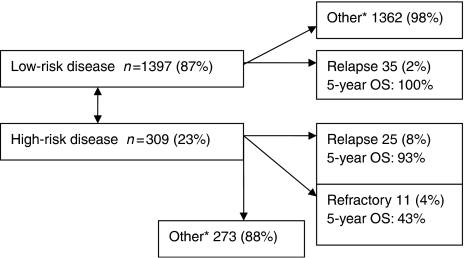
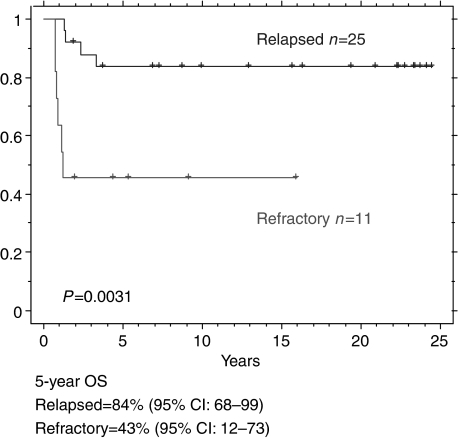
The majority of women requiring chemotherapy for gestational trophoblastic disease (GTN) are cured with their initial chemotherapy treatment. However, a small percentage either become refractory to treatment, or relapse after the completion of treatment. This study investigates the characteristics and outcome of these patients. Patients were identified from the Charing Cross Hospital GTD database. The outcome of these patients with relapsed disease was compared to those with refractory disease. Between 1980 and 2004, 1708 patients were treated with chemotherapy for GTN. Sixty (3.5%) patents relapsed following completion of initial therapy. The overall 5-year survival for patients with relapsed GTN was 93% (95% CI 86-100%). The overall survival for patients with low-risk and high-risk disease at presentation, who subsequently relapsed was 100% (n=35), and 84% (n=25) (95% CI: 66-96%: P<0.05), respectively. Eleven patients were identified who failed to enter remission and had refractory disease. These patients had a worse outcome compared to patients with relapsed disease (5-year survival 43% (95% CI:12-73% P<0.01)). The outcome of patients with relapsed GTN is good. However, patients with primary chemo-refractory disease do poorly and novel therapies are required for this group of patients.
大多数需要接受化疗的妊娠滋养细胞疾病(GTN)女性通过初始化疗即可治愈。然而,有一小部分患者要么对治疗产生耐药,要么在治疗结束后复发。本研究调查了这些患者的特征及治疗结果。患者来自查令十字医院的GTD数据库。将这些复发疾病患者的治疗结果与耐药患者的结果进行比较。1980年至2004年间,1708例患者接受了GTN化疗。60例(3.5%)患者在初始治疗结束后复发。复发GTN患者的总体5年生存率为93%(95%可信区间86 - 100%)。初诊时为低危和高危疾病且随后复发患者的总体生存率分别为100%(n = 35)和84%(n = 25)(95%可信区间:66 - 96%;P<0.05)。有11例患者未缓解且患有耐药疾病。与复发疾病患者相比,这些患者的治疗结果更差(5年生存率43%(95%可信区间:12 - 73%;P<0.01))。复发GTN患者的治疗结果良好。然而,原发性化疗耐药患者的情况较差,这组患者需要新的治疗方法。