Oya Shunichi, Choi Seok-Rye, Kung Mei-Ping, Kung Hank F
Department of Radiology, University of Pennsylvania, Philadelphia, PA 19104, USA.
Nucl Med Biol. 2007 Feb;34(2):129-39. doi: 10.1016/j.nucmedbio.2006.12.002.
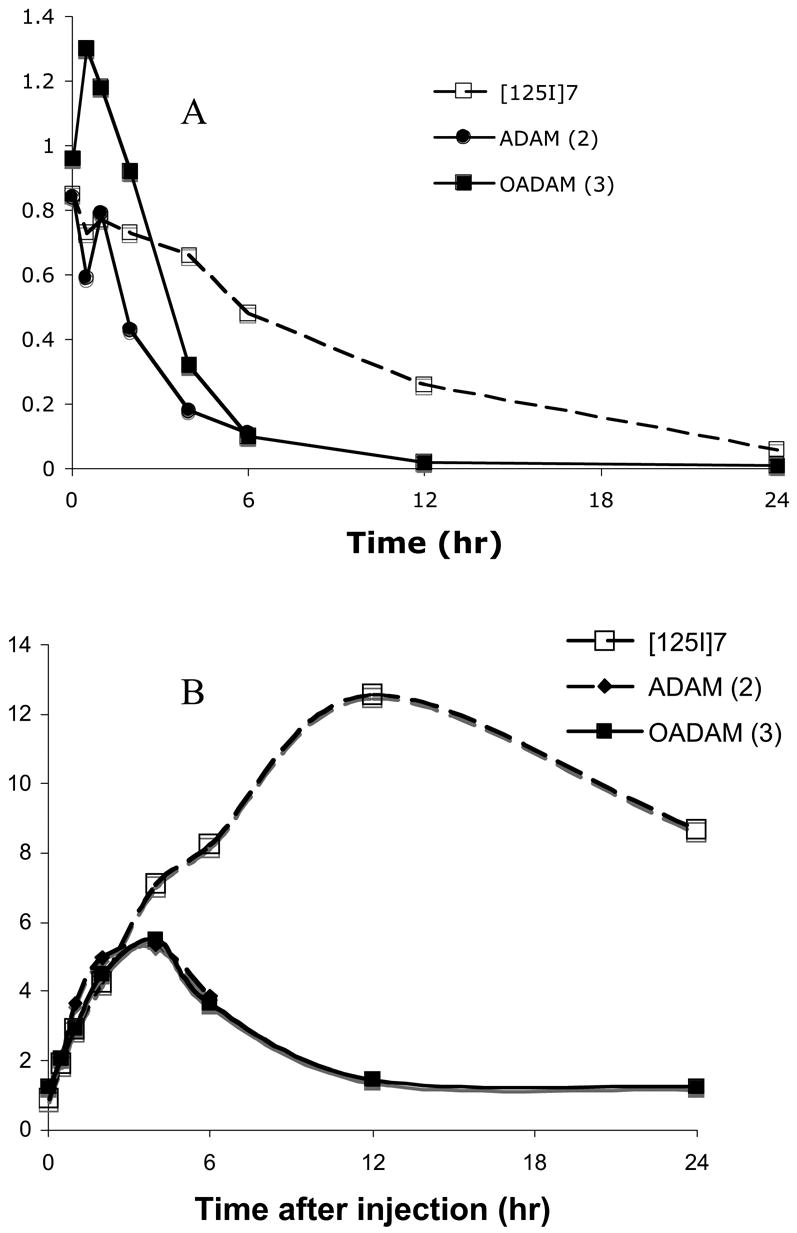
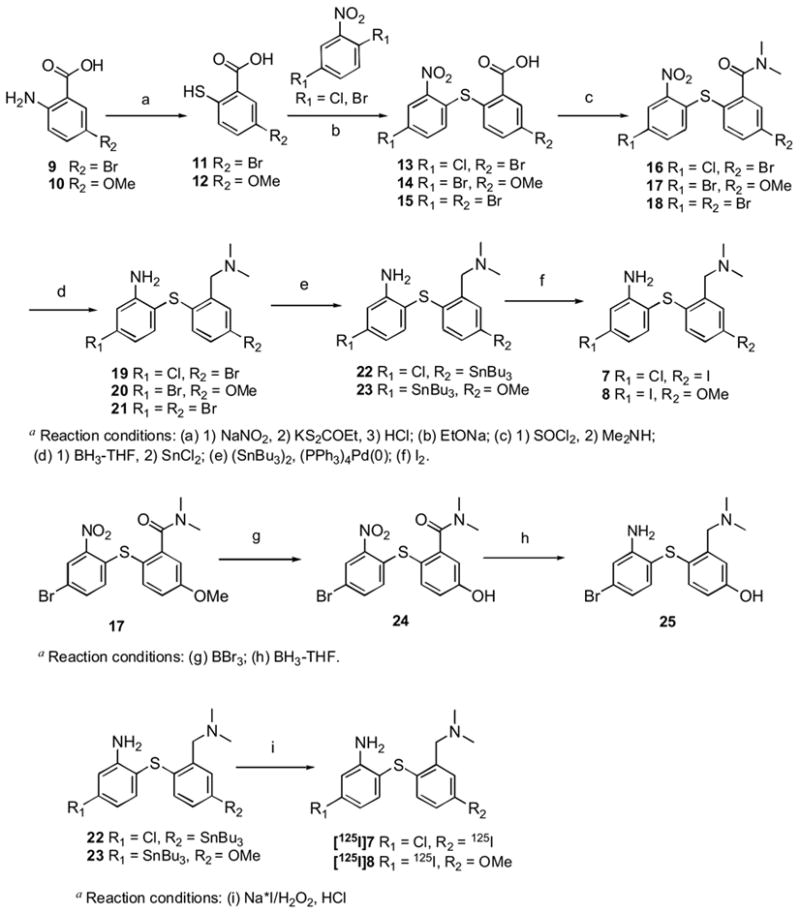
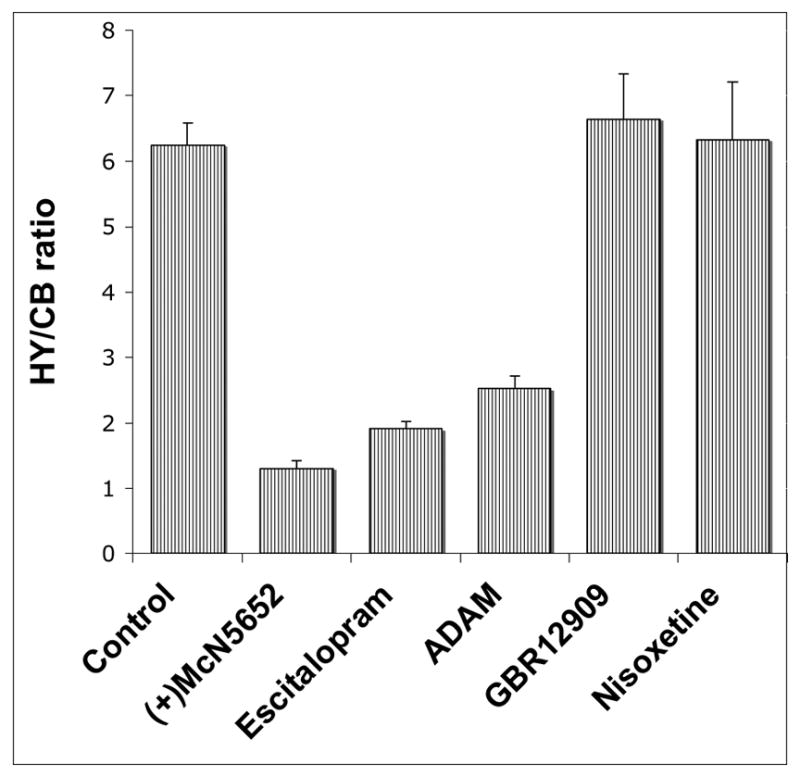
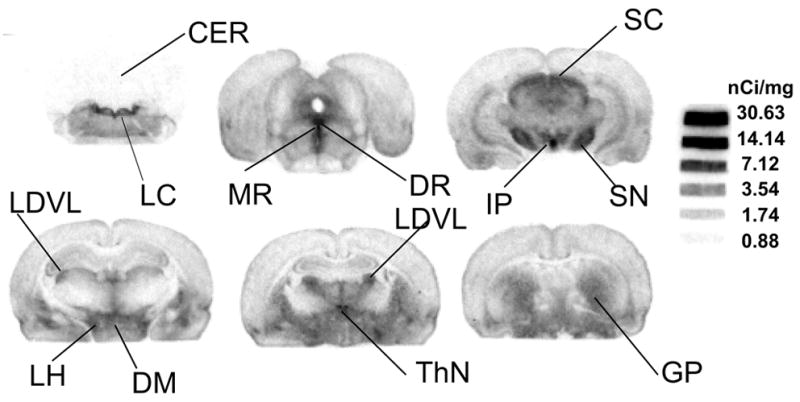
Two novel ligands with 4' substitution on the Phenyl Ring B of biphenylthiol, 5-chloro-2-(2'-((dimethylamino)methyl)-4'-iodophenylthio)benzenamine (7) and 2-(2'-((dimethylamino)methyl)-4'-methoxyphenylthio)-5-iodobenzenamine (8), were prepared and tested as potential serotonin transporter (SERT) imaging agents. The new ligands displayed extremely high binding affinities to SERT (K(i)=0.22+/-0.09 and 0.11+/-0.04 nM, respectively), with very low binding affinities to dopamine and norepinephrine transporters (K(i)>1000 nM). The corresponding [(125)I]7 and [(125)I]8 were successfully prepared from tri-n-butyltin derivatives. They showed good brain uptakes and prolonged retention after intravenous injection in rats (brain uptake was 1.77% and 0.98% dose/g for [(125)I]7, and 0.92% and 0.29% dose/g for [(125)I]8, at 2 and 120 min, respectively). Significantly, [(125)I]7 showed excellent uptake and prolonged retention in the hypothalamus, where SERT concentration was highest. The hypothalamus/cerebellum (HY/CB) ratios (target/background ratios) were 4.24, 7.10, 8.24 and 12.6 at 2, 4, 6 and 12 h, respectively. The HY/CB ratios for [(125)I]8 were 3.97, 5.57 and 5.06 at 1, 2 and 4 h, respectively. Adding the 4'-iodo group to the Phenyl Ring B of Compound (7) appeared to reduce the rate of clearance from the brain, and kinetics favored uptake and retention in the hypothalamus. The localization of [(125)I]7 in the hypothalamus region in the rat brain could be blocked by pretreatment with (+)McN5652, escitalopram and ADAM (2), which are all selective SERT ligands (at 2 mg/kg iv, 5 min pretreatment). Ex vivo autoradiograms of rat brain sections (at 4 h after intravenous injection of [(125)I]7) showed intense labeling in regions of the brain known to have high SERT density. The excellent selective uptake and retention in the hypothalamus region suggest that [(123)I]7 is a potential lead compound for developing new imaging agents targeting SERT-binding sites with single-photon emission computed tomography.
制备了两种在联苯硫醇的苯环B上具有4'取代基的新型配体,即5-氯-2-(2'-((二甲氨基)甲基)-4'-碘苯硫基)苯胺(7)和2-(2'-((二甲氨基)甲基)-4'-甲氧基苯硫基)-5-碘苯胺(8),并将其作为潜在的5-羟色胺转运体(SERT)显像剂进行测试。这些新配体对SERT表现出极高的结合亲和力(K(i)分别为0.22±0.09和0.11±0.04 nM),而对多巴胺和去甲肾上腺素转运体的结合亲和力非常低(K(i)>1000 nM)。相应的[(125)I]7和[(125)I]8由三正丁基锡衍生物成功制备。它们在大鼠静脉注射后显示出良好的脑摄取和较长的滞留时间(在2分钟和120分钟时,[(125)I]7的脑摄取分别为1.77%和0.98%剂量/g,[(125)I]8的脑摄取分别为0.92%和0.29%剂量/g)。值得注意的是,[(125)I]7在下丘脑摄取良好且滞留时间延长,而下丘脑的SERT浓度最高。下丘脑/小脑(HY/CB)比值(靶/本底比值)在2、4、6和12小时分别为4.24、7.10、8.24和12.6。[(125)I]8在1、2和4小时的HY/CB比值分别为3.97、5.57和5.06。在化合物(7)的苯环B上添加4'-碘基团似乎降低了从脑中清除的速率,并且动力学有利于在下丘脑的摄取和滞留。[(125)I]7在大鼠脑下丘脑区域的定位可被(+)McN5652、艾司西酞普兰和ADAM(2)预处理阻断,这三种都是选择性SERT配体(静脉注射2 mg/kg,预处理5分钟)。大鼠脑切片的离体放射自显影片(静脉注射[(125)I]7后4小时)显示在已知具有高SERT密度的脑区域有强烈标记。在下丘脑区域的优异选择性摄取和滞留表明[(123)I]7是开发用于单光子发射计算机断层扫描靶向SERT结合位点的新型显像剂的潜在先导化合物。