Uramoto H, Mitsudomi T
Cancer Chemotherapy Center, University of Occupational and Environmental Health, Japan.
Br J Cancer. 2007 Mar 26;96(6):857-63. doi: 10.1038/sj.bjc.6603665. Epub 2007 Feb 27.
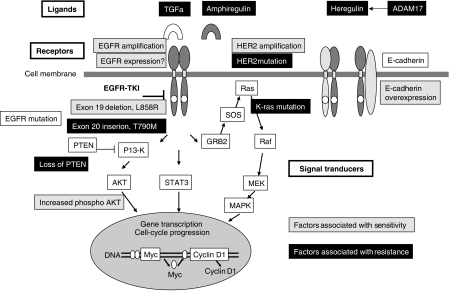
Subsets of patients with non-small cell lung cancer respond remarkably well to small molecule tyrosine kinase inhibitors (TKI) specific for epidermal growth factor receptor (EGFR) such as gefitinib or erlotinib. In 2004, it was found that EGFR mutations occurring in the kinase domain are strongly associated with EGFR-TKI sensitivity. However, subsequent studies revealed that this relationship was not perfect and various predictive markers have been reported. These include EGFR gene copy numbers, status of ligands for EGFR, changes in other HER family genes or molecules downstream to EGFR including KRAS or AKT. In this review, we would like to review current knowledge of predictive factors for EGFR-TKI. As all but one phase III trials failed to show a survival advantage of the treatment arm involving EGFR-TKIs, it is necessary to select patients by these biomarkers in future clinical trials. Through these efforts, it would be possible to individualise EGFR-TKI treatment for patients suffering from lung cancer.
非小细胞肺癌患者的某些亚组对表皮生长因子受体(EGFR)特异性的小分子酪氨酸激酶抑制剂(TKI),如吉非替尼或厄洛替尼,反应非常良好。2004年,人们发现激酶结构域中发生的EGFR突变与EGFR-TKI敏感性密切相关。然而,随后的研究表明这种关系并不完美,并且已经报道了各种预测标志物。这些包括EGFR基因拷贝数、EGFR配体状态、其他HER家族基因或EGFR下游分子(包括KRAS或AKT)的变化。在本综述中,我们希望回顾EGFR-TKI预测因素的当前知识。由于除一项III期试验外,其他所有试验均未能显示涉及EGFR-TKIs的治疗组具有生存优势,因此有必要在未来的临床试验中通过这些生物标志物选择患者。通过这些努力,有可能为肺癌患者个体化EGFR-TKI治疗。