
抗炎剂和单HER可预防阿霉素诱导的小鼠心脏毒性和慢性粒细胞白血病细胞积聚。
Anti-inflammatory agents and monoHER protect against DOX-induced cardiotoxicity and accumulation of CML in mice.
作者信息
Bruynzeel A M E, Abou El Hassan M A, Schalkwijk C, Berkhof J, Bast A, Niessen H W M, van der Vijgh W J F
机构信息
Department of Medical Oncology, VU University Medical Center, 1081 HV Amsterdam, the Netherlands.
出版信息
Br J Cancer. 2007 Mar 26;96(6):937-43. doi: 10.1038/sj.bjc.6603640. Epub 2007 Feb 27.
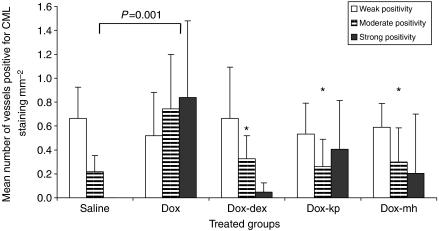
Cardiac damage is the major limiting factor for the clinical use of doxorubicin (DOX). Preclinical studies indicate that inflammatory effects may be involved in DOX-induced cardiotoxicity. Nepsilon-(carboxymethyl) lysine (CML) is suggested to be generated subsequent to oxidative stress, including inflammation. Therefore, the aim of this study was to investigate whether CML increased in the heart after DOX and whether anti-inflammatory agents reduced this effect in addition to their possible protection on DOX-induced cardiotoxicity. These effects were compared with those of the potential cardioprotector 7-monohydroxyethylrutoside (monoHER).BALB/c mice were treated with saline, DOX alone or DOX preceded by ketoprofen (KP), dexamethasone (DEX) or monoHER. Cardiac damage was evaluated according to Billingham. Nepsilon-(carboxymethyl) lysine was quantified immunohistochemically. Compared to saline, a 21.6-fold increase of damaged cardiomyocytes was observed in mice treated with DOX (P<0.001). Addition of KP, DEX or monoHER before DOX significantly reduced the mean ratio of abnormal cardiomyocytes in comparison to mice treated with DOX alone (P<or=0.02). In addition, DOX induced a significant increase in the number of CML-stained intramyocardial vessels per mm2 (P=0.001) and also in the intensity of CML staining (P=0.001) compared with the saline-treated group. Nepsilon-(carboxymethyl) lysine positivity was significantly reduced (P<or=0.01) by DOX-DEX, DOX-KP and DOX-monoHER. These results confirm that inflammation plays a role in DOX-induced cardiotoxicity, which is strengthened by the observed DOX-induced accumulation of CML, which can be reduced by anti-inflammatory agents and monoHER.
心脏损伤是阿霉素(DOX)临床应用的主要限制因素。临床前研究表明,炎症效应可能参与了DOX诱导的心脏毒性。据推测,Nε-(羧甲基)赖氨酸(CML)是在包括炎症在内的氧化应激之后产生的。因此,本研究的目的是调查DOX处理后心脏中CML是否增加,以及抗炎药除了可能对DOX诱导的心脏毒性具有保护作用外,是否还能减轻这种效应。将这些效应与潜在的心脏保护剂7-单羟基乙基芦丁(monoHER)的效应进行比较。
将BALB/c小鼠分别用生理盐水、单独的DOX或先用酮洛芬(KP)、地塞米松(DEX)或monoHER预处理后再给予DOX进行处理。根据比林厄姆标准评估心脏损伤。采用免疫组织化学方法对Nε-(羧甲基)赖氨酸进行定量分析。与生理盐水组相比,DOX处理的小鼠中受损心肌细胞增加了21.6倍(P<0.001)。与单独用DOX处理的小鼠相比,在DOX之前给予KP、DEX或monoHER可显著降低异常心肌细胞的平均比例(P≤0.02)。此外,与生理盐水处理组相比,DOX导致每平方毫米心肌内CML染色血管数量显著增加(P=0.001),CML染色强度也显著增加(P=0.001)。DOX-DEX、DOX-KP和DOX-monoHER可使Nε-(羧甲基)赖氨酸阳性率显著降低(P≤0.01)。这些结果证实炎症在DOX诱导的心脏毒性中起作用,观察到的DOX诱导的CML积累增强了这种作用,而抗炎药和monoHER可降低CML的积累。

 Zotero 插件